
Sunrise Sunset Times Calculator
Pick a place and a date to get sunrise and sunset, day length, solar noon, civil, nautical and astronomical twilight and golden hour, with a table for the whole month.
Free · runs in your browser · nothing is uploaded
This calculator gives you sunrise sunset times for any place and date, with the day length and solar noon on the same screen. Choose a city, a dark-sky place, or your own coordinates, and the headline reports sunrise and sunset along with how much longer or shorter the day is than the day before.
Below the headline, a 24-hour strip shows night, twilight and daylight, and a table lists dawn, golden hour, sunrise, solar noon, sunset and dusk. A month table helps you plan a week or a season, and it names the longest and shortest day of the month. Use the Today and Tomorrow buttons to check the sunrise time tomorrow or the sunset tonight without retyping the date. Every time is in the place’s own time zone, with daylight saving included.
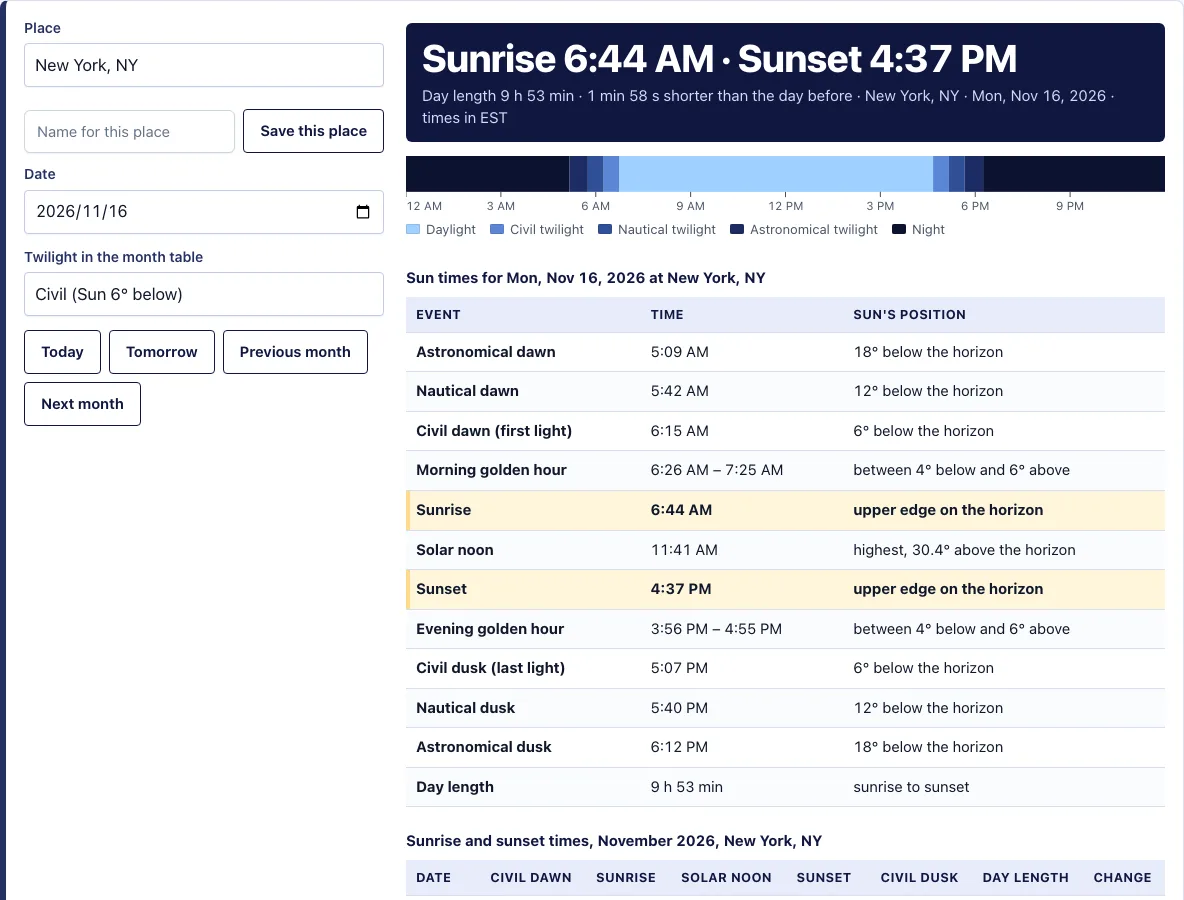
- Open Place and choose a US city, a world city or a dark-sky place from the list.
- To use where you are, choose My location (this device). To enter a spot by hand, pick custom coordinates and type the latitude, longitude and time zone.
- If you check the same spot often, click Save this place.
- Set the Date. To see sunrise today, keep today’s date or click Today. For the next day, click Tomorrow.
- Read the headline for sunrise, sunset and day length. It also shows how much longer or shorter the day is than the day before, in minutes and seconds.
- Check the 24-hour strip, coloured by night, astronomical, nautical and civil twilight and daylight.
- Scan the day table for civil dawn, sunrise, solar noon with the Sun’s height, sunset and civil dusk. The full table also lists the other twilight levels and golden hours.
- Click Previous month or Next month to move through the month table, and set Twilight in the month table to Civil, Nautical or Astronomical to choose which dawn and dusk times appear.
- Click Copy link to copy a link to this page, or Print this month to print the month table.
Times follow the place’s own time zone, with daylight saving included. My location (this device) uses the browser’s location only after you pick it, the position stays in the browser, and nothing is uploaded.
What time is sunrise and sunset today?
Sunrise and sunset times depend on the place and the date. For New York on 21 June 2026, sunrise is 5:25 AM and sunset is 8:31 PM, a day of 15 h 6 min. On 21 December 2026 the same city has sunrise at 7:17 AM and sunset at 4:32 PM.
The sunrise time in the headline is the moment the Sun’s upper edge reaches a sea-level horizon, with the centre of the Sun 0.833 degrees below that horizon. That offset allows for atmospheric refraction, which lifts the Sun’s image near the horizon, and for the Sun’s radius. Each time belongs to the local calendar day in which it happens, and the calculator reports it in the place’s own time zone.
What is the difference between sunrise, civil twilight and first light?
Sunrise is when the Sun’s upper edge reaches a sea-level horizon. Civil dawn comes earlier, when the Sun’s centre sits 6 degrees below the horizon. Nautical dawn is at 12 degrees and astronomical dawn at 18. The table compares civil dawn with sunrise for two New York dates, and the calculator lists all three levels for any day.
People often call dawn first light, but this calculator labels its dawn times as civil, nautical and astronomical, each set by how far the Sun’s centre sits below the horizon. Civil twilight is the bright part of dawn and dusk, when the sky is light enough for most outdoor activity without artificial light.
| Time in New York | 21 June 2026 | 21 December 2026 |
|---|---|---|
| Civil dawn | 4:52 AM | 6:46 AM |
| Sunrise | 5:25 AM | 7:17 AM |
| Solar noon | 12:58 PM, Sun 72.7 degrees high | 11:54 AM, Sun 25.8 degrees high |
| Sunset | 8:31 PM | 4:32 PM |
| Civil dusk | 9:04 PM | 5:03 PM |
| Day length | 15 h 6 min | 9 h 15 min |
What is solar noon and why is it not at 12:00?
Solar noon is the moment the Sun crosses your local meridian and reaches its highest point in the sky. It is rarely exactly 12:00 on the clock. Your position inside the time zone, daylight saving time and the equation of time all move it, so in New York on 21 June it falls at 12:58 PM.
The equation of time is the difference between clock time and the Sun’s position, caused by Earth’s tilt and its elliptical orbit. Across the year it moves solar noon by up to about 16 minutes. The place’s position in its zone matters as well: a city near the western edge of a time zone sees the Sun reach its peak later than a city near the eastern edge. On 21 December the Sun peaks lower in the sky, at 25.8 degrees in New York compared with 72.7 degrees in June, and the day table shows that height next to the time.
Why do the earliest sunset and the latest sunrise not fall on the shortest day?
The earliest sunset and the latest sunrise do not land on the shortest day because the equation of time shifts them. In New York in December 2026 the earliest sunset is 4:28 PM, on 6 to 9 December, and the latest sunrise is 7:20 AM, from 29 December to 10 January 2027. The shortest day is 21 December.
Sunrise and sunset move at different rates across the season, so the two ends of the day reach their extremes on different dates. In New York, sunsets begin moving later about two weeks before the solstice, while sunrises keep moving later into January. Day length still reaches its minimum on 21 December, since it is the gap between the two moving times.
How this tool works and where the numbers come from
Sunrise and sunset are the moments the Sun’s upper edge meets a sea-level horizon (centre 0.833 degrees below, allowing for refraction); civil, nautical and astronomical dawn and dusk are the Sun’s centre 6, 12 and 18 degrees below the horizon; solar noon is the Sun on the local meridian; golden hour is the Sun between +6 and -4 degrees. Computed with astronomy-engine 2.1.19 and checked within 2 minutes against an independent implementation of the NOAA Solar Calculator formulas at 6 places on 5 dates, including polar day, polar night and a daylight-saving change.
Sources
Frequently asked questions
When is sunrise tomorrow?
Click Tomorrow to see what time is sunrise on the next day, along with sunset. The change from one day to the next is usually small, and the headline shows it in minutes and seconds.
What time is sundown today, and when will the sunset be?
Sundown is another word for sunset, so when is sundown today is answered by the sunset time in the headline for your place. Click Tomorrow for sundown tomorrow. The timing of sunset and the sunrise timings today are both shown with the day length, and what time will the sunset be tonight is the same figure, given in the place’s own time zone.
How is day length calculated?
Day length is the time from sunrise to sunset on the chosen date, shown in hours and minutes. For New York on 21 June 2026 it is 15 h 6 min, and the headline gives the difference from the day before.
Why does my sunset time look earlier than the one shown?
The sunset time assumes a flat, sea-level horizon. Hills, buildings, elevation and unusual refraction can shift what you see by a few minutes.
What happens near the poles?
Close to the poles, the Sun can stay above or below the horizon for days or months. In Tromso, Norway (69.6 N), the Sun is up all day on 21 June 2026 with a day length of 24 h, and on 21 December 2026 it stays below the horizon all day, yet civil twilight runs from 9:31 AM to 1:53 PM.
What is golden hour?
Golden hour is the period when the Sun sits between 6 degrees above and 4 degrees below the horizon, a photographers’ rule of thumb. The day table lists the morning and evening golden hours for each date.
Is the calculator free, and does it need my location?
Yes, every day and month on screen is free, and you can print the month without signing up. You never need to share your location, since you can pick a listed place or enter coordinates instead. If you choose My location, the browser’s location is used only then, the position stays in the browser, and nothing is uploaded.
Night follows the sunset. Astronomical Twilight Calculator gives the length of true night and the best Moon-free hour, and Moon tonight shows the Moon’s phase and its rise and set. For any date, Moonrise and moonset calculator works like this page for the Moon. Stargazing calendar rates the coming nights for clouds, moonlight and darkness, Milky Way calendar finds the core season and Moon phase calendar lays out the month’s phases.
Planning a trip? The Night Gaze Camp app ranks campgrounds by tonight’s moonlight, clouds and sky darkness.