
Moon Tonight
Pick a place and a night to see the Moon's phase, rise and set times and the hours the sky is free of moonlight.
Free · runs in your browser · nothing is uploaded
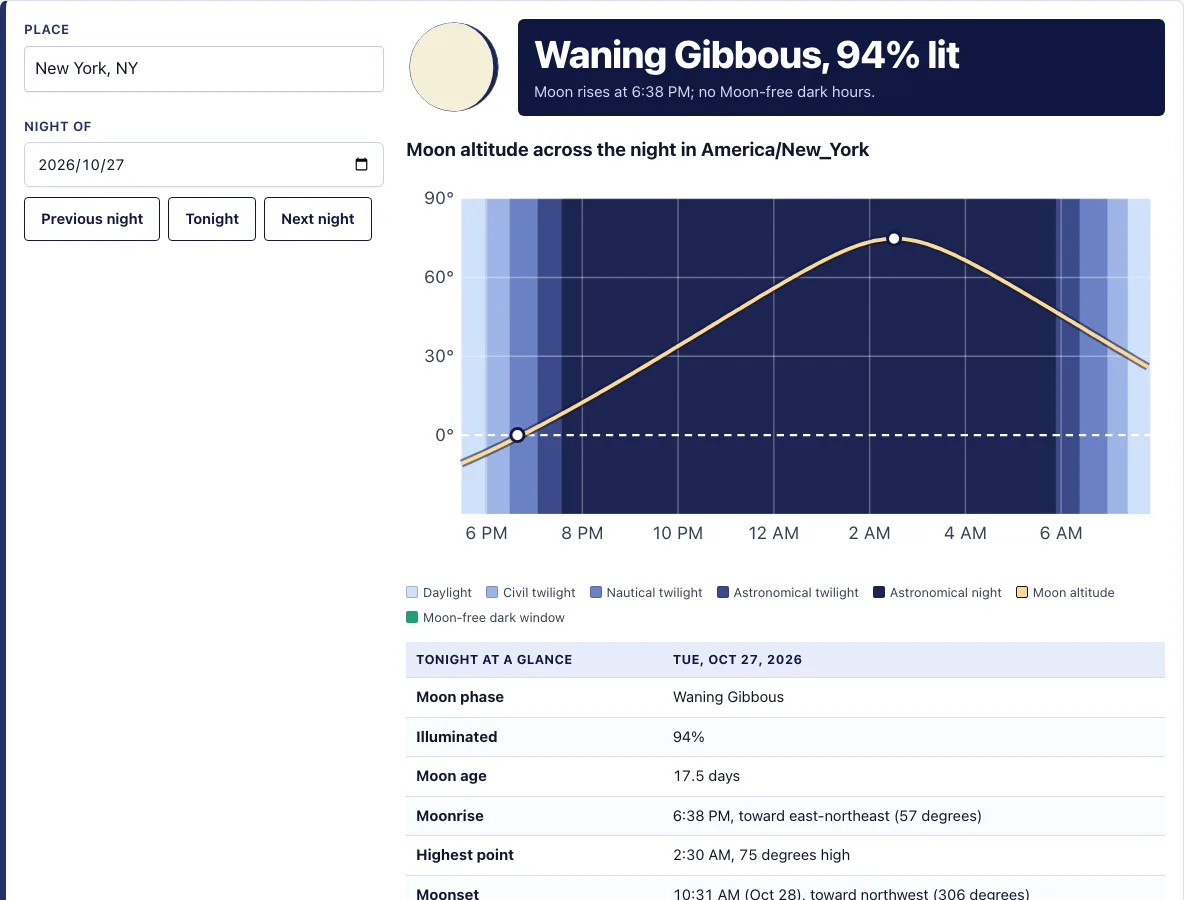
How to use the Moon Tonight tool
- Open the Place control and choose a dark-sky park, a US city or a world city. For your own spot, pick My location (this device) or Custom coordinates and enter latitude, longitude and time zone.
- Check Night of. It starts on tonight’s date in the place’s time zone. Before noon it shows the night that began the evening before, so at 1 AM you see the night you are in. Change it to plan ahead.
- Press Tonight to jump back to the current night, or Previous night and Next night to step one day at a time.
- Read the dark card at the top: the phase, the percent lit and the one-line summary of when the Moon sets or rises and when the sky is dark.
- Look at the chart. The gold line is the Moon’s altitude, the dashed line is the horizon, the background shades from daylight to astronomical night, and the green bar underneath marks the Moon-free dark window.
- Open the table Tonight at a glance for the exact times: Moonrise and Moonset with direction and azimuth, Highest point, Sunset, Astronomical night, Moon-free dark window and Moon-free dark time.
Use Copy link to share the result: the web address keeps the place and date, so anyone who opens it sees the same night.
What kind of moon is it tonight?
The card names the phase for the night, gives the percentage of the disc that is lit and shows the Moon’s age in days. The phase is taken at local midnight, the middle of the night the page covers. For New York on Saturday 24 October 2026 it is a Waxing Gibbous, 99% lit and 14.5 days old, about a day before the full moon of 26 October at 04:12 UTC.
What time does the moon rise and set tonight?
Moonrise and moonset are listed in Tonight at a glance with a clock time and a compass direction. They use the upper edge of the Moon and standard refraction, so they mark when the top of the disc meets the horizon. The worked example for New York on 24 October 2026:
| Event | Time | Direction |
|---|---|---|
| Moonrise | 4:59 PM | east-northeast, azimuth 78 degrees |
| Highest point | 11:43 PM | 60 degrees above the horizon |
| Moonset | 6:40 AM next morning | west-northwest, azimuth 286 degrees |
The Moon rises about 50 minutes later each day on average. A waxing Moon therefore sets later each night, which moves the dark hours toward the early morning, while a waning Moon rises later each night, which leaves the early evening dark.
When is the sky darkest tonight?
The sky is darkest when the Sun is more than 18 degrees below the horizon and the Moon is below it as well. The page calls that span the Moon-free dark window and draws it as the green bar. For Joshua Tree National Park on 3 November 2026 it runs from 6:13 PM to 1:35 AM, 7 h 22 min, ending when the waning crescent rises.
Some nights have no window. In New York on 24 October 2026 astronomical night lasts from 7:34 PM to 5:47 AM, but the Moon is up for all of it until it sets at 6:40 AM, so the summary reads “no Moon-free dark hours.” At Tromso, Norway (69.65 N) on 21 June the Sun never reaches -18 degrees, so there is no astronomical night, and at 78 N in December the Moon can stay up all night. The page says “none in these 24 hours” or “all night” in those cases, never a blank value.
Why is the moon orange tonight?
A Moon close to the horizon often looks orange or red because its light crosses a thicker layer of air, which scatters much of the blue light away. Haze, humidity and smoke strengthen the effect. The gold line on the chart shows how low the Moon is at each hour: the nearer it sits to the dashed horizon line, the more likely the colour. Higher up it looks white or pale grey. The colour belongs to the light path, not to the Moon’s surface.
What moon shape will I see tonight?
The shape you see depends on how much of the lit half faces Earth. Under half lit it is a crescent, at half it is a quarter, and over half it is gibbous. A waxing Moon (growing) has its lit edge on the right in the Northern Hemisphere, a waning Moon (shrinking) on the left, and the sides swap south of the equator.
| What type of moon | Lit | When you see it |
|---|---|---|
| New moon | 0% | Not visible, it is near the Sun |
| Waxing crescent | under 50% | In the west after sunset |
| First quarter | 50% | High in the south at dusk, sets around midnight |
| Waxing gibbous | 50% to 100% | In the sky most of the evening |
| Full moon | 100% | All night, rises at sunset |
| Waning gibbous | 100% to 50% | Rises after dark, up until morning |
| Last quarter | 50% | Rises around midnight, high at dawn |
| Waning crescent | under 50% | Low in the east before sunrise |
What type of moon is it tonight in the UK?
Choose a UK place in the Place control, such as London, and the card shows the phase for the night in UK time. For London on Friday 13 November 2026 the Moon at midnight is a Waxing Crescent, 12.5% lit and 3.7 days old. It rises at 11:43 AM toward the south-east and sets at 6:42 PM toward the south-west, so it is an early-evening Moon that sets before the sky is fully dark. Four nights later, on 17 November, it is a first quarter Moon.
How this tool works and where the numbers come from
Sun and Moon positions come from astronomy-engine. Rise and set use the upper limb with standard refraction (the Moon’s centre is about 0.8 degrees below the horizon at that moment). Astronomical night is the Sun below -18 degrees. The Moon-free dark window is the overlap of astronomical night with the hours the Moon is below the horizon, found by combining the computed rise and set times. The phase is taken at local midnight of the night shown.
Sources
Frequently asked questions
Is the moon dark tonight?
It depends on the place and date. If the summary line says “no Moon-free dark hours,” the Moon is above the horizon during the whole of astronomical night. If it gives a time range, that range is when the sky is free of moonlight.
What is the moon tonight in my area?
Choose My location (this device) in the Place control. The page then uses the position your device reports, which stays in the browser, to show tonight’s phase, rise and set times and dark window.
Are the times exact?
They are computed on your device with the astronomy-engine library (MIT licence) and typically agree with almanac values to within about a minute. Hills, buildings and weather are not modelled, so a ridge to the east can delay the moonrise you actually see.
Why does the moon look upside down in the southern hemisphere?
South of the equator the same Moon appears rotated 180 degrees compared with the north. The page mirrors the Moon image whenever the latitude is south of the equator, so the picture matches the sky.
Does the result change if I pick another date?
Yes. Each date has its own phase, rise, set and dark window, and the times shift steadily from night to night because the Moon rises about 50 minutes later each day on average.
What type of moon is it tonight in the UK?
Pick a UK place in the Place control. The card gives the phase name, the lit percentage and the age in days for that night in UK time. The phase is the same worldwide at one instant, but the clock date and the rise and set times change with the place.
Related tools
- Moon phase today: the phase right now, with age, distance and the next four main phases.
- Moonrise and moonset calculator: rise and set times for a place over several days.
- Astronomical twilight calculator: when the sky becomes fully dark, without the Moon.
- When Is the Next Full Moon?: how many nights remain until the Moon is full.
- Moon phase calendar: plan a month of observing around each phase.
- Full moon calendar: pick the dates when the Moon is brightest.
- New moon calendar: find the darkest nights for faint objects.
- Planets visible tonight: which planets to look for once the sky is dark.
Planning a trip? The Night Gaze Camp app ranks campgrounds by tonight’s moonlight, clouds and sky darkness.