
When Is the Next Full Moon?
The exact moment of the next full moon in your time zone, with a countdown and the next twelve.
Free · runs in your browser · nothing is uploaded
How to find the next full moon here
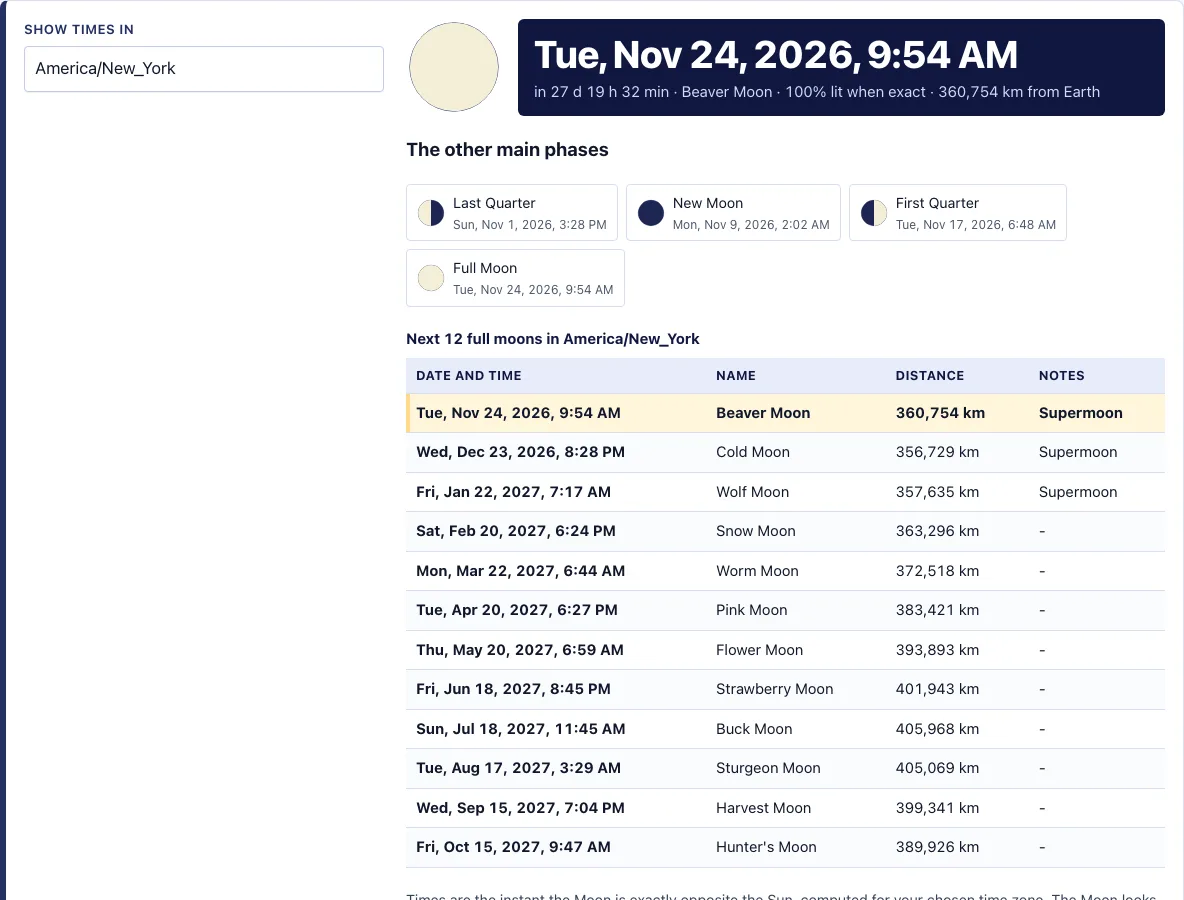
- Open the page. The answer card shows the date and time of the next full moon in your browser’s time zone.
- Open the Show times in selector and choose a different time zone if you need one. The date and time on the card update to that zone.
- Read the countdown underneath the card. It shows days, hours and minutes until the full moon and refreshes every minute.
- Check the Moon’s lit percentage and distance shown for the moment of the full moon.
- Look at The other main phases section for the next last quarter, new moon and first quarter, with local times.
- Scroll to the table of the next 12 full moons. Read the Date and time, Name, Distance and Notes columns. The Notes column marks supermoons and blue moons.
Choose the time zone before you do anything else, because every time on the page follows that choice, including the table and the other main phases. The list holds 12 full moons, so it reaches about a year ahead, and the highlighted first row is always the one counted down above it. Times show the local clock of the chosen zone, with daylight saving applied for the date of each full moon. If you want someone else to see the same view, press Copy link. The link keeps the zone you chose.
When is the next full moon?
Full moon dates, 2026–2027 (UTC)
Every full moon from 26 October 2026 to the end of 2027, in UTC. Your local date can differ by a day, and the tool above converts each one to your time zone. Supermoon means closer than 361,400 km.
| Full moon (UTC) | Name | Distance | Notes |
|---|---|---|---|
| 26 Oct 2026, 04:12 | Hunter’s Moon | 368,859 km | |
| 24 Nov 2026, 14:54 | Beaver Moon | 360,754 km | Supermoon |
| 24 Dec 2026, 01:29 | Cold Moon | 356,729 km | Supermoon |
| 22 Jan 2027, 12:18 | Wolf Moon | 357,635 km | Supermoon |
| 20 Feb 2027, 23:24 | Snow Moon | 363,296 km | |
| 22 Mar 2027, 10:44 | Worm Moon | 372,518 km | |
| 20 Apr 2027, 22:28 | Pink Moon | 383,421 km | |
| 20 May 2027, 11:00 | Flower Moon | 393,893 km | |
| 19 Jun 2027, 00:45 | Strawberry Moon | 401,943 km | |
| 18 Jul 2027, 15:46 | Buck Moon | 405,968 km | |
| 17 Aug 2027, 07:29 | Sturgeon Moon | 405,069 km | |
| 15 Sep 2027, 23:04 | Harvest Moon | 399,341 km | |
| 15 Oct 2027, 13:48 | Hunter’s Moon | 389,926 km | |
| 14 Nov 2027, 03:26 | Beaver Moon | 378,754 km | |
| 13 Dec 2027, 16:09 | Cold Moon | 368,131 km |
The next full moon is the instant the Moon sits exactly opposite the Sun as seen from Earth. The answer card gives that date and time in your chosen zone. The times are computed with the astronomy-engine library and agree within 2 minutes with Fred Espenak’s tables for 2026 to 2028.
The Moon is exactly full for only an instant, but it looks full for about a day on either side. The answer card also lists the other main phases with local times, so you can see when the next new moon or quarter falls.
The date changes with the zone. In New York, which is UTC-5 in winter, the 24 December 2026 full moon at 01:29 UTC shows as 23 December at 8:29 PM.
How long until the next full moon?
The countdown shows the days, hours and minutes until the exact instant of the next full moon, and it refreshes every minute. The count is to that instant, so it stays the same whichever time zone you display. If the countdown shows less than a day, the Moon is close to full now.
Full moons come about every 29.5 days, so the gap between two of them is usually close to a month.
How often is there a full moon?
There is a full moon about once every 29.5 days, which gives 12 or 13 in a calendar year. The average length of one lunar cycle, called the synodic month, is 29.53 days. A year of about 365.25 days holds roughly 12.4 of those cycles, so most years have 12 full moons and some have 13.
What is a supermoon?
A supermoon is a full moon that falls when the Moon is closer to Earth than usual. This tool counts a full moon as a supermoon when it is closer than 361,400 km, which is roughly the closest tenth of the range between the Moon’s nearest and farthest points. The Notes column marks these.
That threshold is a convention, not a fixed boundary in astronomy, and sources put it between about 357,000 and 362,000 km. A full moon at 368,859 km, like the 26 October 2026 example above, does not qualify.
What is a blue moon?
In this tool, a blue moon is the second full moon in one calendar month. The Notes column marks it as “Blue Moon (second this month).” The name refers to the calendar, not the colour, and the Moon looks like any other full moon.
The month is judged in the time zone you have selected. A full moon close to midnight can fall in a different month in another zone, which can change whether it counts as a blue moon. Another definition is also in use, the seasonal blue moon: the third full moon in an astronomical season that has four, such as 19 August 2024. The Notes column marks only the calendar-month kind.
Why does the full moon time differ by time zone?
The full moon happens at one instant, but clocks in different places show that instant at different times. A time zone is a fixed offset from UTC, so the same moment can land on a different date and hour in each zone. The tool shows the instant in whichever zone you select, and the moment itself does not change.
Changing the zone only changes the display. The Copy link button keeps your chosen zone in the link, so the person you send it to sees the same moment in that zone, even though their own clock may read differently.
Frequently asked questions
How this tool works and where the numbers come from
Full moon times are the instants the Moon’s ecliptic longitude is 180 degrees from the Sun’s, computed with astronomy-engine and checked against Fred Espenak’s published phase tables for 2024 to 2036 (every full moon within 2 minutes).
Sources
Frequently asked questions
What is a Harvest Moon?
The Harvest Moon is the full moon closest to the September equinox, so it always falls in September or October. For example, the full moon on 15 September 2027 at 23:04 UTC is the Harvest Moon, because the equinox is on 23 September. The full moon right after it is the Hunter’s Moon: usually the October full moon, or usually the November one in years when the Harvest Moon falls in October, such as 2028.
What are the full moon names?
The tool uses the traditional month names: Wolf, Snow, Worm, Pink, Flower, Strawberry, Buck, Sturgeon, Corn, Hunter’s, Beaver and Cold. The name in the table usually matches the month of the full moon, so you can tell at a glance which month it belongs to. The two exceptions are the Harvest Moon, which takes the place of the Corn or Hunter’s Moon, and the Hunter’s Moon, which usually moves to November when the Harvest Moon is in October.
Does the full moon look full for more than one night?
Yes. The exact full moon lasts only an instant, but the Moon looks full for about a day on either side. For photography, the night before and the night after look almost identical to the night of the exact moment.
How accurate are the times on the tool?
The times are computed with the astronomy-engine library, which is MIT licensed. They agree within 2 minutes with Fred Espenak’s tables for 2026 to 2028.
Can I share the full moon time with someone in another time zone?
Yes. Press Copy link to copy a link that keeps the zone you chose. The person who opens it sees the full moon in that zone.
Can I look up a full moon for a different place or date?
Not with this tool, because it has no place or date input. It shows the next full moon from now and the next 12 in the table. For a whole year at once, use the full moon calendar.
Is the full moon the same as the moon tonight?
Not always. The full moon is a single instant, while the Moon’s appearance on a given night depends on when it rises and sets. To see when the Moon is up, check moon tonight.
Related tools
- Moon phase today: use it to see the Moon’s phase for the current day.
- Full moon calendar: use it to plan a whole year of full moons at once.
- New moon calendar: use it to find new moons and plan dark-sky weekends.
- Moon tonight: use it to see rise, set and the dark window for tonight.
- Moon phase calendar: use it to view every phase across the month.
- Moonrise and moonset times: use it when you need the exact times the Moon rises and sets.
- Next lunar eclipse: use it to find the next time a full moon passes through Earth’s shadow.
- Best nights to stargaze: use it to pick nights for observing the sky.
Planning a trip around the full moon? The Night Gaze Camp app ranks campgrounds by tonight’s moonlight, clouds and sky darkness.