
Telescope Magnification Calculator
Enter your telescope and eyepiece to get magnification, exit pupil and true field, and see which eyepieces suit your scope.
Free · runs in your browser · nothing is uploaded
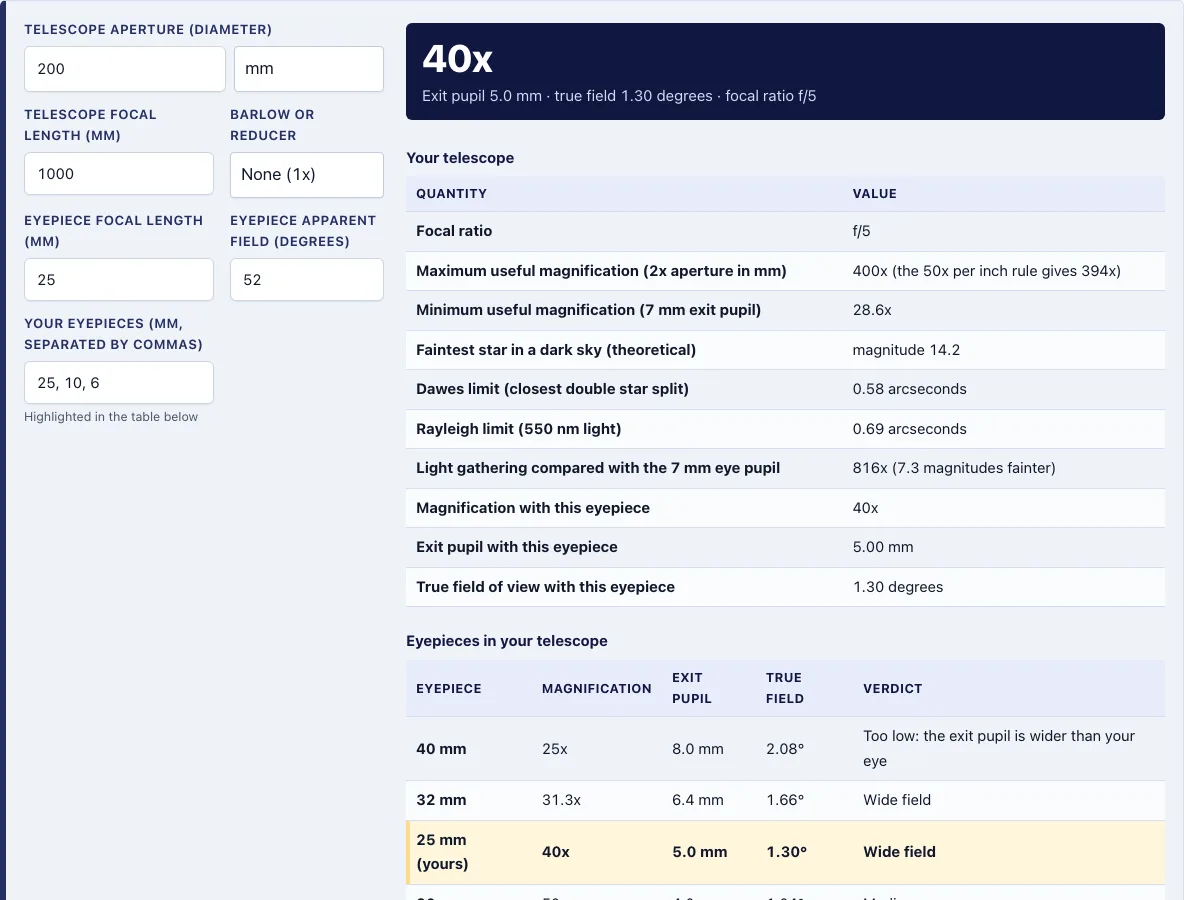
A telescope magnification calculator works out the magnification, exit pupil, true field and focal ratio for a telescope and eyepiece. Enter the aperture and focal length, add a Barlow or reducer if you use one, then the eyepiece focal length and apparent field.
Beyond the answer card, the page shows the useful range for your scope (28.6x to 400x for a 200 mm f/5), the Dawes and Rayleigh resolution limits, the faintest star it can reach, and a table that flags every eyepiece, yours and the common 4 to 40 mm sizes, as too low, too high or well matched. The formulas and worked examples are below.
How to use the Telescope Magnification Calculator
- Enter the telescope aperture (diameter) and select mm or inches.
- Enter the telescope focal length in mm. The default is 1000 mm, the focal length of a 200 mm f/5 telescope.
- Open the Barlow or reducer list and pick none, 0.5x, 0.63x, 0.8x, 1.4x, 2x, 2.5x, 3x or 5x Barlow.
- Type the eyepiece focal length in mm. The default is 25 mm.
- Enter the eyepiece apparent field in degrees. A 52 degree field is common for Plössl eyepieces; use your eyepiece maker’s figure.
- In “Your eyepieces”, type your sizes in mm separated by commas, such as 10, 25, 40. Your sizes are highlighted in the eyepiece table.
- Read the answer card for magnification, exit pupil, true field and focal ratio.
Start with the defaults to check the tool against the worked example in the next section. Use the eyepiece table to compare verdicts before you buy a new eyepiece. Start with the telescope fields, because the eyepiece table and the verdicts all depend on aperture and focal length. The last table groups magnifications by exit pupil, so you can see which of your eyepieces suit wide-field, medium or high-power targets. When you want to keep or share a setup, press Copy link. It copies a link that reproduces your settings.
How do you calculate telescope magnification
Divide the telescope focal length by the eyepiece focal length and multiply by the Barlow factor if you use one: magnification = focal length × Barlow / eyepiece focal length. A 1000 mm telescope with a 25 mm eyepiece gives 1000 / 25 = 40x, and a 2x Barlow takes the same pair to 80x. On a 200 mm f/5 telescope:
| Eyepiece | Magnification | Exit pupil | Verdict in the tool |
|---|---|---|---|
| 40 mm | 25x | 8 mm | Too low: wider than your eye |
| 25 mm | 40x | 5 mm | Wide field |
| 10 mm | 100x | 2 mm | Medium power |
| 4 mm | 250x | 0.8 mm | Very high power |
What is the maximum useful magnification of a telescope
The maximum useful magnification is about 2 times the aperture in millimetres, so 400x for a 200 mm telescope; the “50x per inch” rule gives 394x for its 7.87 inch aperture. Beyond that the image only gets dimmer and softer. The minimum useful magnification is aperture / 7, here 28.6x, below which the exit pupil is wider than a dark-adapted eye. A 70 mm f/10 refractor tops out at 140x, so a 4 mm eyepiece (175x) is flagged as too high.
What is exit pupil
The exit pupil is the width of the light beam leaving the eyepiece, in millimetres: aperture / magnification, or eyepiece focal length / (focal ratio × Barlow factor). The 200 mm telescope at 40x gives 200 / 40 = 5 mm. A 7 mm pupil matches a dark-adapted eye and 0.5 mm marks the 2× aperture limit. These rules of thumb help choose a power:
| Exit pupil | Magnification (200 mm) | Good for |
|---|---|---|
| 5 to 7 mm | 28.6x to 40x | Wide-field sweeping, open clusters, Milky Way, big nebulae, comets |
| 2 to 5 mm | 40x to 100x | Galaxies, most nebulae and star clusters, the whole Moon |
| 1 to 2 mm | 100x to 200x | Planets, lunar craters, globular clusters, planetary nebulae |
| 0.5 to 1 mm | 200x to 400x | Planetary detail and tight double stars in steady air |
What is the Dawes limit
The Dawes limit is the closest pair of equally bright stars a telescope can just split in steady air: 116 / aperture in mm, in arcseconds, which equals 4.56 / aperture in inches. For 200 mm it is 0.58 arcseconds; the Rayleigh criterion, 138 / aperture in mm, gives 0.69. Atmospheric seeing often limits large telescopes to 1 arcsecond or worse.
How faint a star can my telescope see
Use the limiting magnitude 2.7 + 5 log10(aperture in mm): magnitude 14.2 for 200 mm. Published constants for the cm form range from 6.8 to 8.7 and this uses the middle, so trust it to about one magnitude. Light gathering compared with a 7 mm eye pupil is (aperture / 7)², or 816 times for 200 mm, 7.3 magnitudes; a 7 mm eye alone reaches about magnitude 6.9.
How this tool works and where the numbers come from
Magnification = telescope focal length × Barlow / eyepiece focal length; exit pupil = aperture / magnification; maximum useful power 2× aperture in mm (exit pupil 0.5 mm); minimum useful power aperture / 7 (7 mm pupil); Dawes limit 116 / D mm and Rayleigh 138 / D mm in arcseconds; limiting magnitude 2.7 + 5 log10(D mm), the middle of the published constants (6.8 to 8.7 for D in cm). Worked examples were done by hand and are checked in the page’s tests.
Sources
Frequently asked questions
How do you calculate the focal ratio of a telescope?
Divide the focal length by the aperture in the same unit: 1000 / 200 = f/5, and an 8 inch (203.2 mm) telescope with 2032 mm of focal length is f/10. A Barlow multiplies the effective ratio too, so a 2x Barlow makes f/5 behave like f/10.
What does a Barlow lens do to magnification and exit pupil?
It multiplies the magnification by its factor and shrinks the exit pupil by the same factor. On the 200 mm f/5 with a 25 mm eyepiece, a 2x Barlow gives 80x and a 2.5 mm exit pupil.
Why is a 40 mm eyepiece flagged as too low for a 200 mm f/5?
At 25x its exit pupil is 8 mm, wider than the roughly 7 mm opening of a dark-adapted eye, so the extra light is wasted. The 32 mm eyepiece (31x) gives a wide field without that problem.
What happens above the maximum useful magnification?
The view gets bigger but blurrier and shows no extra detail. For a 200 mm telescope that means anything above about 400x. Switch to a longer eyepiece or add a reducer to bring the power down.
Is the true field in the answer card exact?
No. True field = apparent field / magnification is an approximation that ignores the field stop. With a 52 degree eyepiece at 40x it gives 1.3 degrees, close enough for planning a view.
- Angular Size Calculator: find how large the Moon or a planet looks before you magnify it.
- Astrophotography Calculator: plan exposures if you photograph rather than look.
- Sidereal Time Calculator: see which stars are crossing your meridian now.
- Planets Visible Tonight: choose planets to aim at this evening.
- Moon Tonight: check the Moon before a lunar session.
- Star Map Generator: make a chart for finding targets.
- Meteor Shower Tonight: see whether a shower is active for a wide-field eyepiece.
Planning a trip? The Night Gaze Camp app ranks campgrounds by tonight’s moonlight, clouds and sky darkness.