
Stargazing Calendar
Pick a place and a month to see every night scored for darkness and Moonlight, with the five best nights.
Free · runs in your browser · nothing is uploaded
How to use the Stargazing Calendar
- Open the Place list and choose a dark-sky park, a city, My location or Custom coordinates (Latitude, Longitude and Time zone). The scores and the times are for that place, so set it first.
- Pick a month in the Month list; it opens on the current month. The grid starts on the weekday the month really starts on, so it reads like a wall calendar.
- Type a year in the Year box, such as 2026.
- Read the month grid. Each night shows its score and a colour from poor to excellent; a small Moon disc marks new and full moons and a short label marks eclipses.
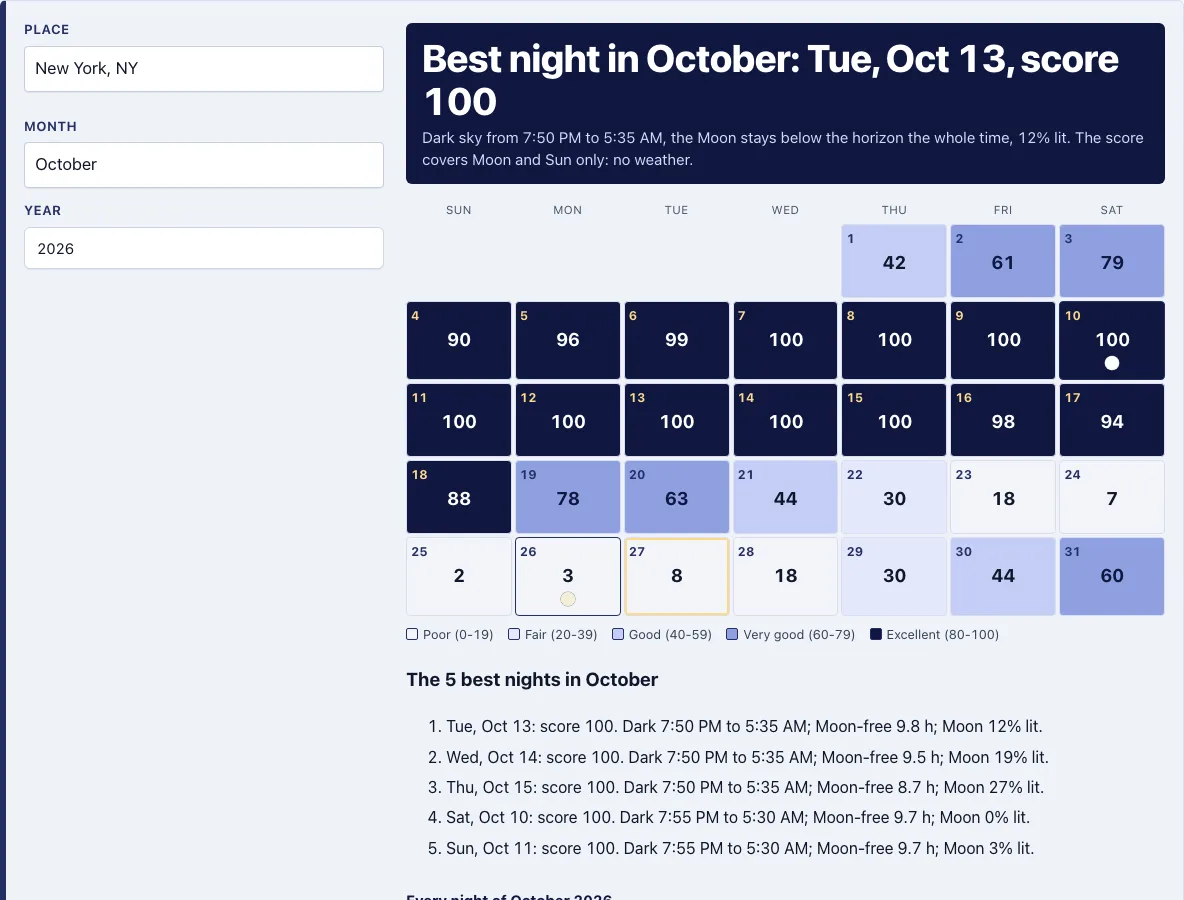
- Read the top card: the best night, its dark window from astronomical dusk to dawn, the Moon-free hours and the Moon’s lit share.
- Scroll to The 5 best nights, then the table of every night with score, astronomical night window, Moon-free dark hours, Moon lit and events.
- Check the colour key under the grid (Score colours) if you forget which band a colour means; today’s cell has a gold outline.
- Press Print this month for a paper copy or Copy link to share the place, month and year.
When are the best nights to stargaze this month?
Look for the highest scores on the grid, usually the nights around new moon. The top card names the single best night and the five-night list ranks the rest. Scores fall into five colour bands:
| Band | Score |
|---|---|
| Poor | 0 to 19 |
| Fair | 20 to 39 |
| Good | 40 to 59 |
| Very good | 60 to 79 |
| Excellent | 80 to 100 |
In New York in October 2026 fifteen nights, 4 to 18 October, score 80 or more. The five best are 13, 14, 15, 10 and 11 October, all 100, and the worst is 25 October with 2.
How does the Moon affect stargazing?
Moonlight is what the score mostly measures. A night runs from local noon to the next noon and only minutes with the Sun more than 18 degrees below the horizon count. Each such minute earns 1 point while the Moon is down. With the Moon up it earns 1 minus twice the Moon’s lit fraction times the sine of its altitude, never below 0. The score is those points divided by the length of the dark night (at least 4 hours), times 100.
| Moon situation | Points per dark minute |
|---|---|
| Full Moon at 45 degrees | 0 |
| Quarter Moon at 45 degrees | about 0.29 |
| 10% crescent at 30 degrees | 0.90 |
So a waxing Moon that sets before midnight still leaves the pre-dawn hours dark, and a thin crescent costs little. A waning Moon rises late and spoils the second half of the night instead.
The lunar cycle lasts about 29.5 days, so good nights arrive in one long block around each new moon and poor ones around each full moon. In October 2026 in New York the block of nights scoring 80 or more lasts fifteen nights, and the poorest nights fall around the full moon.
What are the best nights for stargazing in 2026?
Set the Year box to 2026 and step through the Month list; the grid is recalculated for your place, so the strongest nights depend on where you are as well as on the lunar cycle. A lunar eclipse is marked on the night that contains it: in New York the total lunar eclipse of 3 March 2026 peaks at 6:34 AM, so it sits on 2 March, the night of 2 to 3 March. Solar eclipses are daytime events and stay on their date, with how much of the Sun is covered at your place, or a note that it is not visible there.
How this tool works and where the numbers come from
Each night is sampled every 5 minutes from local noon to noon with astronomy-engine. Only minutes with the Sun more than 18 degrees below the horizon count; a minute earns 1 point with the Moon below the horizon, or 1 minus twice the Moon’s lit fraction times the sine of its altitude (not below 0) with it up; the score is the points divided by the length of the dark night (at least 4 hours) times 100. New and full moons were checked against Fred Espenak’s phase list and eclipse marks against NASA’s eclipse catalogs. Weather is not modelled.
Sources
Frequently asked questions
What is the best time to see stars tonight?
Between astronomical dusk and dawn, shown as the dark window on the top card. A high Moon-free hour count that night means a darker sky.
Does the calendar account for clouds?
No. Clouds, haze, light pollution and your local horizon are not in the score. Check a forecast first, and look at a light pollution map for the spot you pick, since a perfect score cannot make a bright sky dark.
Why is every night zero?
At high latitudes around midsummer the Sun never gets 18 degrees below the horizon, so there is no astronomical night. Tromso in June is an example, and the card says so.
Are new moons and eclipses on the right date?
New and full moons and solar eclipses sit on the local calendar day of the event in the place’s time zone. A lunar eclipse sits on the night that contains it, because each cell is the night that starts on that evening: an eclipse in the small hours of the 3rd is marked on the 2nd.
What happens when two nights have the same score?
The list puts the night with more points first, which means more Moon-free dark hours.
Can I print the calendar?
Yes. Print this month prints the grid and the table of nights in black and white tones.
What does a night on the grid mean?
The evening that starts on that date and ends the next morning: 10 October covers the night of 10 to 11 October.