
Star Map Generator
Pick a place, date and time and get an accurate chart of that sky, ready to download or print.
Free · runs in your browser · nothing is uploaded
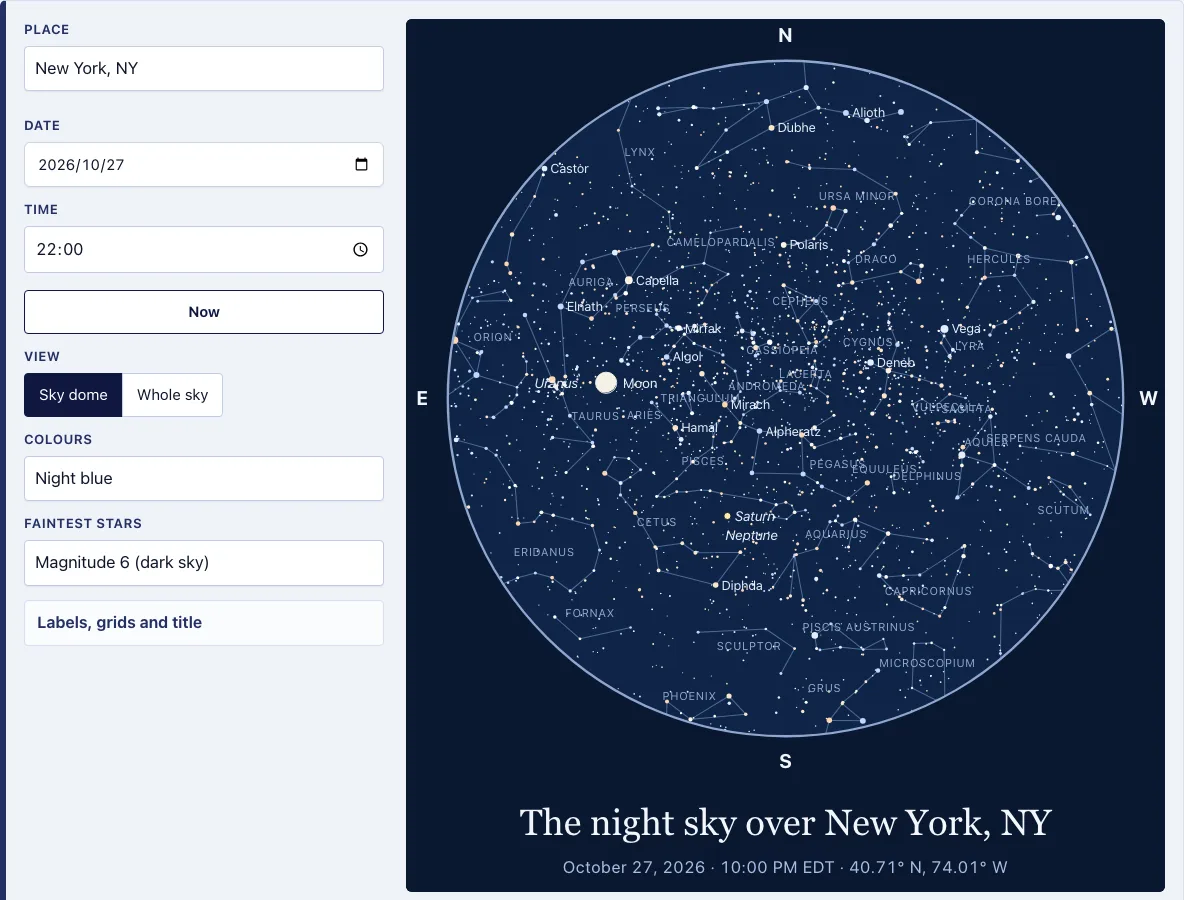
How to use the Star Map Generator
- Choose a Place. Pick a preset, My location (this device) or Custom coordinates (Latitude, Longitude, Time zone).
- Set the Date. It starts at today’s date at the place you chose.
- Set the Time. It starts at 22:00 local time. Press Now to jump to the current date and time at that place.
- Pick a View. Sky dome shows the sky above you, with north at the top and east on the left. Whole sky shows every star that rises at that latitude.
- Choose a Colours theme and a Faintest stars level. Use magnitude 6 for a dark sky and magnitude 3 for a city.
- Tick the boxes you want under Labels, grids and title. Type your own Title or Caption line if you want different wording.
- Press Download SVG for a file that scales to any poster size, or Download PNG for a 2,400-pixel-wide image. To print, choose Paper (A4 or US Letter) and press Print.
Copy link stores the place, date, time and every option. Below the map, the tables Moon and planets at this moment and Brightest named stars above the horizon list altitude and direction. A warning appears when the Sun is above -6 degrees: the star positions are still correct, but the stars cannot be seen in that light.
How can I create a star map?
A star map needs a place, a date and a time, plus the position of every star at that moment. Choose the three settings above the chart and the tool works out where each star stood relative to your horizon, then draws it with the constellations, the Moon and the planets.
Each star’s year-2000 position is adjusted for its proper motion and for precession, the slow 26,000-year wobble of Earth’s axis. The result is lifted for atmospheric refraction, about 0.57 degrees at the horizon. Faintest stars sets how many points appear:
| Faintest stars | Typical place |
|---|---|
| Magnitude 3 | City |
| Magnitude 4 | Suburbs |
| Magnitude 5 | Countryside |
| Magnitude 6 | Dark sky |
What is the best free star map?
The best choice depends on whether you want a chart to use under the sky or a finished poster. This generator gives an accurate chart for any date and place, as SVG and PNG files to download and print, plus tables with the altitude and direction of the bright stars and planets.
Commercial posters, such as those sold by thestarposter.com and magicalnightsky.com, provide a printed chart. Choose one of those if you want a finished object for a wall.
Can I create my own constellation?
Not inside the tool: it draws the 88 official constellations as stick figures, after the IAU and Sky & Telescope charts, and labels up to 62 of the brightest named stars. You can switch the lines and names off, though, and use the bare star field as the starting point for your own pattern.
To invent your own pattern, print a chart with Constellation lines turned off and Faintest stars set to 6, which gives you the most points. Then join stars with a pencil.
What did the night sky look like on my birthday?
Enter your birth place, birth date and birth time, and the generator shows the night sky over that spot at that moment, with the Moon in its real phase and the planets where they were. If the time is unknown, leave it at 22:00, which gives the evening sky of that date. The sky turns 15 degrees per hour, so the time changes the chart as much as the date does.
For example, New York on 24 October 2026 at 10:00 PM EDT shows 2,476 stars brighter than magnitude 6 above the horizon. The Moon is a waxing gibbous, 98% lit, 52 degrees up in the southeast. Saturn is 46.5 degrees up in the SSE, Vega 37.7 degrees up in the WNW and Capella 27.9 degrees up in the NE.
Canopus (declination -52.7) never rises at New York’s latitude of 40.7 N, so no New York map shows it.
How this tool works and where the numbers come from
Stars of the Yale Bright Star Catalogue (5th rev. ed.) are moved from J2000 by proper motion, rotated to the horizon of the chosen place and moment with astronomy-engine (IAU 2006 precession, nutation, Earth rotation) and lifted by standard refraction. Tests compare star altitudes with an independent IAU 1976 precession and Meeus sidereal-time calculation (agreement better than 0.003 degrees) and with Meeus Example 21.b (theta Persei).
Sources
Frequently asked questions
How to get a star map for free?
Set your place, date and time, then press Download PNG or Download SVG. The SVG file is a vector drawing, so it stays sharp at poster size; the White (print) theme saves ink on a home printer.
Can I make a birthday star map?
Yes. Enter the birth place, date and time, choose a theme and type your own Title and Caption line if you like. Press Copy link to keep the exact chart, or Download PNG for an image to print or share.
Does the map show the Moon and planets?
Yes. The Moon is drawn with its real phase, bright side towards the Sun, and the planets are labelled while Moon and planets is ticked. The table Moon and planets at this moment always lists each body’s altitude, direction, magnitude and whether it needs binoculars.
Why does the sky look different on another night?
The sky turns once every 23 h 56 min, so the same arrangement of stars comes back about 4 minutes earlier each night, or about 2 hours earlier each month. Change the date to see the sky at another point in the year.
How accurate is the star map?
Star positions agree with an independent precession and sidereal-time calculation to better than 0.003 degrees, far finer than a printed dot. Each star is moved from its year-2000 position by proper motion and precession, and refraction lifts objects near the horizon by about half a degree.
Can I sell a star map poster I made here?
Yes. The SVG and PNG charts you download are yours to print, sell or put in a book without credit. The star positions are scientific facts, and the catalogue and constellation data behind them allow commercial use. Just don’t copy the generator itself to run a rival service; see the terms.
Related tools
- Planets Visible Tonight: use it to see which planets are up and bright right now.
- Moon Tonight: use it to check the Moon’s phase and position for the current night.
- Moon Phase on My Birthday: use it to see what the Moon looked like on the day you were born.
- Sidereal Time Calculator: use it to find local sidereal time for a place and moment.
- Stargazing Calendar: use it to plan observing nights across the year.
- Meteor Shower Tonight: use it to check whether a meteor shower is active.
- Astronomical Twilight Calculator: use it to find when the sky is dark enough to see faint stars.
- Solar System Simulator: use it to watch the planets move through their orbits.
Planning a night out under the stars? The Night Gaze Camp app ranks campgrounds by tonight’s moonlight, clouds and sky darkness.