
Solunar Calendar
Choose a place and a date to see the solunar periods of the day and a rating for every day of the month.
Free · runs in your browser · nothing is uploaded
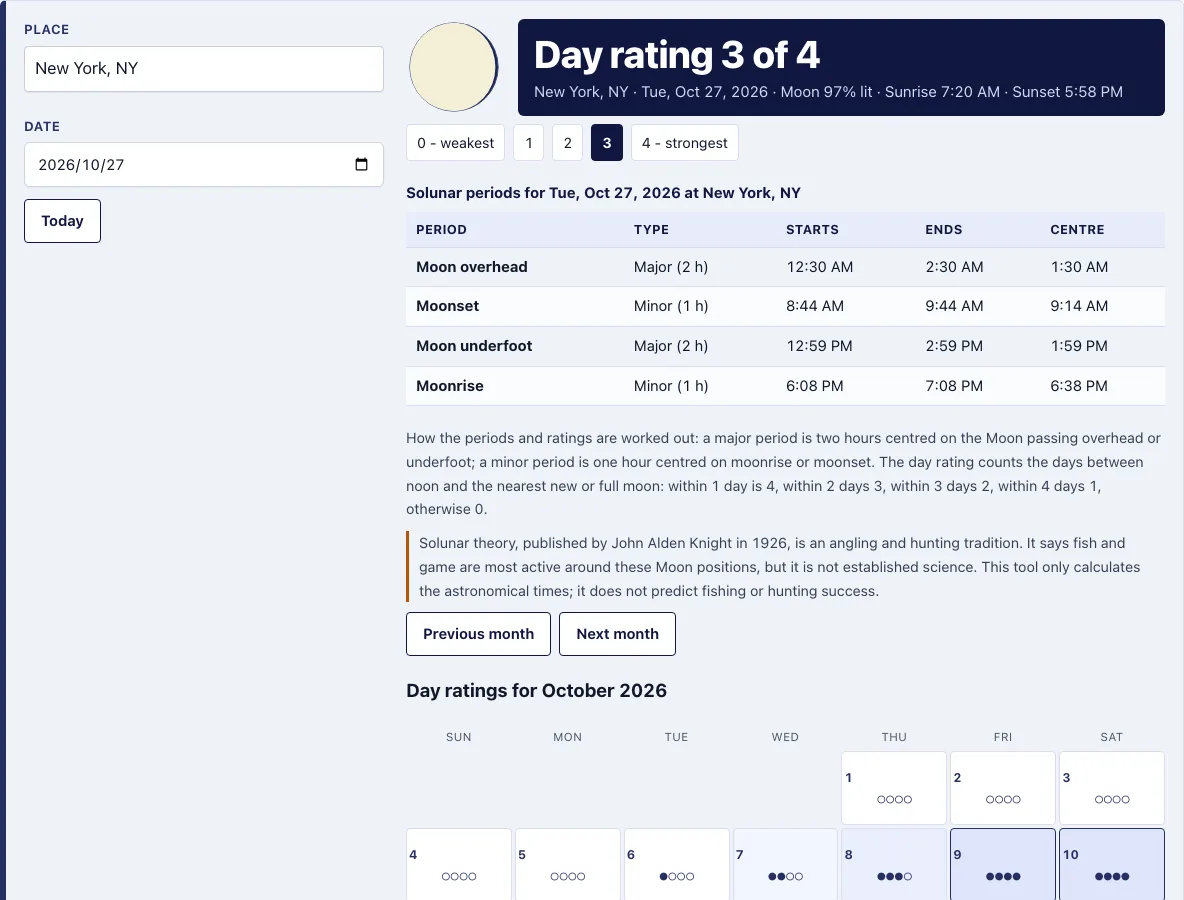
How to use the Solunar Calendar
- Open the Place list and choose a dark-sky park, a US or world city, My location, or custom coordinates.
- Type a date into the Date box, or click Today to start from the current date.
- Read the headline Day rating N of 4. It shows the place, the date, the Moon lit percentage and the Sun’s rise and set.
- Check the Rating scale, which runs from 0 (weakest) to 4 (strongest). The day’s value is marked on it.
- Look at the table Solunar periods for your date. It gives each period’s type, start, end and centre.
- Click Next month or Previous month to move through the calendar, then scan the Day ratings grid for that month. Each day shows four dots.
- Click any day in the grid to select it and update the results above. Darker cells with four filled dots are the highest-rated days, and the selected day has a gold outline.
- Remember the periods are astronomical times. Read the note under the table before you plan around them.
Use Copy link to get a link to the page you are viewing, and Print month to print the month grid on paper for your trip planning.
What is the solunar theory?
The solunar theory says fish and game are more active at certain positions of the Moon. John Alden Knight laid it out in 1926. It is an angling and hunting tradition rather than established science, and the tool’s periods come from that tradition.
The tradition links activity to two things: where the Moon is during the day, and what phase it is in. Its timing points are the Moon crossing overhead or underfoot, and its rising and setting. It also holds that quarter moons are the weakest days, which is why this tool gives them the lowest rating.
How are solunar periods calculated?
The tool finds the times when the Moon passes overhead (upper transit) or underfoot (lower transit), and when it rises or sets, for the place you choose. It centres a period on each of these events. It then rates the day by how close it falls to a new or full moon.
The Moon rises, sets and transits about 50 minutes later each day. Because of this, one day per month lacks each type of period, and a day can have two to four periods. Each period belongs to the local calendar day on which its centre falls.
The day rating depends only on the Moon’s phase. Take the distance in days between 12:00 local time and the nearest exact new or full moon, then use this scale:
| Distance from nearest new or full moon at 12:00 local time | Rating |
|---|---|
| Within 1 day | 4 |
| Within 2 days | 3 |
| Within 3 days | 2 |
| Within 4 days | 1 |
| More than 4 days | 0 |
Quarter moons sit about 7.4 days from a new or full moon, so they always rate 0.
Worked example: New York, Tuesday 24 November 2026 (full moon)
| Period | Type | Starts | Ends | Centre |
|---|---|---|---|---|
| Minor | Moonset | 6:35 AM | 7:35 AM | 7:05 AM |
| Major | Moon underfoot | 10:43 AM | 12:43 PM | 11:43 AM |
| Minor | Moonrise | 3:46 PM | 4:46 PM | 4:16 PM |
The day rates 4 because the full moon falls on 24 November, within a day of 12:00 local time. The day has no overhead period, because the Moon passes overhead just after midnight and that period is not on this day’s list.
How this tool works and where the numbers come from
Moon transit (overhead), lower transit (underfoot), moonrise and moonset come from astronomy-engine for the chosen place and are centred in periods of 2 hours (major) and 1 hour (minor). The day rating is 4 within 1 day of the nearest exact new or full moon at 12:00 local time, 3 within 2 days, 2 within 3, 1 within 4 and 0 beyond. Times were compared with PyEphem; the rating rule is the page’s own documented convention because solunar theory has no official standard.
Sources
Frequently asked questions
What is a major and a minor solunar period?
A major period lasts 2 hours and is centred on the Moon passing overhead or underfoot. A minor period lasts 1 hour and is centred on moonrise or moonset. The tool lists both in the Solunar periods table.
What are the best solunar days?
Under this tool’s rule, the best days are rated 4 of 4, which means they fall within one day of a new or full moon. In 2026, counted in New York time, 50 days rate 4 and 167 rate 0. In November 2026 for New York, 8 and 9 November (new moon on 9 November) and 23 and 24 November (full moon on 24 November at 9:54 AM) rate 4. 25 November rates 3, because its noon is just over a day after the full moon.
Why does a day sometimes show only two or three periods?
The Moon rises, sets and transits about 50 minutes later each day, so one day a month misses each type of period. A day can have two to four periods, and the table shows only those that fall on that date.
Does the place change the day rating?
Almost never. The rating depends only on the Moon’s phase, so places in the same time zone show the same rating for a given date; only a day on the edge of a rating step can change with the time zone. Period times do change with the place and its time zone, so pick a different location to see when they fall for you.
Does a high rating mean the fish will bite?
No. The tool calculates astronomical times only and does not predict fishing or hunting success. Use the rating as one part of your plan, and check local conditions such as weather and water levels as well.
Why are sunrise and sunset shown?
Many anglers also favour dawn and dusk, so the tool shows the Sun’s rise and set beside the periods. In the polar regions it says when the Sun stays up or down all day.
Related tools
- Moonrise Moonset Calculator: use it for exact Moon rise, set and direction times at a place.
- Full Moon Calendar: use it to find full moon dates when you plan around the strongest days.
- New Moon Calendar: use it to find new moon dates, which also give high ratings.
- Moon Phase Calendar: use it to see the phase of the Moon on every day of the month.
- Moon Tonight: use it to check what the Moon looks like this evening.
- Moon Phase Today: use it for a quick read of today’s phase.
- Astronomical Twilight Calculator: use it for dawn and dusk times if you fish or hunt in low light.
- Stargazing Calendar: use it to find nights that are worth planning for observing the sky.
Heading out overnight? The Night Gaze Camp app ranks campgrounds by tonight’s moonlight, clouds and sky darkness.