
Solar System Scale Calculator
Choose the Sun's size, the Earth's size or the model's length and get every planet's model size, distance and paces.
Free · runs in your browser · nothing is uploaded
The Solar System Scale Calculator works out how big the Sun and planets should be, and how far apart they should sit, when you shrink the solar system to a size you can hold or walk through. You enter one measurement, such as the Sun’s diameter or the distance to Neptune, and the tool returns a scale ratio, a table of model sizes and distances, a strip diagram, and a walking model with paces between each body.
It suits classroom projects, science fairs, and backyard walks. You can work in metric or imperial units, include Pluto, and print a one-page instruction sheet for your group.
How to use the Solar System Scale Calculator
Start with the default settings (a Sun 20 cm across), then change one control at a time.
- Open Scale by and choose what you want to fix: the Sun’s size, Earth’s size, or Model length (the distance from the Sun to the last planet, Neptune or Pluto).
- Type the number in the size box. For a Sun 20 cm across, enter 20.
- Pick a Unit from mm, cm, in, m, ft, miles or km. The unit also sets the system, so mm, cm, m and km are metric and in, ft and miles are imperial.
- Set the Pace length. It is 75 cm by default, or about 30 in for imperial units. Use your own stride so the paces are easy to count.
- Tick Include Pluto (dwarf planet) if you want Pluto in the results.
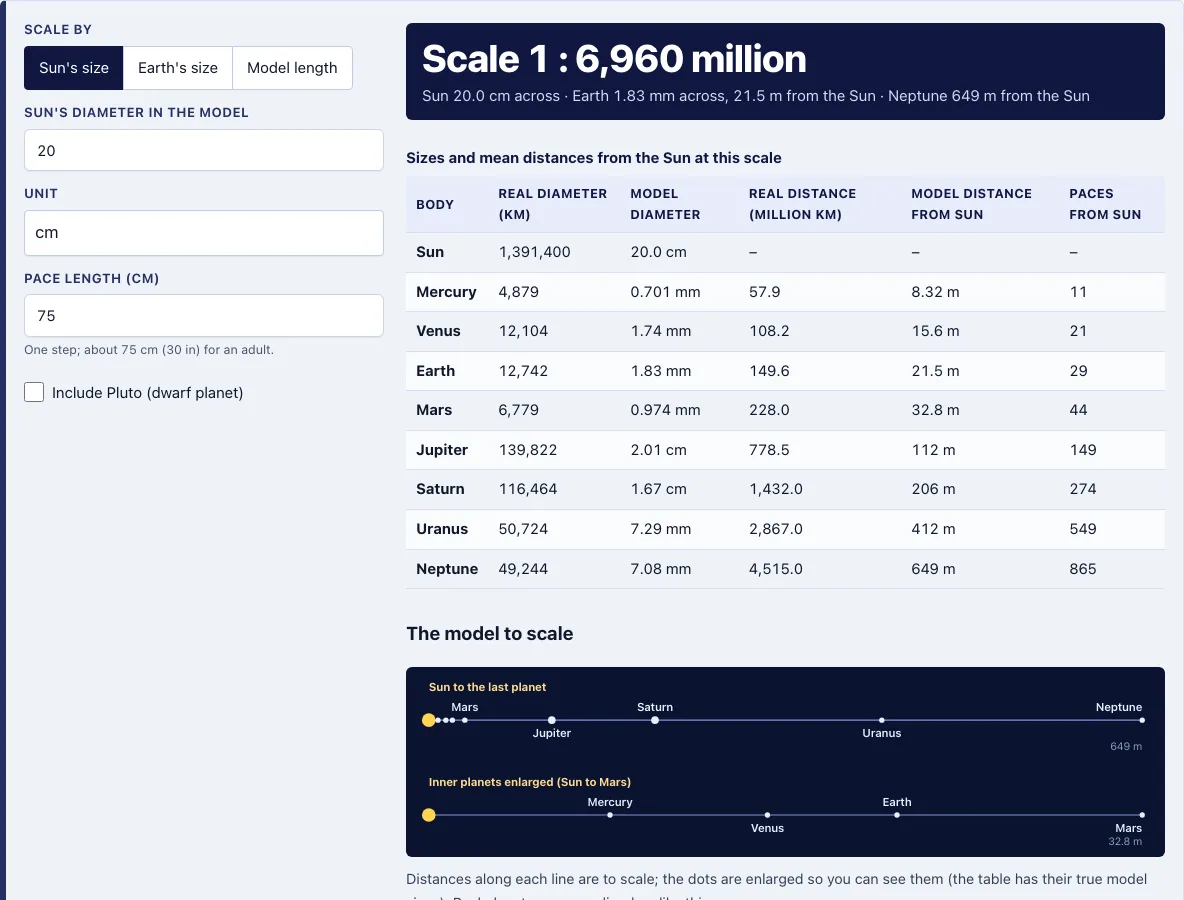
- Read the scale ratio, such as “Scale 1 : 6,960 million”, and the summary line above the table.
- Check the table for each body’s model diameter and model distance from the Sun.
- Follow the Walking model list, which gives the paces from each body to the next and the ball size to put down.
Copy link stores your settings, so you can reopen the same model or send it to a partner. Print instruction sheet prints the table, the strip and the walking steps on one page.
What is the solar system scale in cm?
With the Sun 20 cm across, the scale is 1 : 6,960 million, and every real size and distance shrinks by that factor. Earth comes out at 1.83 mm across. A Sun 1 cm across gives 1 : 139,140 million, which makes Earth about 0.09 mm.
Metric results use mm, cm, m or km, and imperial results use in, ft or miles. The exact conversions are 1 in = 2.54 cm, 1 ft = 0.3048 m, and 1 mile = 1,609.344 m.
| Body | Model diameter | Model distance from Sun |
|---|---|---|
| Mercury | 0.701 mm | 8.32 m |
| Venus | 1.74 mm | 15.6 m |
| Earth | 1.83 mm | 21.5 m |
| Mars | 0.974 mm | 32.8 m |
| Jupiter | 2.01 cm | 112 m |
| Saturn | 1.67 cm | 206 m |
| Uranus | 7.29 mm | 412 m |
| Neptune | 7.08 mm | 649 m |
How does a planet scale calculator work?
It divides the model size by the real size to get one scale factor, then multiplies each real diameter and distance by that factor. Paces come from dividing the model distance by your pace length. Earth at 21.5 m is 29 paces from the Sun with a 75 cm pace.
The steps are k = model size / real size, model diameter = real diameter × k, model distance = real distance × k, and paces = model distance / pace length. The Sun is 109.2 times wider than Earth, and 1 AU is 107.5 Sun diameters.
What happens to planet sizes in a long model?
If the model must fit a 100 m corridor from the Sun to Neptune, the scale becomes about 1 : 45,150 million. Earth shrinks to 0.28 mm across and sits 3.3 m from the Sun. At that size the planets are dust specks, so classroom models often use one scale for sizes and another for distances.
How do you plan a solar system scale model project?
Choose your fixed measurement from the space you have. Then check that the planets are still large enough to see.
- Measure the longest straight run you have, indoors or outdoors.
- Enter that length as Model length, or enter a Sun size that fits the table.
- Check the Earth and Jupiter diameters. If they look like specks, use a second, larger scale for sizes.
- Set a pace length you can count, then print the instruction sheet.
How far away is the nearest star in a scale model?
At the 20 cm Sun scale, Proxima Centauri sits about 5,770 km away, roughly 8,900 times farther than Neptune. Its real distance is 4.2465 light years, or about 268,550 AU.
The distance comes from a Gaia parallax of 768.07 milliarcseconds. The tool shows Proxima Centauri at the same scale as the planets, so the gap is easy to see.
How this tool works and where the numbers come from
Scale factor = model size / real size; every diameter and distance is multiplied by it. Diameters are twice the NASA volumetric mean radii, distances the NASA semi-major axes; Proxima Centauri uses its Gaia parallax (768.0665 mas). Unit factors are exact (1 in = 2.54 cm). Tests check the Sun/Earth ratio 109.2, 1 AU = 215 solar radii and round trips between the three scale modes.
Sources
Frequently asked questions
How big is Earth if the Sun is a basketball?
A basketball is about 24 cm across. With Scale by set to the Sun’s size and 24 cm entered, Earth comes out at 2.2 mm (a peppercorn) about 25.8 m away, and Neptune is 779 m from the ball.
Why does my model need two scales?
At one scale the planets are either specks or the distances become kilometres. With a 20 cm Sun, Earth is under 2 mm wide yet Neptune sits 649 m away, so many classroom models use one scale for sizes and a separate one for distances.
What happens when I tick Include Pluto?
Pluto is added as a dwarf planet. If you use Model length, the length then runs to Pluto’s distance of 5,869.7 million km instead of Neptune’s 4,515.0 million km, so the whole model stretches out.
Which unit should I choose?
Pick the unit you plan to measure with: millimetres and centimetres suit a tabletop Sun, while m, ft or miles suit a model length for a room, corridor or field. The number and the unit together set the scale, and every result is shown in a readable unit of the same system.
Can I save or share my settings?
Yes. Click Copy link to store the size, unit, pace length and Pluto setting in the link, then send it to someone who needs the same model.
Are the planets in the strip diagram in their real positions?
No. The strip shows real distances to scale but enlarges the dots, and planets are never lined up like this in reality. For actual positions, use the Solar System Simulator.
Related tools
- Solar System Simulator: use it to see where the planets really are, instead of a scale model.
- Angular Size Calculator: use it to work out how large the Sun or a planet looks from Earth.
- Planets Visible Tonight: use it to find which planets you can see in the sky tonight.
- Star Map Generator: use it to make a star chart for your observing location.
- Telescope Magnification Calculator: use it to choose an eyepiece for viewing planets.
- Moon Phase Calendar: use it to check the Moon’s phase before an observing session.
Taking the class outside after dark? The Night Gaze Camp app ranks campgrounds by tonight’s moonlight, clouds and sky darkness.