
Sidereal Time Calculator
Pick a place and a moment to get local and Greenwich sidereal time, plus the bright stars crossing your meridian.
Free · runs in your browser · nothing is uploaded
A sidereal time calculator gives the time kept by the stars: local sidereal time is the right ascension that is crossing your meridian right now. This one opens on the current moment and ticks every second. Pick a place from the Place menu or enter your own latitude and longitude, and the large card shows local mean sidereal time as hh:mm:ss.
Below it you get Greenwich mean and apparent sidereal time, the right ascension on your meridian and the length of a sidereal day. A star table lists the bright stars nearest your meridian with their crossing times and heights, and an hourly table shows local sidereal time through the date you choose.
How to use the Sidereal Time Calculator
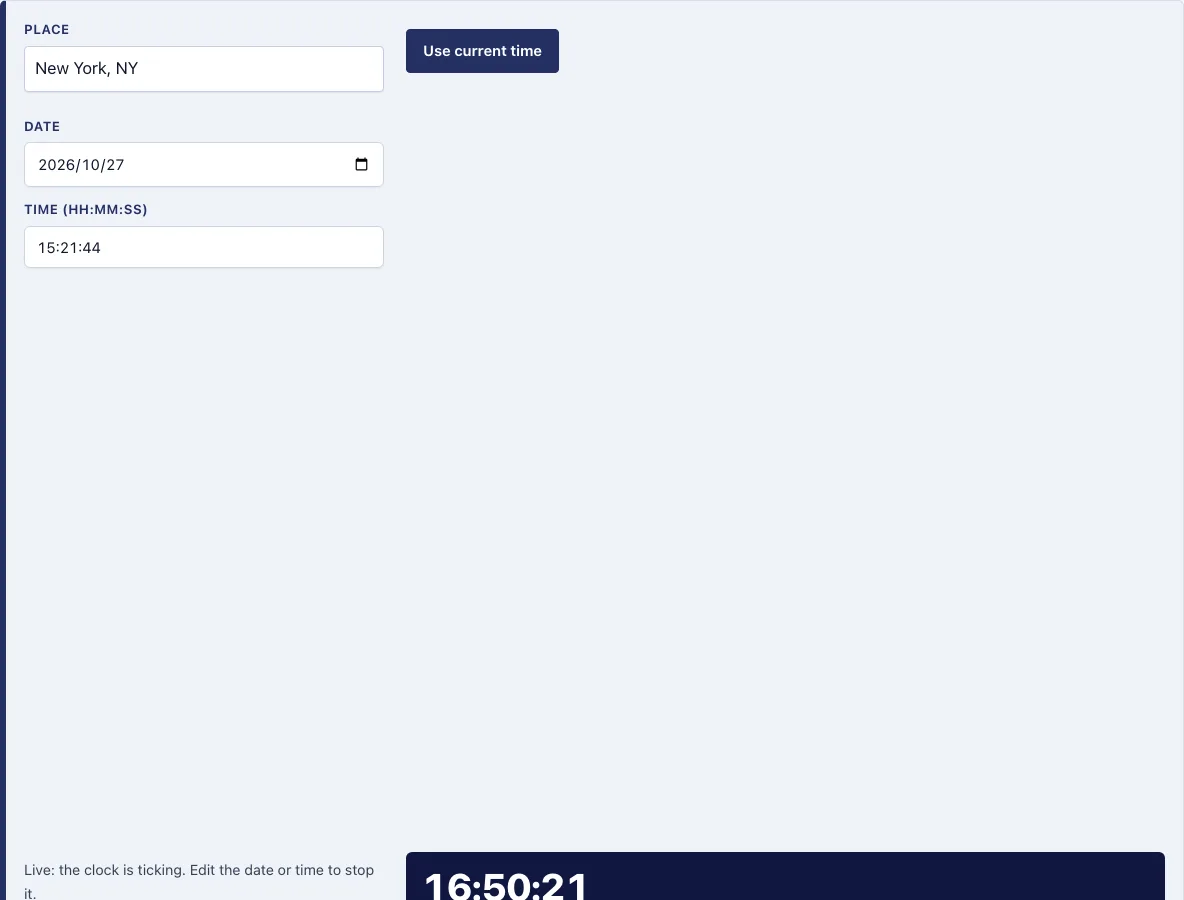
- Open the Place menu. Choose a dark-sky place or city from the list, or pick My location (this device). For your own spot, choose Custom coordinates and enter Latitude, Longitude and Time zone.
- Check the Date field. The page opens with the current date in the place’s time zone.
- Check the Time (HH:MM:SS) field. It ticks each second while the page is live.
- To view another moment, type a new date or time. Ticking stops once you edit either field. Select Use current time to restart the live clock.
- Read the big card. It shows local mean sidereal time (LMST) as hh:mm:ss.
- Check the results for Greenwich Mean Sidereal Time, Greenwich Apparent Sidereal Time, Local Apparent Sidereal Time, the right ascension on your meridian, the equation of the equinoxes and the length of a sidereal day.
- Read the star table. It shows the 8 of 20 bright stars closest to your meridian, with magnitude, crossing time, minutes ahead or ago, and height at that moment.
- Use the hourly table to see local mean sidereal time at each whole hour of your chosen date.
To share a setup, select Copy link. It reproduces your place, date and time settings, so the person who opens it sees the same results.
What is sidereal time?
Sidereal time measures the Earth’s rotation against the distant stars rather than the Sun. At any place, local sidereal time equals the right ascension of the objects on your meridian, the line running from the north point through the zenith to the south point. When the sidereal clock reads 05:00:00, objects at right ascension 5 hours are crossing that line.
How do you calculate local sidereal time?
Take Greenwich sidereal time for the moment and add your east longitude divided by 15, because 15 degrees of longitude equals one hour. East longitude counts positive and west longitude counts negative.
- Find Greenwich Mean Sidereal Time (GMST) for the date and UT time.
- Divide your longitude in degrees by 15. At 74.0 degrees west, that is −4 h 56 min.
- Add the two. If the total passes 24 hours, subtract 24.
For example, GMST at 1987-04-10 19:21:00 UT is 08:34:57.09. Adding −4 h 56 min for New York gives 03:38:57.09.
How long is a sidereal day?
A sidereal day is 23 hours, 56 minutes and 4.0905 seconds, the time Earth takes to turn once relative to the vernal equinox, which is very nearly the stars. Measured against the stars themselves (the stellar day) it is 8 milliseconds longer, 86,164.0989 seconds, because the equinox slowly precesses. It is 235.9 seconds shorter than a 24-hour solar day. The ratio of the two is 1.00273790935, so sidereal time gains about 9.86 seconds each hour.
What is the difference between sidereal time and solar time?
Solar time follows the Sun, so a solar day is 24 hours. Sidereal time follows the stars and runs ahead of solar time, because Earth also moves along its orbit and must turn slightly more than once to bring the Sun back to the same spot.
| Feature | Sidereal time | Solar time |
|---|---|---|
| Reference point | Distant stars | The Sun |
| Length of one day | 23 h 56 min 4.0905 s | 24 h |
| What it tells you | Which stars are on your meridian | When the Sun is highest |
What is Greenwich Mean Sidereal Time?
Greenwich Mean Sidereal Time (GMST) is sidereal time on the prime meridian at Greenwich, England, and every local sidereal time starts from it. The tool computes it with the IAU 1982 expression from Meeus’ Astronomical Algorithms, chapter 12, using the Julian Date in UT:
θ0 = 280.46061837 + 360.98564736629 (JD − 2451545.0) + 0.000387933 T² − T³/38710000 degrees, where T is Julian centuries since J2000.0
It reproduces Meeus’ worked examples: 13h10m46.37s at 1987-04-10 0h UT and 8h34m57.09s at 19:21 UT.
What stars are on my meridian now?
The stars on your meridian are those whose right ascension matches your local sidereal time at that moment, so they sit at their highest point in the sky. The tool lists the 8 of 20 bright stars closest to your meridian, with the clock time each crosses and its height then.
Height equals 90 degrees minus the absolute difference between your latitude and the star’s declination. At New York (40.71 N), Sirius culminates at 32.6 degrees and Vega at 88 degrees.
How this tool works and where the numbers come from
Greenwich Mean Sidereal Time uses the IAU 1982 expression in Jean Meeus, Astronomical Algorithms (2nd ed.), chapter 12, and reproduces his examples 12.a and 12.b to a millisecond. Apparent time comes from astronomy-engine (IAU 2006/2000B). Star positions are SIMBAD (CDS) J2000 coordinates and proper motions, moved to the chosen date for precession and nutation.
Sources
Frequently asked questions
Is the time entered in UT or UTC?
The tool takes UT to equal UTC, and the two differ by no more than 0.9 seconds. For most uses, you can enter UTC.
Why is Canopus missing from my star list?
Canopus has a declination of about −52.7 degrees, so it never rises north of latitude 37.3 N, and New York is at 40.7 N. A star that never clears the horizon cannot cross the meridian above it; the table still lists the nearest stars by hour angle and says “Never rises here” in the height column.
Does daylight saving change the results?
The hourly table follows the place’s time zone, so daylight-saving days are handled by the time zone you select. Check that the time zone is correct for the date you are viewing.
Can I check sidereal time for a past or future date?
Yes. Type a new date and time in the fields, and the results update for that moment. Ticking stops until you choose Use current time.
Do the star heights include atmospheric refraction?
No. Heights ignore refraction, so a star near the horizon will look a little higher in the real sky than the table shows.
- Julian Date Calculator: convert a calendar date into the Julian Date the sidereal formula uses.
- Star Map Generator: see where the stars sit once you know which are near your meridian.
- Astronomical Twilight Calculator: find when the sky is dark enough for faint stars.
- Planets Visible Tonight: check which planets are up this evening.
- Angular Size Calculator: work out how large an object appears in the sky.
- Milky Way Calendar: plan when the Milky Way is well placed.
- Solar System Simulator: explore the planets of the solar system.
Planning a trip? The Night Gaze Camp app ranks campgrounds by tonight’s moonlight, clouds and sky darkness.