
Planets Visible Tonight
Pick a place and a date to see which planets are up in the dark, when, in which direction and how bright, with a sky chart you can move through the night.
Free · runs in your browser · nothing is uploaded
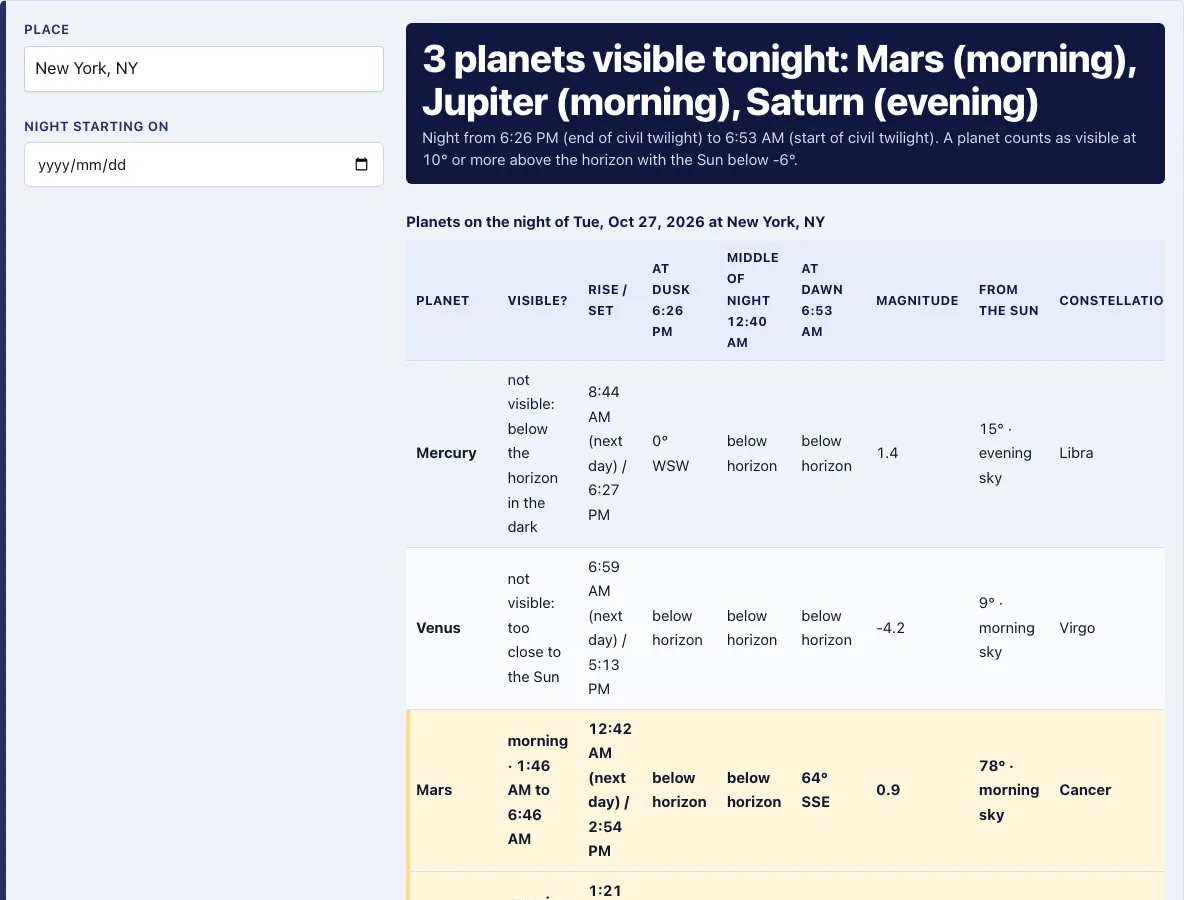
- Open Place and choose a dark-sky place, a US city or a world city, or pick My location (this device). For an exact spot choose Custom coordinates and enter Latitude, Longitude and Time zone.
- Set Night starting on. It starts on today’s date at the place you chose.
- Read the headline, which lists the planets visible to the naked eye with the part of the night.
- In the table, read Visible? for each planet with its first and last visible time, and Rise / set for planning.
- Compare the At dusk, Middle of night and At dawn columns: height in degrees and compass direction.
- Check Magnitude, From the Sun (angle from the Sun and morning or evening sky) and Constellation.
- Under Close pairs, see any planet within 5 degrees of the Moon or of another planet.
- In Sky chart drag the Time slider from one hour before dusk to one hour after dawn. It starts at the current time when you look at tonight.
The highlighted rows are the naked-eye planets that are visible. Uranus and Neptune carry the label telescope. Rise and set times that fall after midnight carry the note (next day), and the From the Sun column also says whether the planet is in the morning or the evening sky. If the Sun never gets below 6 degrees, the page says there is no dark sky instead of listing planets.
What planets are visible tonight from my location?
A planet is visible tonight if it reaches 10 degrees above the horizon at some moment between the end of evening civil twilight and the start of morning civil twilight, when the Sun is below 6 degrees. The tool samples every 10 minutes with standard refraction and gives one of these results for each planet.
| Visible? | What it means |
|---|---|
| evening | Up in the first 90 minutes of the night and gone before the middle of the night |
| dusk to (time) | Up in the first 90 minutes, still up after the middle of the night, gone before the last 90 minutes |
| (time) to dawn | Not up in the first 90 minutes, rises to 10 degrees before the middle of the night and stays until dawn |
| morning | Up in the last 90 minutes, and only after the middle of the night |
| all night | Up in both |
| late evening to early morning | Up only in the middle of the night |
| not visible: too close to the Sun | Less than 15 degrees from the Sun |
| not visible: below the horizon in the dark | Never reaches 10 degrees while it is dark |
“Dusk” and “dawn” are the ends of civil twilight, and “middle of night” is the midpoint between them, which is not solar midnight.
Is Jupiter visible tonight?
Read the Jupiter row for your night. It says whether Jupiter gets above 10 degrees in the dark and from what time. For New York on the night starting 2026-10-24 (civil night 6:31 PM to 6:50 AM) the five planets look like this.
| Planet | Result | Key numbers |
|---|---|---|
| Saturn | dusk to 4:31 AM | magnitude 0.3, Cetus, 14° up in the east at dusk, 47° up in the south-southwest at midnight |
| Mars | morning, from about 1:51 AM | magnitude 0.9, Cancer |
| Jupiter | morning, from about 2:31 AM | magnitude -2.0, Leo |
| Venus | not visible, too close to the Sun | 7° from the Sun, near inferior conjunction |
| Mercury | not visible | below 10° throughout the dark |
Why can’t I see Venus when it is so bright?
Because it is too close to the Sun. Venus can be the brightest planet and still be lost in the glare or below the horizon in the dark. When a planet is less than 15 degrees from the Sun the tool says “too close to the Sun”. On 2026-10-24 Venus is 7 degrees from the Sun, near inferior conjunction: it is passing between Earth and the Sun, so we look at its mostly unlit side.
What does the sky chart show?
It shows the whole sky as a circle with north at the top and east on the left, as you see it lying on your back and looking up. The outer circle is the horizon and the centre is straight overhead. The Moon and each planet above the horizon are drawn where they are at the time on the slider, and the background darkens as the Sun sinks. Planets below the horizon are listed under the chart.
What does magnitude mean?
Magnitude is brightness at the middle of the night, and smaller numbers, including negative ones, are brighter. Jupiter at -2.0 outshines Saturn at 0.3, and the naked eye reaches about 6 under a dark sky, so Uranus (about 5.6) is a marginal case and Neptune (about 7.8) needs optical help.
How this tool works and where the numbers come from
Planet positions, magnitudes, elongation and constellations from astronomy-engine (VSOP87 theory), checked against PyEphem: altitude within 0.2 degrees, azimuth within 0.3 degrees, elongation within 0.3 degrees, constellations identical, magnitudes within 0.4 (Venus 0.7, a different brightness model). Visibility rule and dusk/dawn definitions as stated on the page.
Sources
Frequently asked questions
Which planets are visible tonight?
It depends on your place and date, so the tool checks the night you choose instead of giving a fixed list. A planet marked evening, morning, all night or with a time range is above 10 degrees in the dark at some point.
Does the tool cover Uranus and Neptune?
Yes. They have rows with the same columns and the label “telescope”, because they are too faint to count as easy naked-eye targets.
Can I see planets from a city?
The five bright planets are easy to pick out even under city lights when they are well above the horizon, as steady points that do not twinkle much. Uranus and Neptune are not.
Why does a rise or set time say “(next day)”?
Rise and set are the first ones after local noon of the chosen date. When one falls after midnight the tool adds “(next day)”.
How accurate are the positions?
They come from the astronomy-engine library. Checked against PyEphem, heights agree within 0.2 degrees, angles from the Sun within 0.3 degrees and constellations exactly; magnitudes agree within 0.4, except Venus, where the two brightness models differ by up to 0.7.
Why does the tool say “No dark sky here tonight”?
Where the Sun stays above 6 degrees below the horizon, for example Tromso in June, no planet can be seen against a dark sky. Where it stays below that line all day, for example Longyearbyen in December, all 24 hours count as night.
Planets are easier to place once you know the Moon and the darkness. Moon tonight gives the Moon’s phase and its rise and set, and Moonrise and moonset calculator covers any date. Astronomical twilight calculator tells you when the sky is fully dark. Meteor shower tonight adds any active shower. Star map generator draws the stars around the planets, Solar system simulator shows where the planets are in their orbits, and Stargazing calendar and Eclipse calendar look further ahead.
Planning a trip? The Night Gaze Camp app ranks campgrounds by tonight’s moonlight, clouds and sky darkness.