
Next Solar Eclipse
Pick a place to see the next six solar eclipses and what you would see of each: timing, coverage and totality.
Free · runs in your browser · nothing is uploaded
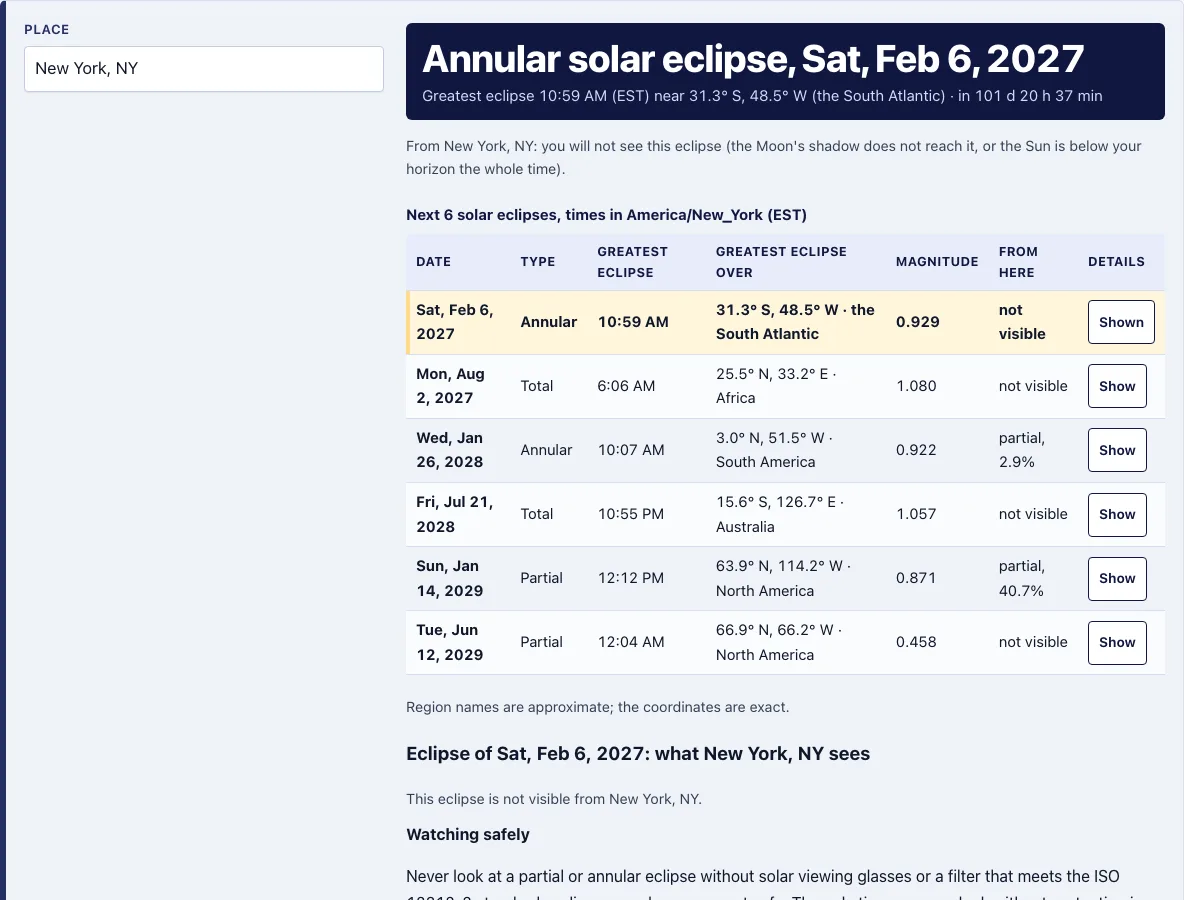
How to use the Next Solar Eclipse tool
- Open the Place list and pick a dark-sky park, a US city, a world city or My location (this device). Times use that place’s time zone.
- If your spot is missing, choose Custom coordinates and enter Latitude, Longitude and Time zone.
- Read the top card: type and date of the next eclipse, greatest eclipse time, its latitude and longitude with a rough region, and a countdown.
- Read the sentence under the card. It says what your place sees: nothing, a partial eclipse with its coverage, or totality or a ring.
- Scan the table. Columns: Date, Type, Greatest eclipse, Greatest eclipse over, Magnitude, From here and Details. From here is the quickest column: it reads not visible, partial with a percentage, or total or annular with a duration.
- Press Show on a row for the local circumstances: partial begins (C1), totality or ring begins (C2), maximum, ends (C3) and partial ends (C4), each with the Sun’s altitude and whether it is above the horizon.
- Read Watching safely below the table before you plan to look at the Sun, and follow its link to NASA’s eclipse safety page for what a safe solar viewer looks like.
- Press Copy link to share your place and the eclipse you opened. The link keeps both, so the person who opens it sees the same local timings.
What are the next 5 upcoming solar eclipses?
After 24 October 2026 the next five are 6 February 2027 (annular), 2 August 2027 (total), 26 January 2028 (annular), 22 July 2028 (total) and 14 January 2029 (partial). The sixth, on 12 June 2029, is also partial.
| Date | Type | Greatest eclipse near |
|---|---|---|
| 6 Feb 2027 | Annular | 31.3 S 48.5 W, South Atlantic |
| 2 Aug 2027 | Total | 25.5 N 33.2 E, Egypt (6 min 23 s on the central line) |
| 26 Jan 2028 | Annular | 3.0 N 51.5 W, Amapá, northern Brazil |
| 22 Jul 2028 | Total | 15.6 S 126.7 E, northwest Australia |
| 14 Jan 2029 | Partial | 63.9 N 114.2 W, northern Canada |
Where will the next total solar eclipse be?
On 2 August 2027, with greatest eclipse at 25.5 N 33.2 E in Egypt and totality of 6 minutes 23 seconds on the central line. Totality covers the Sun only inside a narrow path; everyone else around it sees a partial eclipse.
Will there be a solar eclipse on February 17, 2026?
There was: an annular eclipse over Antarctica, with greatest eclipse near 65 S 87 E and a magnitude of 0.964, so the Moon’s disc spanned 96% of the Sun’s and left a thin ring.
How do I read the numbers for one place?
Take the total eclipse of 12 August 2026, greatest eclipse near 65 N 25 W off Iceland. Reykjavik was inside the path: totality of about one minute at 17:48:37 UT (near the edge of the path the length is sensitive to the Moon’s exact radius, so it can differ by a few seconds between calculations) with the Sun 25 degrees high. London saw a partial eclipse with 91% of the Sun’s area covered at 18:13 UT, Paris 92%, New York about 9%. Obscuration is the share of the Sun’s area covered; magnitude is the share of its diameter covered, and inside the path of totality or annularity it is the ratio of the Moon’s and Sun’s diameters (NASA convention), so above 1 means the Moon looks larger than the Sun. Greatest eclipse is the moment the Moon’s shadow axis passes closest to the centre of Earth, about 17:46 UT on that date (NASA’s catalogue lists 17:47:06 in Terrestrial Dynamical Time, which it puts 75 seconds ahead of UT, so 17:45:51 UT; this page computes 17:45:47 UT).
When is the next solar eclipse after 2026?
The first after the end of 2026 is the annular eclipse of 6 February 2027, greatest eclipse at 16:00 UT over the South Atlantic. In the whole of 2027 there are two solar eclipses, the annular one in February and the total one on 2 August. In 2028 there are two more, the annular eclipse of 26 January and the total eclipse of 22 July. Most places on Earth see one of them only as a small partial eclipse or not at all, which is why the From here column matters more than the date.
What is an annular solar eclipse?
The Moon is too far from Earth to cover the whole Sun, so a ring of sunlight stays visible around it. The four types differ in what the Moon’s shadow does to Earth:
| Type | What happens | Magnitude at greatest eclipse |
|---|---|---|
| Total | The Moon is close enough to hide the Sun along a narrow path | 1 or more |
| Annular | The Moon is too far away and leaves a ring of Sun | below 1 |
| Hybrid | Annular at the ends of the path, total in the middle (the 14 November 2031 eclipse) | around 1 |
| Partial | The shadow axis misses Earth, so nobody sees totality or a ring | below 1 |
Every central eclipse is also partial over a region thousands of kilometres wide, so a place just outside the path still sees most of the Sun covered. That is why the tool reports obscuration for every place, not only for places on the path.
How this tool works and where the numbers come from
Eclipses and local circumstances come from astronomy-engine. Hybrid (annular-total) classification, magnitudes and Saros series are added with our own geometry and checked against NASA’s Five Millennium Catalog of Solar Eclipses for all 454 eclipses of 1900 to 2100 (type, date, Saros), and local totality duration, Sun altitude and diameter ratio against NASA’s central-line path tables. Annular durations can differ from NASA’s by up to 2% because of different Sun and Moon radius conventions.
Sources
- NASA Eclipse Web Site (Fred Espenak), Five Millennium Catalog of Solar Eclipses 2001 to 2100
- NASA Eclipse Web Site, Path of the Total Solar Eclipse of 2024 Apr 08 (central line table)
- NASA, Eclipse safety (ISO 12312-2 solar viewers)
- astronomy-engine (Don Cross), the Sun and Moon position library used for every calculation
Frequently asked questions
Is it safe to look at a solar eclipse?
Not during partial or annular phases without solar viewing glasses or a filter that meets ISO 12312-2; ordinary sunglasses are not safe. Only during totality, when no bright Sun shows, can you look unprotected. Cameras, binoculars and telescopes need filters on the front.
What time is the next solar eclipse?
It depends on where you are. The tool converts each time to the zone of your place; the 6 February 2027 eclipse reaches greatest eclipse at 16:00 UT, over the South Atlantic.
Why does the tool say the Sun is below the horizon?
A place counts as seeing an eclipse only if the Sun is above its horizon at some point. If the maximum falls before sunrise or after sunset, you only see the part with the Sun up.
Does it include weather?
No. Check a forecast before you travel for an eclipse.
Can I use it for a place that is not in the list?
Yes. Choose Custom coordinates, enter Latitude, Longitude and Time zone, and every row of the table is recalculated for that spot.
What does the countdown count to?
To the moment of greatest eclipse, when the Moon’s shadow axis passes closest to the centre of Earth, not to the first contact at your place; the detail table shows your own start time.
How accurate are the types and times?
Types, dates and Saros numbers match NASA’s catalog for all 454 eclipses from 1900 to 2100. Totality duration, Sun altitude and diameter ratio match NASA’s central-line tables; annular durations can differ by up to 2%.