
Next Lunar Eclipse
Pick a place to see the next eight lunar eclipses with contact times and whether the Moon is above your horizon.
Free · runs in your browser · nothing is uploaded
How to use the Next Lunar Eclipse tool
- Open the Place list and pick a dark-sky park, a US city, a world city or My location (this device). Times switch to that place’s time zone.
- For a spot that is not listed, choose Custom coordinates and fill in Latitude, Longitude and Time zone.
- Read the top card: type and date of the next eclipse, greatest eclipse time, a countdown and the verdict for your place.
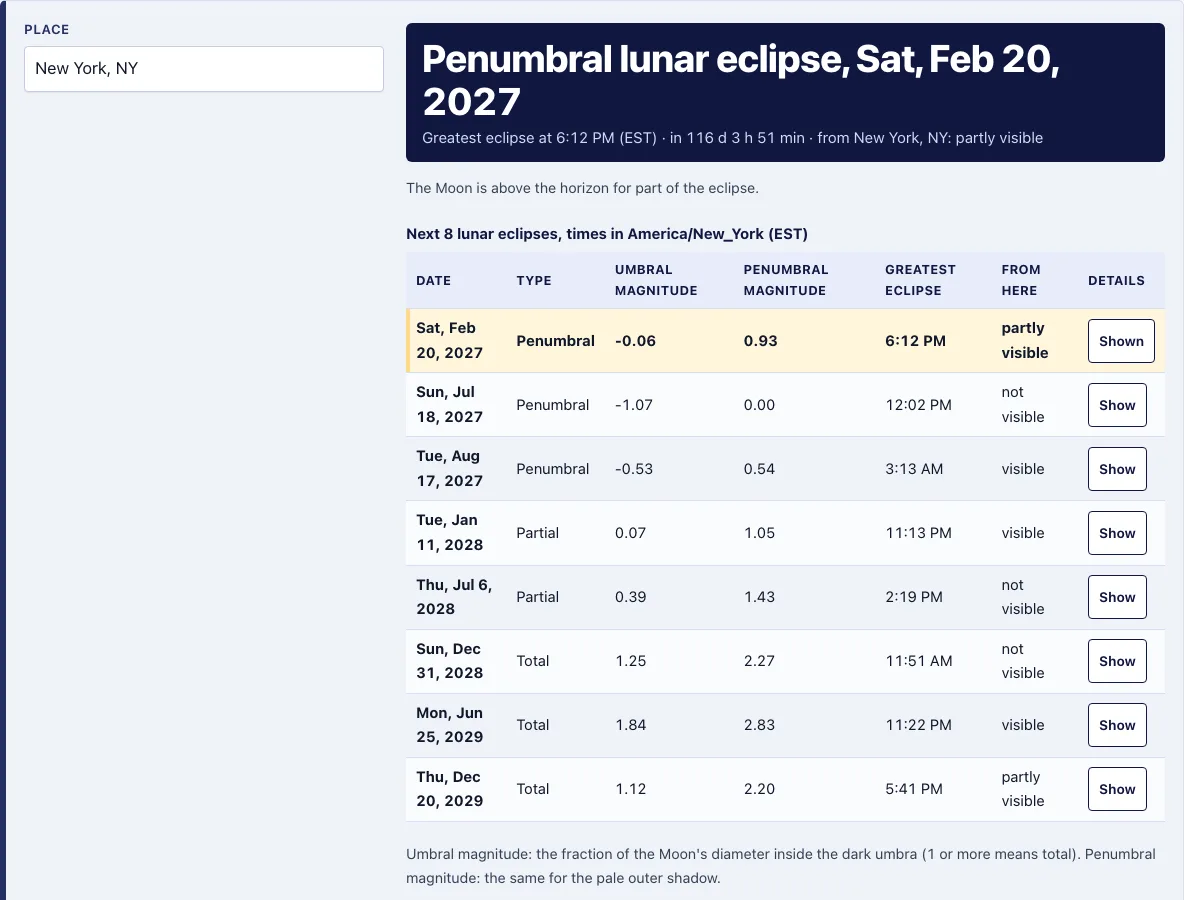
- Scan the table. Its columns are Date, Type, Umbral magnitude, Penumbral magnitude, Greatest eclipse, From here and Details.
- Press Show on a row to open that eclipse. The detail table gives the contact times P1, U1, U2, greatest eclipse, U3, U4 and P4, each with the Moon’s altitude and whether it is above or below the horizon.
- Look at the diagram under it, The Moon’s path through Earth’s shadow. North is up; for places south of the equator it is turned upside down to match the sky there.
- Press Copy link to send the same place and eclipse to someone else.
Changing the place changes the time zone and the From here column together, so you can compare a few cities in a minute. The Show button also highlights the chosen row, so you always know which eclipse the detail table and diagram belong to.
What is the next lunar eclipse?
The next lunar eclipse is the first row of the table: the earliest full moon after today on which the Moon crosses Earth’s shadow. Earth’s shadow has a dark core, the umbra, and a pale outer ring, the penumbra. Umbral magnitude is the share of the Moon’s diameter inside the umbra; penumbral magnitude is the same for the outer ring.
| Type | Umbral magnitude | What you see |
|---|---|---|
| Penumbral | below 0 | Only the pale shadow. The Moon dims slightly; most people notice nothing. |
| Partial | 0 to 1 | A dark bite of the Moon sits inside the umbra. |
| Total | 1 or more | The whole Moon is inside the umbra and turns copper red. |
Is March 3, 2026 a Blood Moon?
Yes, that was a total lunar eclipse, and a total eclipse is popularly called a Blood Moon because sunlight bent through Earth’s atmosphere tints the Moon copper. Its umbral magnitude was 1.15 and totality lasted 58 minutes. The contact times, in UT:
| Contact | Time (UT) |
|---|---|
| Penumbral begins (P1) | 08:44 |
| Partial begins (U1) | 09:50 |
| Total begins (U2) | 11:04 |
| Greatest eclipse | 11:34 |
| Total ends (U3) | 12:03 |
| Partial ends (U4) | 13:17 |
| Penumbral ends (P4) | 14:23 |
From New York the Moon sank to 4 degrees at the start of totality and was at -6 degrees by its end, so the eclipse was partly visible there. From London it was not visible at all.
What is the lunar eclipse calendar after 2026?
The six eclipses after 24 October 2026 are: 20 Feb 2027 penumbral (magnitude 0.93), 18 Jul 2027 penumbral (a graze at 0.001), 17 Aug 2027 penumbral (0.54), 12 Jan 2028 partial (umbral magnitude 0.07), 6 Jul 2028 partial (0.39) and 31 Dec 2028 total (1.25, with 71 minutes of totality from 16:16 to 17:28 UT).
Where will a lunar eclipse be visible?
Everywhere on the night side of Earth where the Moon is above the horizon. The tool calls an eclipse visible when the Moon stays up for the whole umbral phase, or the whole penumbral phase of a penumbral eclipse, and partly visible when it rises or sets in between.
How this tool works and where the numbers come from
Eclipses are found with astronomy-engine. Magnitudes and contact times use Earth’s shadow enlarged by 1% for the atmosphere (the Espenak/NASA convention), fitted and then checked against NASA’s Five Millennium Catalog of Lunar Eclipses for all 459 eclipses of 1900 to 2100: types, dates and Saros numbers match, magnitudes agree within 0.002 and contact times within about a minute. Visibility is the Moon’s altitude above the horizon with standard refraction.
Sources
Frequently asked questions
How many lunar eclipses will there be in 2026?
Two: the total eclipse of 3 March and the partial eclipse of 28 August.
What time is the next lunar eclipse?
Greatest eclipse of the 20 February 2027 penumbral eclipse is at 23:13 UT, which is 6:13 PM in New York. The tool shows every time in the time zone of the place you pick, so check that zone before you set an alarm.
Can you see a penumbral lunar eclipse without a telescope?
Usually not. The Moon only passes through the pale outer shadow and dims slightly, so most people notice no change. The tool still lists it and tells you whether the Moon is up.
Is a lunar eclipse safe to look at?
Yes. Unlike a solar eclipse, a lunar eclipse needs no eye protection; binoculars add detail but are optional.
What is the difference between a lunar and a solar eclipse?
In a lunar eclipse the Moon moves into Earth’s shadow at full moon and everyone on the night side can see it. In a solar eclipse the Moon’s shadow falls on Earth at new moon and only a small region sees it at full strength.
How many lunar eclipses are there in a year?
Between two and three in the years 2026 to 2035, according to the Eclipse Calendar; 2026 has two, 2027 and 2028 have three each.
How accurate are the times?
The calculation was checked against NASA’s catalog for all 459 lunar eclipses from 1900 to 2100: types and dates match, magnitudes agree within 0.002 and contact times within about a minute. Weather and local hills are not considered.