
New Moon Calendar
Choose a year and a place to see every new moon, a countdown to the next one and the darkest nights around each.
Free · runs in your browser · nothing is uploaded
How to use the New Moon Calendar
- Enter a year in the Year box. The range is 1900 to 2100, and the box starts on the current year.
- Click Previous year or Next year to move through the years one at a time.
- Open the Place list and choose a dark-sky park, a US or world city, my location, or custom coordinates. The place sets the time zone, so every time on the page matches that location.
- Read the countdown at the top of the page. It shows the next new moon in days, hours and minutes.
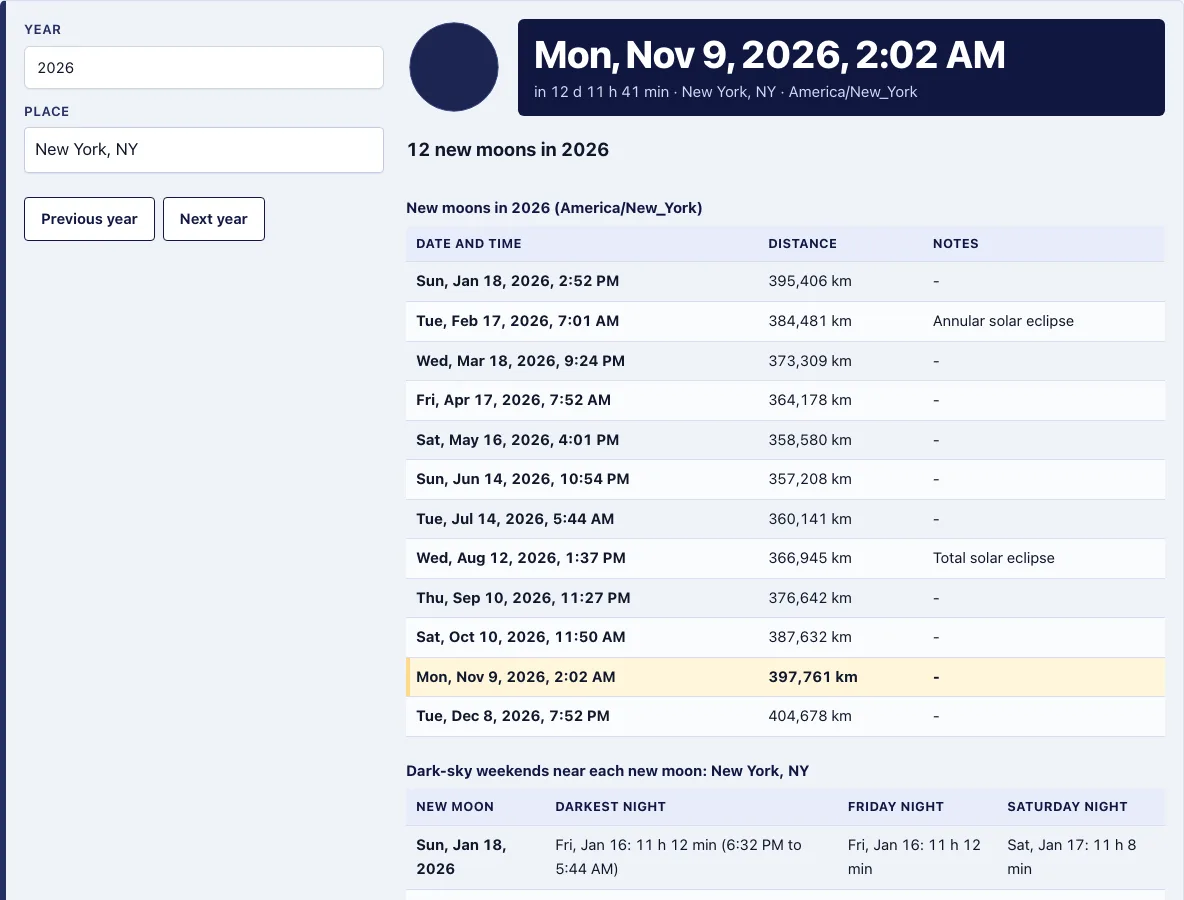
- Check the table New moons in your chosen year. It lists the Date and time of each new moon, its Distance from Earth, and a Notes column that flags solar eclipses.
- Check the table Dark-sky weekends near each new moon. Its columns are New moon, Darkest night, Friday night and Saturday night.
- In each cell, read the hours and minutes of Moon-free dark time. The Darkest night cell also gives the time window, for example from 6:16 PM to 5:08 AM.
- Change the Place to compare camping spots. The dark hours depend on latitude and longitude, so a far-north place can show No astronomical darkness in summer.
Use the Copy link button to share the page with the year and place already set. Click Print to make a paper copy of the tables.
What are the New Moon dates for 2026?
2026 has 12 new moons, one in each month. The times below are in New York time. The first falls on 18 January at 2:53 PM and the last on 8 December at 7:53 PM. Other places show the same instants at different clock times.
| New moon (New York time) | Notes |
|---|---|
| Sun 18 Jan, 2:53 PM | |
| Tue 17 Feb, 7:02 AM | Annular solar eclipse |
| Wed 18 Mar, 9:24 PM | |
| Fri 17 Apr, 7:52 AM | |
| Sat 16 May, 4:02 PM | |
| Sun 14 Jun, 10:55 PM | |
| Tue 14 Jul, 5:44 AM | |
| Wed 12 Aug, 1:37 PM | Total solar eclipse |
| Thu 10 Sep, 11:27 PM | |
| Sat 10 Oct, 11:51 AM | |
| Mon 9 Nov, 2:03 AM | |
| Tue 8 Dec, 7:53 PM |
What is a dark-sky weekend?
A dark-sky weekend is a Friday or Saturday night near a new moon when the sky is at its darkest. The tool checks the three nights before and the three nights after each new moon, which always include one Friday and one Saturday, and names the darkest of the seven nights.
A night runs from local noon to the next local noon. The tool counts the Moon-free dark time: the minutes when the Sun is more than 18 degrees below the horizon (astronomical darkness) and the Moon is also below the horizon. The figures are accurate to about 4 minutes.
For New York and the new moon of 9 November 2026, the nights compare like this:
| Night | Moon-free dark time |
|---|---|
| Friday 6 Nov | 10 h 36 min |
| Saturday 7 Nov | 10 h 44 min |
| Wednesday 11 Nov (darkest) | 10 h 52 min, from 6:16 PM to 5:08 AM |
The darkest night is not always a weekend, and not always the night of the new moon. Here the nights from 7 to 11 November are within 8 minutes of each other, about the size of the 4-minute sampling plus the slow lengthening of November nights, so they are about equally dark; the tool names 11 Nov only because its count is highest. For the first few nights after a new moon, the thin evening crescent sets during twilight and takes nothing from the dark hours. The loss starts a few nights later, as the crescent sets about 50 minutes later each night: on 13 November it is up until about 7:48 PM and the night loses 1 h 32 min. The season matters too. For the new moon of 14 June 2026, New York’s darkest night has only 4 h 44 min of dark (10:36 PM to 3:20 AM) because summer nights are short. The new moon of 8 December gives 11 h 24 min. Far north in summer, such as Tromso in June, the table shows “No astronomical darkness”, and if the Moon stays up through all the dark hours it shows “Moon up all night”.
How this tool works and where the numbers come from
New moon times come from astronomy-engine (Moon and Sun at the same ecliptic longitude), shown in the time zone of the chosen place. Moon-free dark time of a night is the number of minutes between local noon and the next local noon with the Sun more than 18 degrees below the horizon and the Moon’s upper limb below the horizon, sampled every 4 minutes and compared with an independent program (PyEphem). Solar eclipse flags use astronomy-engine and were compared with the NASA Five Millennium Catalog of Solar Eclipses for 1900 to 2100 (454 eclipses; eight borderline central eclipses with gamma beyond 0.995 come back as partial).
Sources
Frequently asked questions
Which is the next New Moon?
The next new moon is the first one after the current date for the place you choose. The tool shows it at the top of the page with a countdown in days, hours and minutes. To see the full list for a year, change the Year box or use the year buttons.
Is February 17, 2026 a New Moon?
Yes. The new moon falls on 17 February 2026 at 7:02 AM New York time. It is an annular solar eclipse, which is visible only from a narrow track or a remote region, so most places will not see it.
What does the solar eclipse flag mean?
The flag in the Notes column means a solar eclipse happens somewhere on Earth at that new moon. It does not mean you can see it from your place. A hybrid eclipse is shown as either annular or total. In 2026 the flags fall on 17 February (annular) and 12 August (total).
Why is the darkest night sometimes not a weekend?
The darkest night is the one with the most Moon-free dark minutes, and it can fall on any of the seven nights checked. Moonrise moves about 50 minutes later each night, and the crescent after a new moon sets later each night, so from about three nights after the new moon the evenings lose dark time; before it, the waning crescent rises late in the dark hours. Check the Darkest night column rather than assuming a weekend is best.
How far away is the Moon at a new moon in 2026?
The Moon’s distance at new moon ranges from 357,208 km on 14 June to 404,678 km on 8 December 2026. The distance appears in the Distance column for each new moon. A closer Moon is slightly larger in the sky, but it still gives no light at new moon.
Does the place I choose change the results?
Yes. The place sets the time zone, so the clock times change, and it also changes how long the sky stays dark. Latitude matters most: far north in summer, the table may show “No astronomical darkness” for a place that has dark nights in winter.
Related tools
- Full Moon Calendar: use it to find full moon dates and their traditional names.
- Moon Phase Calendar: use it to see every phase of the Moon for each day.
- Moon Tonight: use it to check how bright the Moon is tonight.
- Moonrise Moonset Calculator: use it to get Moon rise and set times at your campsite.
- Milky Way Calendar: use it to pick the best nights to photograph the Milky Way.
- Astronomical Twilight Calculator: use it to find when full darkness starts and ends at your location.
- Next Solar Eclipse: use it to find upcoming eclipse dates and the places where they are visible.
- Stargazing Calendar: use it to see what is worth observing on each night.
Planning a trip? The Night Gaze Camp app ranks campgrounds by tonight’s moonlight, clouds and sky darkness, so a new moon weekend turns into a real campsite.