
Moonrise Moonset Calculator
Choose a place and a date to see when the Moon rises, crosses the sky and sets, and in which direction.
Free · runs in your browser · nothing is uploaded
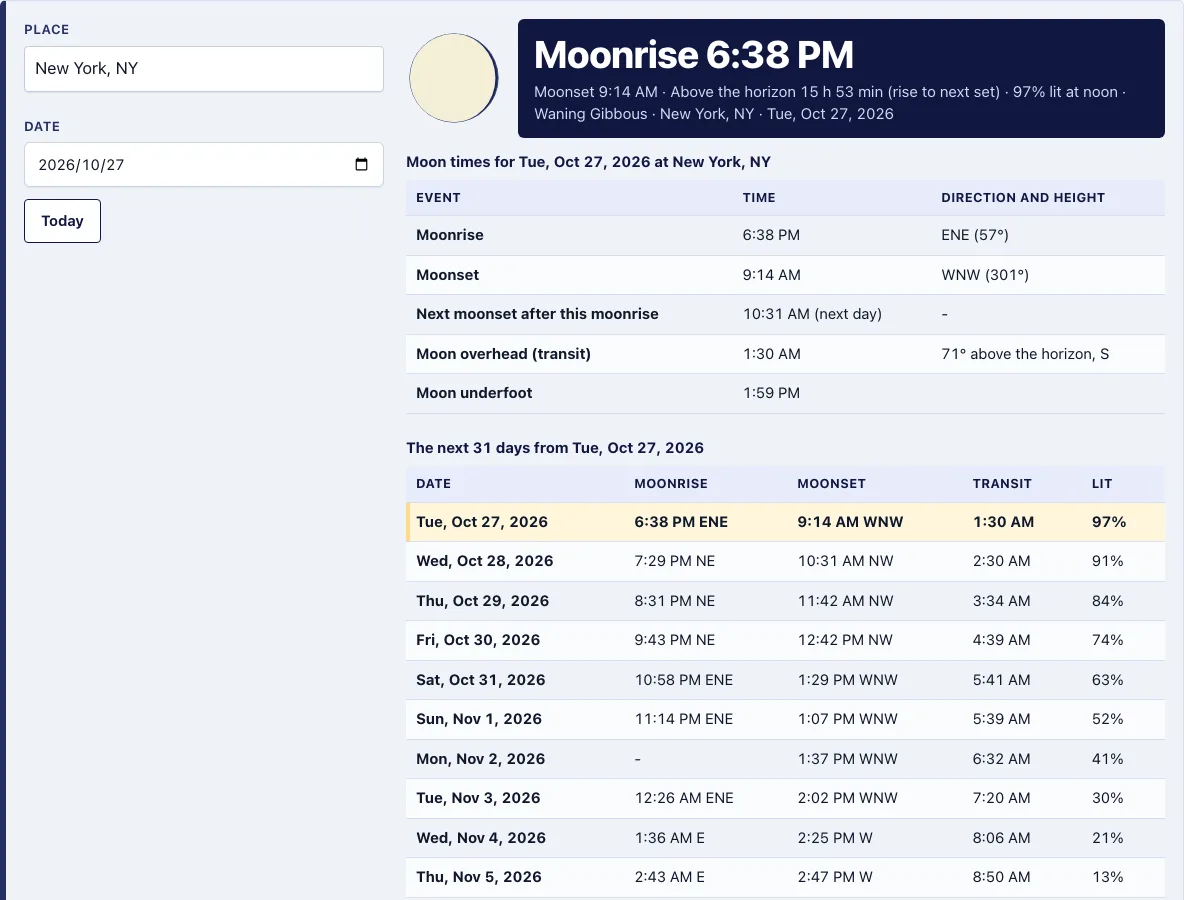
How to use the Moonrise Moonset Calculator
- Open the Place list and choose a dark-sky park, a US or world city, My location, or custom coordinates.
- Type a date in the Date box. To jump to today, press Today.
- Read the headline. It shows the moonrise time, the moonset time, how long the Moon is above the horizon, the lit percentage at 12:00 and the phase name.
- Find the table titled Moon times for your date. Check the rows Moonrise, Moonset, Moon overhead (transit) and Moon underfoot. Each direction appears as a 16-point compass name with the azimuth in degrees.
- If the Moon rises that day, read Next moonset after this moonrise. It adds (next day) when that set falls on the following date.
- Scroll to The next 31 days from your date. Use the Moonrise, Moonset, Transit and Lit columns to plan ahead. A dash means that day has no rise or no set.
- Change the Date to look at another day. The 31-day table always starts on the date you choose, and the first row is highlighted.
- Pick a place south of the equator and the Moon picture is turned the way that hemisphere sees it. Near the poles the headline can say the Moon is up, or below the horizon, all day.
The Copy link button copies a link you can share, and Print table prints the table so you can take it outdoors.
When does the Moon rise tonight?
Tonight’s moonrise is the Moonrise value for today’s date at your chosen place. Select the place, press Today, and read the headline or the Moonrise row. The rise happens about 50 minutes later each night, so the time shifts from one evening to the next.
The Moon moves around Earth in the same direction that Earth turns, so it has to travel a little further each day before it appears above the horizon. Phoenix on 23 November 2026 shows the result:
| Phoenix, 23 Nov 2026 | Value |
|---|---|
| Moonrise | 4:27 PM, ENE, 62 degrees |
| Moonset | 6:07 AM, WNW, 296 degrees |
| Moon overhead (transit) | 11:50 PM, 81 degrees above the horizon |
| Time above the horizon | 14 h 55 min, from moonrise to the next moonset |
The next evening, the moonrise is 5:19 PM, which is 52 minutes later. The next moonset, at 7:22 AM on 24 November, ends that stay above the horizon.
Why is there no moonrise some days?
Some calendar days have no moonrise because the Moon rises about 50 minutes later each day. Because each rise is later than the one before, once a lunar month a rise slips past midnight into the next date, so one calendar day gets no rise at all. Moonset can skip a day in the same way, and the 31-day table shows a dash on those days.
New York on 2 November 2026 is a clear example. The Moon rises at 11:14 PM on 1 November, and the next rise is at 12:26 AM on 3 November. Nothing rises on 2 November, so the tool shows no moonrise for that date.
What counts as moonrise, and which way does the Moon rise?
Moonrise is the moment the upper edge of the Moon appears at the horizon. The calculator uses standard atmospheric refraction of 34 arcminutes, which bends light upward so the Moon is seen slightly before it geometrically reaches the horizon. With the Moon’s apparent radius of about a quarter of a degree, the centre of the Moon is roughly 0.8 degrees below the horizon at the moment of rise. Real horizons with hills, trees or buildings will shift what you see by minutes.
The compass direction is the azimuth of the Moon at that moment, measured from north through east. The Moon follows a path close to the Sun’s, but tilted by about five degrees, so over a month it rises from a more northerly to a more southerly point on the horizon and back, and the width of that swing changes over an 18.6-year cycle.
How this tool works and where the numbers come from
Positions come from astronomy-engine. Moonrise and moonset are the moments the Moon’s upper limb meets the horizon with standard refraction of 34 arcminutes, topocentric, at sea level; transit is hour angle zero. Every event is assigned to the local calendar day of the chosen place’s time zone. Rise, set, transit and lower transit times were compared with PyEphem for 8 places and 5 dates and agree within about a minute.
Sources
Frequently asked questions
Which direction does the Moon rise?
A rising Moon appears in the east half of the sky and a setting Moon in the west half. The exact moon azimuth depends on the Moon’s declination, so it changes from night to night. From New York in November 2026, rise azimuths stay between about 53 and 128 degrees.
How long is the Moon up?
The Moon is up from one moonrise to the next moonset. The headline shows this length in hours and minutes. The row Next moonset after this moonrise gives the set that ends that stay, and it can fall on the following day.
Can the Moon stay up or down all day?
Yes, near the poles the Moon can stay above or below the horizon for a whole day. In Tromso on 22 December 2026 the Moon is up all day. In Tromso on 10 December 2026 and Reykjavik on 5 March 2024, it stays below the horizon all day. The tool prints a plain message in place of times.
Why can moonset come before moonrise on the same date?
A rise is listed under the calendar day it happens on, so a set earlier that day can appear above the rise. In Phoenix on 23 November 2026, the moonset at 6:07 AM comes before the 4:27 PM moonrise. To find the set that ends your time above the horizon, use the Next moonset row.
How accurate are the times?
Each time is when the upper edge of the Moon touches the horizon, using standard atmospheric refraction of 34 arcminutes, at sea level, in the time zone of the place you chose. Hills and buildings change what you actually see. Times were checked against the PyEphem program for 8 places and 5 dates, and rise, set, transit and underfoot times agree within about a minute.
Why does the Moon picture look turned around?
The Moon picture is turned for places south of the equator, which matches the view from there. The lit percentage is the share of the disc that is lit at 12:00 local time.
Related tools
- Moon Tonight: check the phase and moonrise for tonight.
- Moon Phase Today: see the phase for today’s date.
- Moon Phase Calendar: browse the phases for a whole month.
- Full Moon Calendar: find the dates of each full moon.
- New Moon Calendar: plan dark-sky nights around the new moon.
- Solunar Calendar: look up periods based on Moon rise, set and transit.
- Astronomical Twilight Calculator: find when the sky gets dark enough for stargazing.
- Moon Phase On My Birthday: see what the Moon looked like on your birthday.
Out in the field? The Night Gaze Camp app ranks campgrounds by tonight’s moonlight, clouds and sky darkness, with the Moon’s rise and set already worked in.