
Moon Phase Today
The Moon right now in your time zone: phase, percent lit, age, distance and the next four main phases with countdowns.
Free · runs in your browser · nothing is uploaded
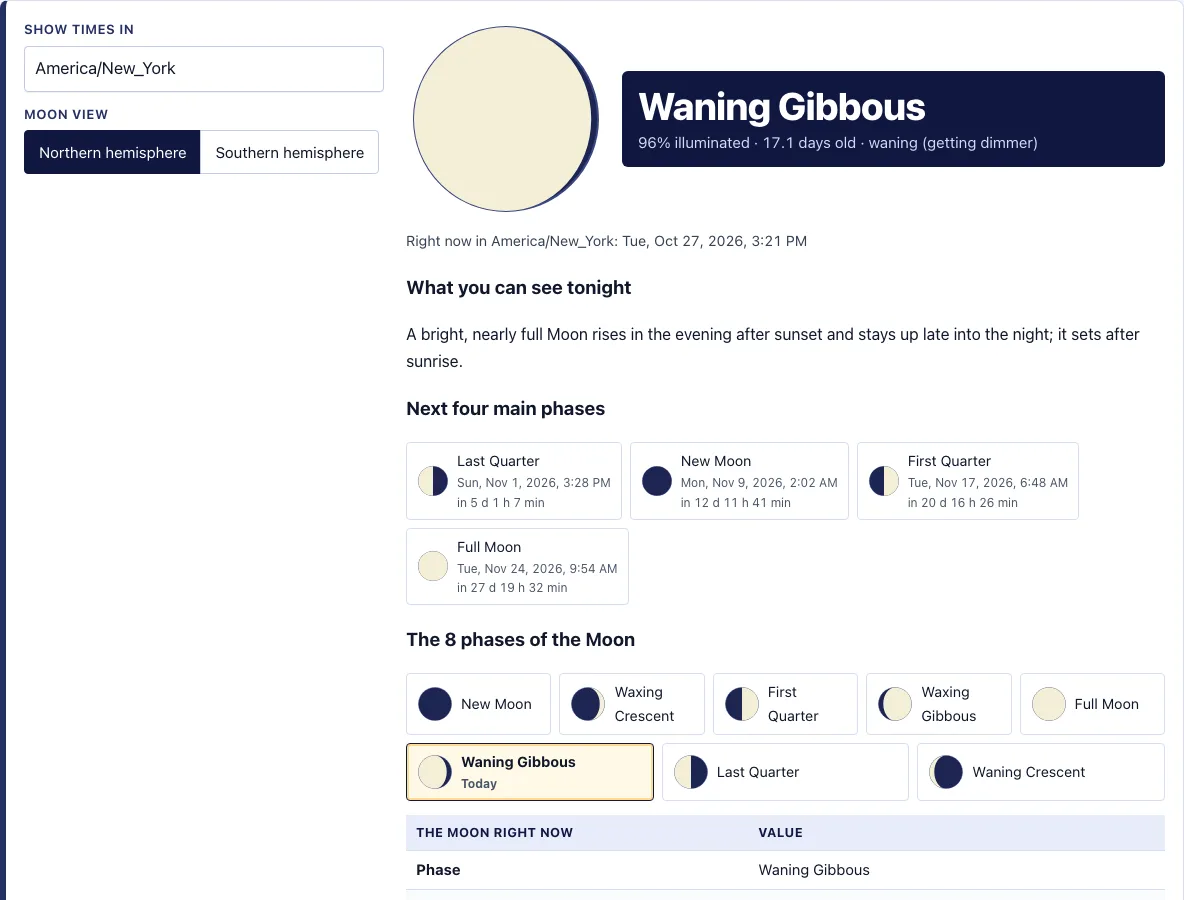
How to use the Moon Phase Today tool
- Open Show times in and pick your time zone. The list starts on the zone your browser reports, so you may not need to change it.
- Check Moon view. It is preselected as Northern or Southern hemisphere from your zone; switch it if you are watching from the other side of the equator.
- Read the large Moon image, the phase name, the percent illuminated, the age in days and the waxing or waning label.
- Check the line “Right now in” followed by your zone and the date and time, to confirm which moment you are reading.
- Read What you can see tonight for one sentence on the current phase.
- Scan Next four main phases for the local date, time and countdown of each, such as “in 1 d 1 h 15 min”.
- Use The 8 phases of the Moon to see where today sits in the cycle; the current phase is outlined in gold.
- Open the table The Moon right now for illumination to one decimal, age, distance, apparent size and elongation from the Sun.
Leave the page open: it recalculates by itself every 60 seconds, and the Moon pictures in the next-phase list and the 8-phase strip follow the Moon view you chose, so they are mirrored in the Southern view too. Copy link keeps your zone and view.
What phase is the Moon in today?
The phase is set by the elongation, the angle between the Moon and the Sun measured along the ecliptic: 0 degrees at new moon, 90 at first quarter, 180 at full moon and 270 at last quarter. The page uses the four main names within about 12 hours of the exact moment, which is plus or minus 6.1 degrees, and crescent or gibbous names in between:
| Phase name | Elongation range (degrees) |
|---|---|
| Waxing crescent | 6.1 to 83.9 |
| Waxing gibbous | 96.1 to 173.9 |
| Waning gibbous | 186.1 to 263.9 |
| Waning crescent | 276.1 to 353.9 |
Waxing means the lit part is growing, which is true while the elongation is below 180 degrees; waning means it is shrinking. Age is the time since the last exact new moon. Lunations run between about 29.3 and 29.8 days with an average of 29.53 days, so age stays between 0 and about 29.8. Illumination is 0% at new moon, 50% at the quarters and 100% at full moon, and it changes slowly near new and full moon, so 97% looks much like 99%.
The distance to the Moon varies from roughly 356,000 to 407,000 km. Its apparent diameter is 2 times atan(1737.4 km divided by the distance): about 29.4 arcminutes at the farthest point, 31.08 at the mean distance of 384,400 km and 33.5 at the nearest.
Is it a full moon tonight?
It is when the phase name reads Full Moon, which the page uses within about 12 hours of the exact moment of opposition (elongation 180 degrees, 100% lit). Look at the name rather than the percentage alone: on 24 October 2026 at 12:00 UTC the page reads 96% and Waxing Gibbous, because the full moon was still about 1.7 days away. The instant of full moon is the same worldwide, but the local date can differ between cities.
What is the date of the next full moon?
The first Full Moon row in Next four main phases is the answer, shown in your zone. The four main phases alternate, so a full moon always appears among the next four. For 24 October 2026 at 12:00 UTC the Moon was 13.8 days old, 376,060 km away and 31.8 arcminutes wide, and the list was:
| Next phase | Date and time (UTC) |
|---|---|
| Full Moon | 26 October 2026, 04:12 |
| Last Quarter | 1 November 2026, 20:29 |
| New Moon | 9 November 2026, 07:03 |
| First Quarter | 17 November 2026, 11:48 |
What can you see of the Moon tonight in each phase?
Each phase follows a typical pattern of rising and setting, the same in both hemispheres:
| Phase | Rises | Sets |
|---|---|---|
| New Moon | with the Sun, not visible | with the Sun |
| Waxing crescent | mid-morning | a few hours after sunset |
| First Quarter | around midday | around midnight |
| Waxing gibbous | in the afternoon | after midnight |
| Full Moon | near sunset | near sunrise |
| Waning gibbous | in the evening | after sunrise |
| Last Quarter | around midnight | around midday |
| Waning crescent | after midnight, closer to dawn each day | in the afternoon |
South of the equator the Moon appears upside down compared with the north, so the lit side of a waxing Moon is on the left. The Moon view switch mirrors every image on the page.
How this tool works and where the numbers come from
The elongation (Moon minus Sun ecliptic longitude) and the illuminated fraction come from astronomy-engine for the current minute. Main phases are named within 12 hours of the exact moment (6.1 degrees of elongation), crescent and gibbous names fill the gaps. Age is the time since the last exact new moon. Apparent diameter is 2 atan(1737.4 km / distance). Main-phase times were checked against Fred Espenak’s catalogue.
Sources
- astronomy-engine (Don Cross), the Sun and Moon position library used for every calculation
- Espenak, F. AstroPixels: Phases of the Moon catalogue, 2001 to 2100 (independent check of the main-phase times)
- NASA Goddard Space Flight Center, Moon Fact Sheet (mean radius 1737.4 km, synodic period 29.53 days, apparent diameter)
Frequently asked questions
What is the current moon phase?
It is the name in the headline card beside the large Moon image, such as Waxing Gibbous or Full Moon. It refreshes every 60 seconds, so it matches the time on the “Right now” line.
What is the moon age today?
Moon age is the number of days since the last exact new moon, from 0 at new moon to about 29.8 days just before the next one. The page shows it in the headline card and in the table.
Is the moon phase the same everywhere?
Yes. At one instant the phase is identical everywhere on Earth. Only the local clock time and date change with the time zone you select.
Does waning mean the Moon is shrinking?
No. Waning means the lit part is getting smaller. The Moon’s real apparent size changes only a little with its distance, between about 29.4 and 33.5 arcminutes.
Can the Moon be seen at new moon?
Not in practice. At new moon the Moon is almost in the same direction as the Sun, so its lit side faces away from us and the sky is at its darkest.
Does the page update on its own?
Yes, every 60 seconds, so you can leave it open and watch the illumination and age change.
Related tools
- Moon tonight: rise and set times, direction and the Moon-free dark window for your place.
- When Is the Next Full Moon?: the next full moon and the twelve after it, with their names.
- Moon phase calendar: the phase of every day of a month or a year.
- Moon phase calculator: the phase for any date and time you enter.
- Full moon calendar: every full moon of the year in one list.
- New moon calendar: the darkest nights for faint objects.
- Moonrise and moonset calculator: when the Moon comes up and goes down at your location.
- Next lunar eclipse: when the Moon next passes through Earth’s shadow.
- Moon phase on my birthday: the phase on the day you were born.
Planning a trip? The Night Gaze Camp app ranks campgrounds by tonight’s moonlight, clouds and sky darkness.