
Moon Phase on My Birthday
Enter your birth date to see the Moon on the day you were born, on your next birthdays and when the same phase returns.
Free · runs in your browser · nothing is uploaded
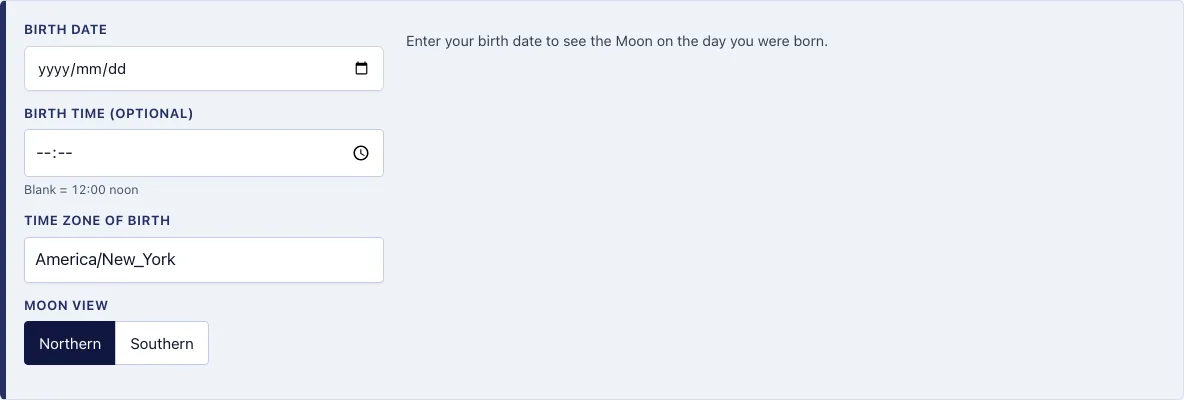
How to use the Moon Phase on My Birthday tool
- Enter your date of birth in Birth date. Years from 1800 to 2100 are accepted.
- Enter Birth time if you know it. Leave it blank and the page uses 12:00 noon.
- Choose Time zone of birth, the zone of the place where you were born, so that the time is read correctly.
- Pick Northern or Southern under Moon view. This only sets the orientation of the Moon pictures.
- Read the headline card: phase, percent illuminated, age in days and waxing or waning, with a Moon image. The note below states the instant used, for example “Moon at Tue, May 15, 1990, 12:00 PM (America/New_York)”, and says when noon was assumed.
- Open Birthdays with the same Moon as the day you were born for the upcoming birthdays that match your birth phase. Each row gives the age, date, phase, percent lit, the difference in days and a “19-year cycle” note.
- Scroll to Moon phase on your next 10 birthdays and to the strip of 101 small Moons from age 0 to 100; the highlighted ones match your birth phase.
Copy link keeps the date, time and zone in the web address. Until a date is entered the page shows a prompt, and an impossible date such as 30 February, a year outside 1800 to 2100 or a time that is not hours and minutes shows a warning instead of a result. The next-birthday table starts with today’s date if today is your birthday.
What was the moon phase on my birthday?
The moon phase on your birthday depends only on your date of birth, not on where you were born. Only the date and time change it, and the time zone decides which calendar date the moment falls on, so a birthday moon phase is the same for everyone born at that instant.
What was my lunar phase at birth?
It is the shape of the lit part of the Moon at the moment you were born, given as a phase name, a percent illuminated and the Moon’s age, the days since the last new moon. The four main names (new, first quarter, full, last quarter) are used within about 12 hours of the exact moment, and crescent or gibbous names fill the gaps.
The phase moves about 12 degrees a day, roughly 3% of the cycle, so the birth time matters: with a blank time the page uses noon and the true phase can differ by up to about 6 degrees. For 15 May 1990 at noon in New York the Moon was Waning Gibbous, 72% lit and 20.5 days old.
How are the next 10 birthdays and the age 0 to 100 strip calculated?
For each age the page takes your birth date in the year you reach that age, at your birth time of day, and computes the Moon at that instant, so each birthday gets its own phase name, percent lit and Moon age. Percent lit rises and falls between 0% and 100% and the age counts days from the last new moon, up to about 29.8. The strip shows all 101 birthdays at once, so you can see at a glance how often a full or new moon falls on your day; each small Moon has its age and a tooltip with the date and phase.
Will the Moon ever look the same on my birthday again?
Yes, and the page lists when. Some birthdays fall within about a day of your birth phase by chance, and every 19 years the match returns by a regular cycle. A match is never exact, so the table shows the difference in days. For the 1990 example the upcoming matches up to age 100 are:
| Age | Birthday | Difference from birth phase | Note |
|---|---|---|---|
| 38 | 15 May 2028 | 1.4 days | 19-year cycle |
| 46 | 15 May 2036 | 0.3 days | |
| 57 | 15 May 2047 | 1.1 days | 19-year cycle |
| 65 | 15 May 2055 | 0.5 days | |
| 76 | 15 May 2066 | 1.3 days | 19-year cycle |
| 84 | 15 May 2074 | 0.1 days | |
| 95 | 15 May 2085 | 1.1 days | 19-year cycle |
What is the 19-year Metonic cycle?
The Metonic cycle is the period after which the Moon’s phases repeat on the same calendar dates: 19 tropical years last 6,939.60 days and 235 synodic months last 6,939.69 days. The page finds it by checking which whole number of years from 1 to 30 comes closest to a whole number of months; 19 years give 235.00.
The repeat is close, not exact. The true Moon runs up to about half a day ahead of or behind its average position, and 19 calendar years contain four or five leap days, so a birthday can be off by up to about two days. A baby born at the minute of the full moon of 25 January 2024 (17:55 UTC) is Full Moon, 100% lit; the 19-year birthdays fall in 2043 (0.5 days off), 2062 (0.7), 2081 (0.7), 2100 (0.4) and 2119 (1.0).
How this tool works and where the numbers come from
The Moon on each birthday is computed at the birth time of day (12:00 local if unknown) with astronomy-engine. A birthday is the same phase when its Moon-Sun elongation is within 12.2 degrees (one day of Moon motion) of the birth value; 19-year multiples are always listed. The cycle length is found by testing which number of years from 1 to 30 is closest to a whole number of synodic months (19 years = 235.00 months). Main-phase times were checked against Fred Espenak’s catalogue.
Sources
Frequently asked questions
Does my birthday moon phase say anything about my personality?
No. The page reports astronomy only: where the Moon was in its cycle on that day, and nothing about character or the future.
Why is the difference from my birth phase never zero?
The Moon’s phase repeats only on average: a lunation lasts between about 29.3 and 29.8 days, and a calendar year is not a whole number of lunations. The page therefore shows how many days apart each birthday’s phase is from your birth phase instead of calling it an exact match.
What do waxing and waning mean?
A waxing Moon is growing toward full, with more of its lit side showing each night; a waning Moon is shrinking after full. The headline card tells you which applied on your birth date.
What if I was born on 29 February?
In years without a 29 February the birthday is taken as 28 February. Every birthday uses the same local time of day as your birth.
Can I look up a birth before 1800 or after 2100?
No, the page accepts birth years from 1800 to 2100. The strip then runs to age 100.
Does the birth time zone matter?
Yes, a little. Your birth time is read in the zone you choose, so 11:30 PM in Tokyo is a different moment from 11:30 PM in New York. Every later birthday uses the same local time of day in that zone, which keeps the comparison fair.
Does the Moon view setting change my phase?
No. It only changes the orientation of the pictures; the phase name, percent lit and age stay the same.
Related tools
- Moon phase calculator: the phase for any date, not just a birthday.
- Moon phase today: the Moon right now.
- Moon phase calendar: the phase of every day of a month or year.
- Full moon calendar: the dates of all full moons in a year.
- New moon calendar: the dates of new moons.
- When Is the Next Full Moon?: the next full moon with a countdown.
- Star map generator: the night sky for a date and place.
Planning a trip? The Night Gaze Camp app ranks campgrounds by tonight’s moonlight, clouds and sky darkness.