
Moon Phase Calendar
Month, year and phase-list views of the Moon with the four main phases at your local time, ready to print.
Free · runs in your browser · nothing is uploaded
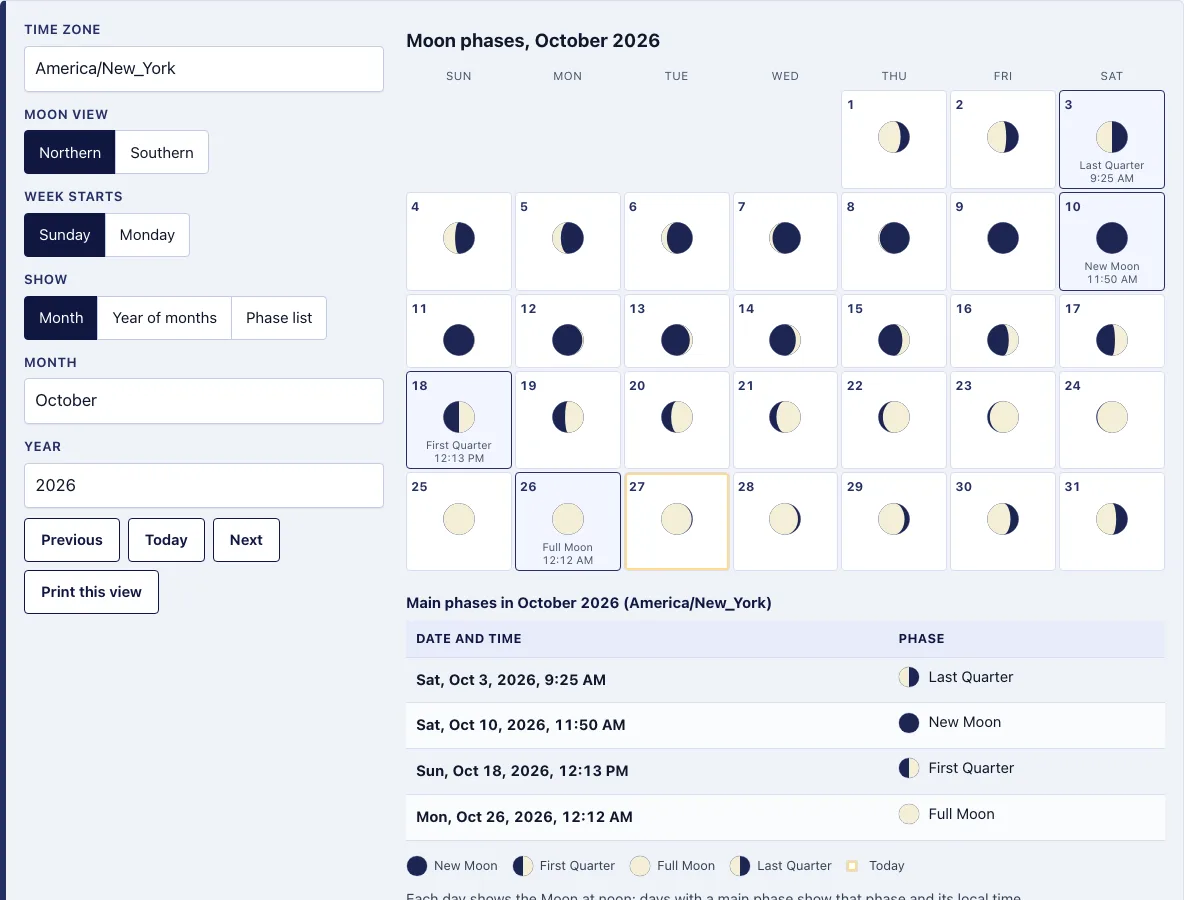
How to use the Moon Phase Calendar
- Set Time zone to your own, so phase times match your clocks, including daylight saving changes.
- Choose Moon view, Northern or Southern. Dates and times stay the same; only the orientation of the Moon icons changes.
- Pick Week starts, Sunday or Monday.
- Under Show, choose Month for a day grid, Year of months for twelve small calendars, or Phase list for a table of phases by month.
- Use the Month and Year selectors for any period from 1900 to 2100, or the buttons Previous, Today and Next to move. Today is outlined in gold.
- In Month view, read the highlighted days for the phase name and local time, then the table “Main phases” under the grid. Hover over a day for its date, phase and percent lit.
In Phase list each column holds one phase, so a month with two full moons shows two entries in the Full Moon column. Use Today after browsing to return to the current month.
Press Print this view to print only the calendar block, with the Moons drawn in black on white. Copy link keeps your zone, view, month and week start in the web address, so the same calendar can be bookmarked or sent to someone.
Fishing and hunting peaks follow the Moon’s position, not just its phase: see the solunar calendar.
What are the moon phases for 2026?
In UTC, 2026 has 50 main phases: 13 full moons, 12 new moons and 25 quarters. The page finds each by searching for the exact moment the angle between the Moon and the Sun reaches 0, 90, 180 or 270 degrees. The full moons, in UTC:
| Full moon | Date in UTC | Full moon | Date in UTC |
|---|---|---|---|
| 1 | 3 Jan | 8 | 29 Jul |
| 2 | 1 Feb | 9 | 28 Aug |
| 3 | 3 Mar | 10 | 26 Sep |
| 4 | 2 Apr | 11 | 26 Oct |
| 5 | 1 May | 12 | 24 Nov |
| 6 | 31 May | 13 | 24 Dec |
| 7 | 29 Jun |
Local dates can differ from this list by a day when a phase falls near midnight UTC. October 2026 in New York shows Last Quarter on Saturday 3 October at 9:26 AM, New Moon on 10 October at 11:51 AM, First Quarter on 18 October at 12:13 PM and Full Moon on Monday 26 October at 12:12 AM. In Los Angeles the same full moon falls on Sunday 25 October at 9:12 PM: one instant, 04:12 UTC, two local dates.
How many full moons are there in a year?
A year has 12 or 13 full moons. Full moons are 29.53 days apart on average, so twelve cycles take about 354 days, and a 365-day year sometimes has room for a thirteenth, as 2026 does. A Blue Moon in the calendar-month sense is a second full moon within one month. In 2026 that is May, with full moons on 1 May and 31 May in UTC, so 31 May is the Blue Moon. Other definitions of the term exist.
How is each day’s Moon icon chosen?
Each day shows the Moon at 12:00 local time. On the day of a new moon, quarter or full moon the icon shows that exact phase instead, together with its local time, so those days are always marked. In the Southern view every icon is mirrored, because the Moon looks upside down south of the equator; the dates are unchanged.
Why can a month have two full moons or none?
A lunar month, from new moon to new moon, averages 29.53 days and ranges from about 29.3 to 29.8 days. Calendar months are 28 to 31 days long, so the two do not line up. A 30- or 31-day month can hold two full moons (or two of any phase), and February, at 28 days or 29 in a leap year, can pass with no full moon at all. In the Phase list, count the entries under each phase column to see which months are doubled for the year you picked.
How this tool works and where the numbers come from
Each day shows the Moon at 12:00 local time, or the exact phase on the day of a new moon, first quarter, full moon or last quarter. The main phases are found by searching for the Moon-Sun elongation of 0, 90, 180 and 270 degrees with astronomy-engine and are converted to the chosen time zone. The main-phase times for 2024 to 2035 were checked against Fred Espenak’s catalogue to within two minutes.
Sources
Frequently asked questions
Is there a moon phase calendar for 2027?
Yes. Set Year to 2027 and step through the months, or choose Year of months or Phase list to see the whole year at once. Any year from 1900 to 2100 works.
Can I print a moon phase calendar?
Yes. Pick the view you want and press Print this view. The printout holds only the calendar block, drawn in black on white, so it suits paper.
Why do the dates differ from a UTC table?
The page shows times in the zone you choose, daylight saving applied. A phase near midnight UTC lands on a different date locally, so set Time zone to your own place before comparing.
Do the Southern hemisphere icons show different phases?
No. The Southern view mirrors each icon, since the Moon looks upside down from south of the equator. Phase dates and times are the same in both views.
How do I find the phase on a particular day?
Open Month view and find the day: each cell shows the Moon at 12:00 local time, or the exact phase on a main-phase day. Hover over a cell for the date, phase name and percent lit.
Which years does the calendar cover?
Every year from 1900 to 2100. Pick one in the Year selector; the Month selector is used in Month view and is greyed out in the year views.
Related tools
- Moon phase today: the phase right now, updated every minute.
- Full moon calendar: the full moons only, in one list.
- New moon calendar: the new moons, for planning dark skies.
- Moon phase calculator: the phase for a date and time you enter.
- When Is the Next Full Moon?: the upcoming full moon with a countdown.
- Eclipse calendar: upcoming solar and lunar eclipses.
- Stargazing calendar: good observing nights around the Moon.
- Moon tonight: rise, set and the Moon-free dark window for your place.
Planning a trip? The Night Gaze Camp app ranks campgrounds by tonight’s moonlight, clouds and sky darkness.