
Moon Phase Calculator
Enter a date to get the Moon phase, age and elongation, list a date range, or find when a chosen phase happens next.
Free · runs in your browser · nothing is uploaded
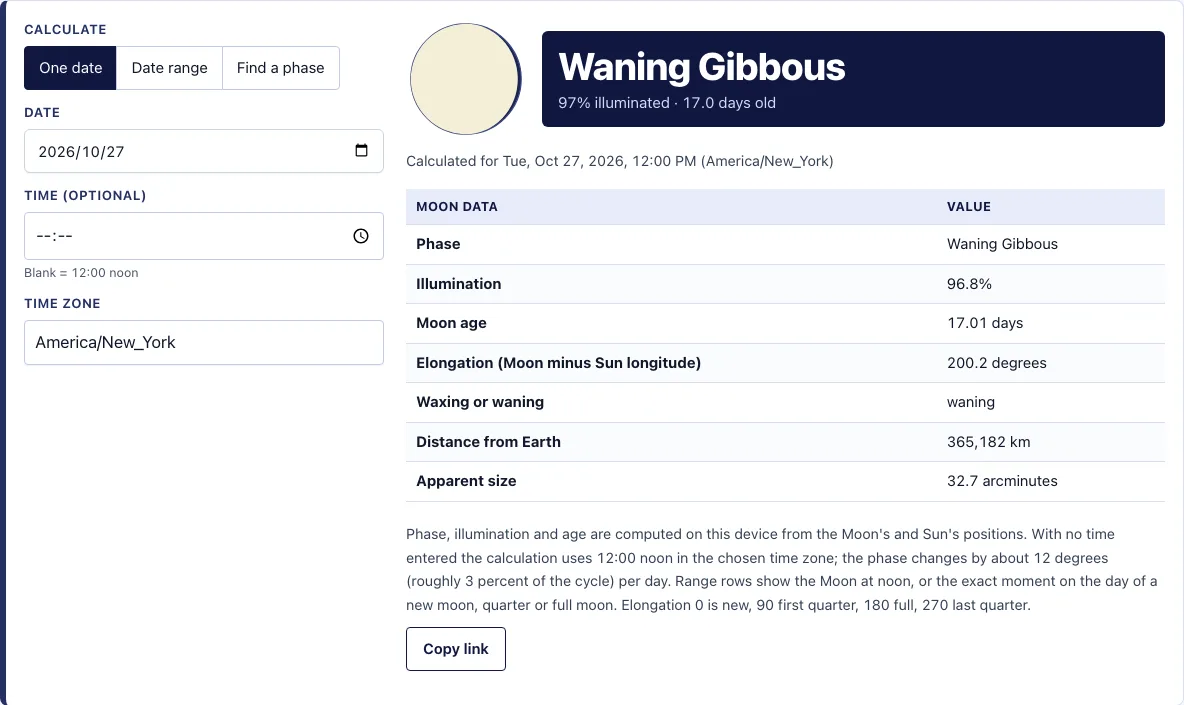
How to use the Moon Phase Calculator
- Under Calculate, choose a mode: One date, Date range or Find a phase.
- Set Time zone. It applies to all three modes.
- In One date, enter the Date and, if you know it, the Time. A blank time means 12:00 noon.
- Read the headline card and the table: Phase, Illumination, Moon age, Elongation, Waxing or waning, Distance from Earth and Apparent size. The line “Calculated for” shows the exact instant and zone.
- In Date range, enter From date and To date. Each row gives the date, the phase with its icon, how much is lit, the age, the elongation and, on main-phase days, the phase with its local time. Those rows are highlighted. Download CSV saves the table.
- In Find a phase, choose New Moon (0 degrees), First Quarter (90), Full Moon (180), Last Quarter (270) or Any angle and type an elongation from 0 to 360, then enter a From date. The table lists the next six times the Moon reaches it.
Ranges longer than 366 days are cut to 366 rows and a note says so. In Find a phase the first row is highlighted and the headline card above the table shows the first date and a Moon picture at the chosen angle. If an entry is invalid, such as a time that is not hours and minutes or an end date before the start date, a warning appears instead of a result. Copy link keeps the mode, dates and zone in the web address.
What was the Moon phase on a specific date?
The phase follows from the elongation, the angle between the Moon and the Sun measured along the ecliptic. The Moon gains about 12.19 degrees on the Sun each day (360 degrees divided by the 29.53-day synodic month), so a date alone leaves the phase uncertain by about 6 degrees either way; a time of day makes it exact to the minute.
| Phase | Elongation (degrees) | Illumination |
|---|---|---|
| New Moon | 0 | 0% |
| First Quarter | 90 | 50% |
| Full Moon | 180 | 100% |
| Last Quarter | 270 | 50% |
Illumination is close to (1 minus the cosine of the elongation) divided by 2, and the page shows the exact geocentric value. The four main names apply within 12 hours of the exact moment; in between the Moon is crescent or gibbous. A worked example: 25 December 2026 at noon in New York is a Waning Gibbous Moon, about 96% lit, elongation 203.4 degrees, 358,457 km away and 33.3 arcminutes wide, a large-looking Moon near its closest approach.
How do you calculate the age of the Moon?
Moon age is the time since the last exact new moon, in days, from 0 to about 29.8. The page finds that new moon and measures to your date and time; it is not a date difference divided by a fixed number, because lunations range from 29.3 to 29.8 days. At 12:00 UTC on 1 January 2000 the Moon was a Waning Crescent, 23% lit and 24.6 days old. A full moon falls about halfway round, near 14.8 days on average.
How do I find the next date of a Moon phase?
Use Find a phase. After 24 October 2026 the next full moons are on 26 October at 04:12 UTC, 24 November at 14:54 UTC and 24 December at 01:29 UTC. For a phase between the main ones choose Any angle: the Moon is at 45 degrees, halfway between new and first quarter, next on 13 November 2026 at 08:34 UTC. Consecutive results are one lunation apart, 29.3 to 29.8 days.
What do the distance and apparent size tell me?
The Moon’s distance ranges from roughly 356,000 to 407,000 km, and its apparent diameter is 2 times atan(1737.4 km divided by the distance). At the mean distance of 384,400 km that is 31.08 arcminutes; at 358,457 km, the distance in the December 2026 example above, it is 33.3. A full or new moon near its closest approach is the usual meaning of the word supermoon, and the same Moon seen near its farthest point looks about 12% narrower.
How this tool works and where the numbers come from
Elongation is the Moon minus Sun ecliptic longitude from astronomy-engine; illumination is the geocentric illuminated fraction; age is the time since the last exact new moon. With no time entered the calculation uses 12:00 local. The next-phase finder searches for the exact moment the elongation reaches the target. The new, quarter and full moon times were checked against Fred Espenak’s catalogue to within two minutes.
Sources
- astronomy-engine (Don Cross), the Sun and Moon position library used for every calculation
- Espenak, F. AstroPixels: Phases of the Moon catalogue, 2001 to 2100 (independent check of the main-phase times)
- NASA Goddard Space Flight Center, Moon Fact Sheet (mean radius 1737.4 km, synodic period 29.53 days, apparent diameter)
Frequently asked questions
Can I check the Moon phase for a whole month?
Yes. Choose Date range, enter the first and last day, and the table lists one row per day. Each row shows the Moon at 12:00 local time, or the exact phase on the day of a main phase. Download CSV saves the rows.
How do I find the next full moon date?
Select Find a phase, choose Full Moon and enter a From date. The table lists the next six full moons in your time zone, with the date, time, illumination and age of each.
What angle is a waxing crescent?
Any elongation between about 6 and 84 degrees. For a moment between the main phases, type the angle under Any angle to find the next date it occurs.
Which time zone should I pick?
The zone where you are or where the event happens. It applies to every mode and its daylight saving rules are included; the “Calculated for” line shows the zone used.
Why does the time of day matter?
The elongation changes about 12 degrees per day, roughly 3% of the whole cycle, so one calendar date can show noticeably different phases at 1 AM and 11 PM. With no time entered the page uses 12:00 noon.
Related tools
- Moon phase today: the phase right now, updated every minute.
- Moon phase calendar: the phase of every day of a month or year.
- Moon phase on my birthday: the phase on the day you were born and on later birthdays.
- Full moon calendar: every full moon of the year in one list.
- New moon calendar: the dates of new moons for dark skies.
- When Is the Next Full Moon?: the next full moon with a countdown.
- Moonrise and moonset calculator: rise and set times at your location.
- Next lunar eclipse: when the Moon next enters Earth’s shadow.
Planning a trip? The Night Gaze Camp app ranks campgrounds by tonight’s moonlight, clouds and sky darkness.