
Milky Way Calendar
Pick a place and a year to see the Milky Way core season, the best months and the Moon-free nights.
Free · runs in your browser · nothing is uploaded
How to use the Milky Way Calendar
- Open the Place list and choose a dark-sky park, a city, My location or Custom coordinates (Latitude, Longitude and Time zone).
- Type the year into the Year box. For a 2026 plan, enter 2026.
- Open Core height at least and choose 5, 10, 15 or 20 degrees. The default is 15; a lower value lengthens the season but keeps the core near the horizon.
- Read the top card: the core season for your place, the highest the core ever gets there, and the best month with its average hours per night.
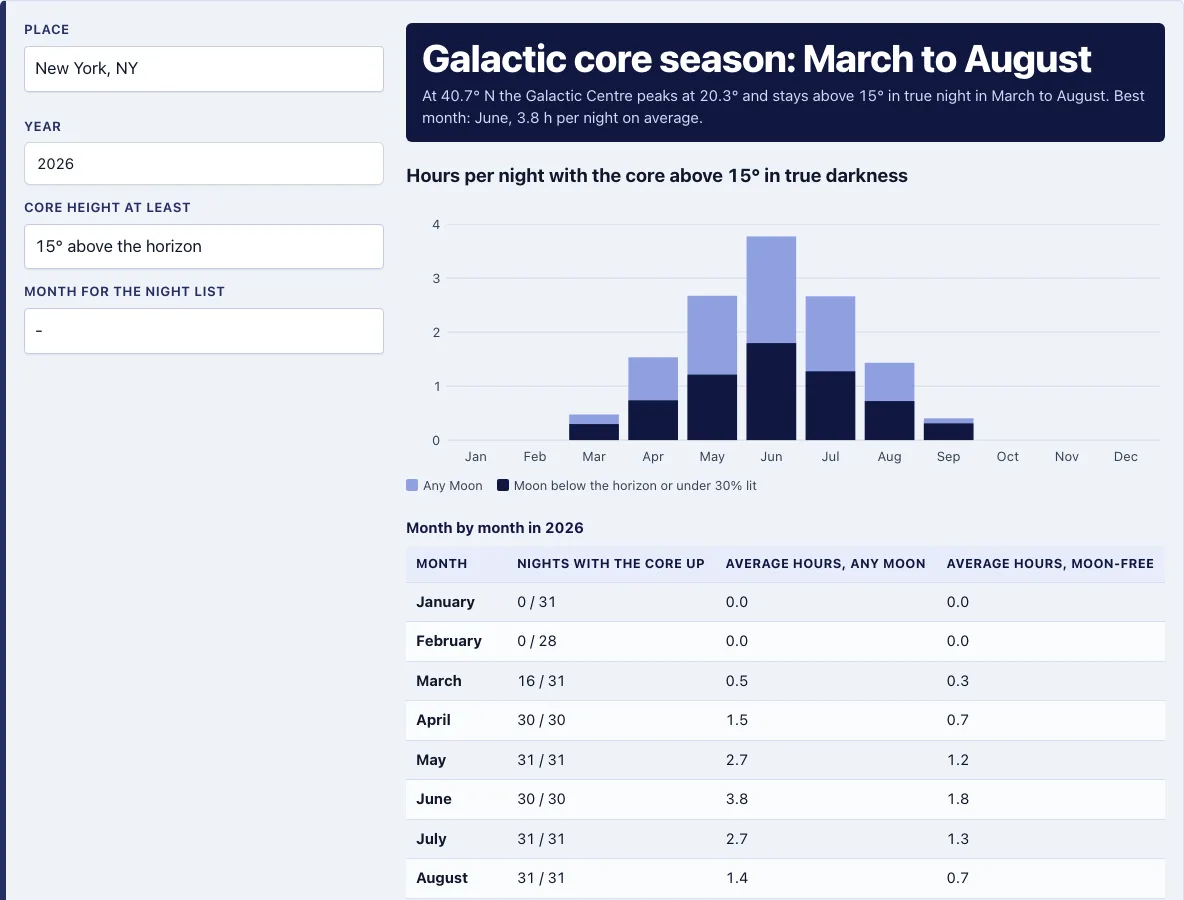
- Compare the bar chart and the month table: hours with any Moon and hours that are Moon-free. The darker bar is the Moon-free part, so a month with a tall pale bar and a short dark one is bright with moonlight on most nights.
- Go to Best Moon-free windows, next 12 months. Each row gives the nights, the best night, the core window on it, Moon-free hours, peak height and time, and how much of the Moon is lit.
- Choose a month in Month for the night list to read every night of it. Download all nights (CSV) saves the whole year, Print this month prints the list and Copy link shares your settings. The CSV opens in any spreadsheet if you want to filter nights yourself.
When can you see the Milky Way in 2026?
It depends on latitude. At 15 degrees, in true darkness, the core season in 2026 is March to September at Los Angeles (34 N), March to August at New York and February to October at Sydney (34 S). The tool counts a month when the core clears the height for at least 30 minutes on at least half its nights.
| Place, 2026, core at 15 degrees | Core season | Best month, average hours per night |
|---|---|---|
| Los Angeles (34 N) | March to September | June, 5.4 |
| New York | March to August | June, 3.8 |
| Sydney (34 S) | February to October | June, about 11 |
| 52 N | none: the core peaks at 9 degrees | none |
| Tromso (70 N) | none: the core never rises | none |
What month is the Milky Way visible?
Whichever months pass the height test in dark sky. Lowering Core height at least to 10 or 5 degrees stretches Los Angeles to February to October, the range most guides quote; raising it to 20 degrees keeps March to September because the core peaks near 27 degrees there.
What is the best time of year to see the Milky Way?
June, for the places above, because the core is up for the most hours in dark sky. AstroBackyard writes that in the Northern Hemisphere the core is typically visible from February through October, best from May to August, and in the Southern Hemisphere best from April to September. The tool is stricter (15 degrees, astronomical night), so its months lie inside those ranges.
How high does the Milky Way core get?
At most 90 degrees minus the gap between your latitude and the core’s declination of -29 degrees: about 27 degrees at 34 N, 85 degrees at 34 S and 9 degrees at 52 N. North of about 61 N it never rises. Above 48.6 degrees of latitude the Sun stays within 18 degrees of the horizon around midsummer, so for some weeks no night is astronomically dark and the chart shows zero hours.
How this tool works and where the numbers come from
The Galactic Centre (Sagittarius A*, RA 17h 45m 40.04s, Dec -29 deg 00’ 28.1" J2000) is precessed to the date; its height is checked against a textbook sidereal-time and precession calculation within 0.05 degrees. A minute counts when the core is above the chosen height and the Sun is more than 18 degrees below the horizon; Moon-free means the Moon is below the horizon or less than 30% lit. Core seasons were compared with published photography guides.
Sources
Frequently asked questions
When can I see the Milky Way galaxy tonight?
Open Every night of the current month and find tonight’s row. If its core window and Moon-free window overlap with a clear sky, tonight is a good night. Moon-free means the Moon is below the horizon or less than 30% lit.
Can I see the Milky Way core from 52 N?
Only low in the south. The core peaks at 9 degrees there, so it never reaches 15; with Core height at least set to 5 degrees the 2026 season is April and May.
What does it show for the Southern Hemisphere?
The same rules, but the core climbs much higher: at Sydney it peaks at about 85 degrees and the 2026 season runs February to October, with June the best month at about 11 hours per night, because winter nights are long.
Why does the chart show zero hours?
Either the core never clears your chosen height at your latitude, or the Sun stays within 18 degrees of the horizon (no astronomical night), as at 52 N in midsummer.
Does it include clouds and light pollution?
No. Heights ignore refraction and local horizons, times are good to about 3 minutes, and clouds, haze and light pollution are not modelled.
How is the Moon lit percentage found?
From the Moon’s lit fraction at local midnight of each night. A Moon under 30% lit counts as Moon-free even while it is up.