
Meteor Shower Tonight
Pick a place and a date to see which meteor showers are active tonight, the best hour to watch and about how many meteors you can expect.
Free · runs in your browser · nothing is uploaded
A meteor shower is on tonight when the date falls inside the activity period of a shower in the International Meteor Organization’s working list, and how good it is depends on your place, the Moon and the sky. This tool takes a place, a date and the darkness of your sky. It returns the best major shower for the night, the dark window, the Moon’s effect and a table of every active shower with an estimated number of meteors per hour. The numbers are estimates for planning a night outside, not a count of meteors you will certainly see.
“Tonight” means the night that starts on the evening of the date you choose and ends the next morning, so a shower can count when its activity covers either of those two dates.
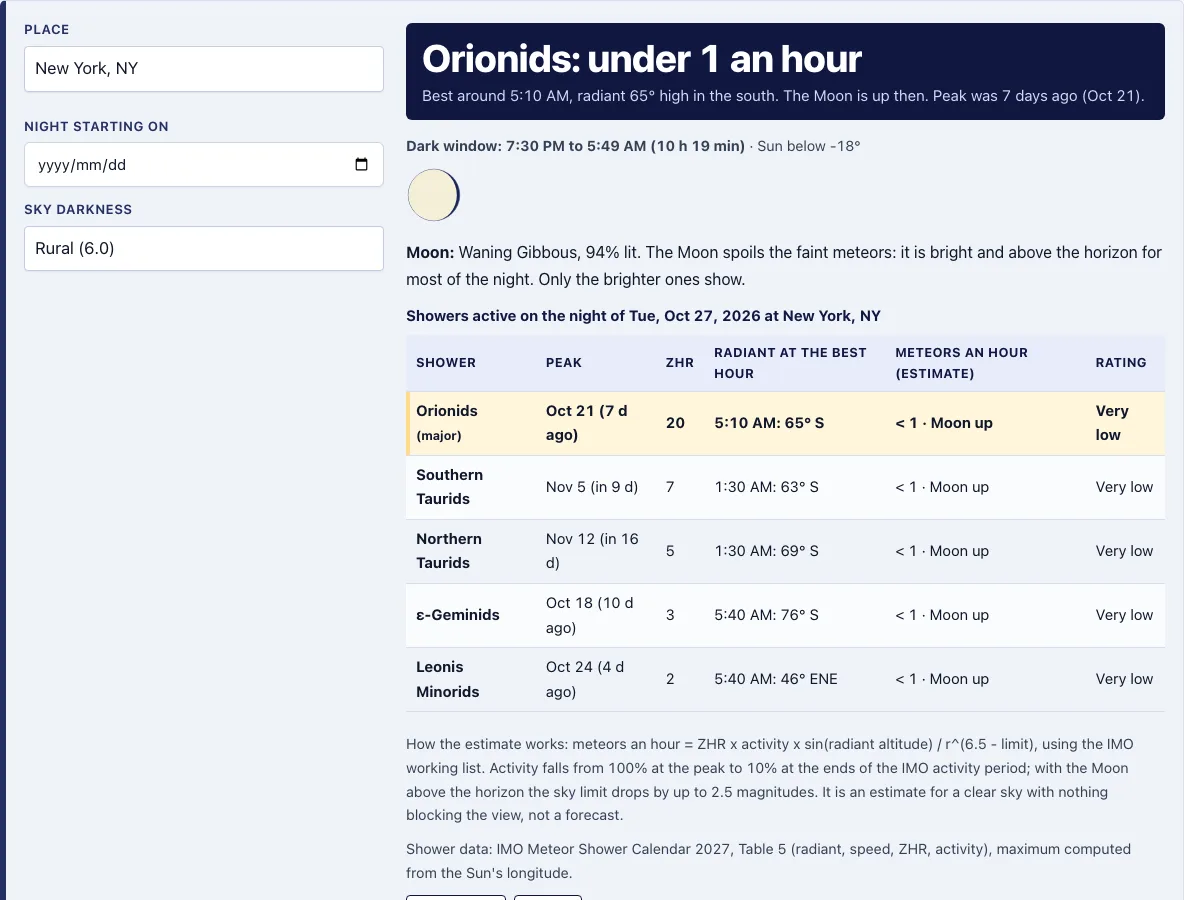
- Open Place and pick a dark-sky park, a US city or a world city, or choose My location (this device). For exact coordinates choose Custom coordinates and fill in Latitude, Longitude and Time zone.
- Check Night starting on. It starts on today’s date at your place; change it to plan another night.
- Set Sky darkness to the closest match: Very dark (faintest star 6.5), Rural (6.0), Suburban (5.0) or City (4.0).
- Read the headline for the best major shower, then the dark window and the Moon line. The Moon line gives the phase, the percent lit, whether it spoils faint meteors and when it is below the horizon.
- Scan the table: Shower, Peak, ZHR, Radiant at the best hour (time, height and compass direction), Meteors an hour (estimate) and Rating.
- If no major shower is active, press the button under the headline, such as Show the April Lyrids peak night, to jump to the next one.
Copy link reproduces the result with the same place, date and sky darkness. Print prints it. The result updates as soon as you change a control. In the table, a “Moon up” tag means the Moon is above the horizon at the best hour, so the real rate is lower than the formula alone says, and the highlighted row is the best major shower.
What time is the best time to watch a meteor shower tonight?
The best time is the hour in the dark window when the shower’s radiant stands highest, preferring hours when the Moon is below the horizon. The tool checks the radiant every 10 minutes between the end of evening twilight and the start of morning twilight and shows the best time with the radiant’s height and compass direction.
For Phoenix on the night starting 2026-12-13 the dark window runs from 6:50 PM to 5:55 AM. The Geminid radiant is best around 2:20 AM, 89 degrees high, nearly overhead, and the Moon, 23% lit, is below the horizon from 9:40 PM to 5:50 AM.
Is there a meteor shower tonight in my area?
A shower counts as active when the evening date or the next morning’s date lies inside its activity period in the IMO working list. The active list depends on the date, while the dark window and the radiant height depend on where you are, so one shower can get very different rates in different places.
From Sydney on the night starting 2027-01-03 the Quadrantid radiant (declination +49 degrees) stays below the horizon and the estimate is under 1 an hour. From New York on the same night it is high in the northeast before dawn. A place far north in summer can have no dark sky at all, and then the tool says so instead of rating a shower.
Which direction should I look for tonight’s meteor shower?
Face the radiant’s compass direction at the best hour, shown in the table as a time, a height and a direction such as “2:20 AM: 89° SSE”, and keep a wide view of the sky. Meteors can appear anywhere; the radiant only marks where their paths trace back to.
The radiant also drifts from night to night. The tool follows the IMO drift series, for example the Perseid radiant moves from 37° right ascension on Aug 5 to 63° on Aug 25, and precesses the position to the date.
How is the rate worked out?
The estimate is the IMO visual formula for the zenithal hourly rate turned around: meteors an hour = ZHR × activity × sin(radiant altitude) ÷ r^(6.5 − sky limit). ZHR is the rate for an ideal observer with the radiant overhead under a magnitude 6.5 sky. The population index r comes from the IMO table, and the sky limit is your Sky darkness choice.
| Perseids (ZHR 110, r = 2.2), at the peak | Sky limit | Radiant altitude | Estimate |
|---|---|---|---|
| Ideal sky, radiant overhead | 6.5 | 90° | 110 an hour |
| Suburban sky, radiant overhead | 5.0 | 90° | 34 an hour |
| Ideal sky, radiant 30° high | 6.5 | 30° | 55 an hour |
Activity is 100% at the peak and falls on either side along the measured profile of each main shower: the rise and fall slopes fitted by Jenniskens (1994, Astronomy & Astrophysics 287, 990) to visual counts, with a sharp main peak plus a broad background for the Quadrantids, Perseids, Leonids, Geminids and Ursids. A week before the Perseid peak that gives about 11% of the peak rate (ZHR around 12), and three nights before the Geminid peak about 11%. Showers without a published profile use a generic assumption: activity falls to 10% at the ends of the IMO activity period. With the Moon above the horizon at the best hour the sky limit drops by up to 2.5 magnitudes.
What do the ratings and Moon verdicts mean?
Ratings follow the estimated rate: Excellent is 50 or more an hour, Good 20 to 50, Fair 8 to 20, Poor 2 to 8 and Very low under 2. The Moon verdict is none, minor, some or spoils, from the illuminated fraction multiplied by the share of the dark window with the Moon up.
On the night starting 2026-10-24 in Phoenix the Orionids (ZHR 20) are nearly four days past their peak and a 99% lit Moon is up all night, so with a Rural sky the estimate is about 1 an hour and the verdict is spoils.
How this tool works and where the numbers come from
Estimated rate = ZHR x activity x sin(radiant altitude) / r^(6.5 - sky limit), the IMO visual formula ZHR = N x r^(6.5 - LM) / sin(h) turned around. Showers, radiants, drift, speeds, r and ZHR from the IMO working list; the peak is the moment the Sun reaches the IMO solar longitude (converted from J2000). Activity away from the peak follows the published rise and fall slopes of Jenniskens (1994) for the ten main showers. Radiant altitudes were checked against PyEphem within 0.2 degrees, peak times against the IMO calendars within 1 hour.
Sources
Frequently asked questions
Why does the tool say “No dark sky here tonight”?
In polar summer the Sun does not get far enough below the horizon for a dark window. The tool shows that message instead of a rating for the place and night.
Why is a shower marked “Not rated”?
Some showers have a variable ZHR in the IMO list, so there is no single number to scale. They are still listed with their radiant but get no hourly estimate.
What if no major shower is active tonight?
The headline names the next major shower and its peak date. A major shower has a ZHR of 10 or more and a real peak. On 2026-03-01, for example, the next one is the April Lyrids, peaking Apr 22, 2026, about 52 days away.
Does a bright Moon stop me seeing meteors?
It does not stop them, but it hides the fainter ones. The Moon line says whether it is below the horizon and for which hours, so you can watch in the Moon-free stretch.
Is the Antihelion Source listed?
No. It gives a few meteors an hour on most nights, but it is a diffuse region of sky rather than a shower, so it is left out.
Does “tonight” mean the date I pick?
It means the night that starts on the evening of that date and ends the next morning.
Pick the right night first, then the time. Meteor shower calendar lists every peak of a year with the Moon at each one. Moon tonight gives the Moon’s rise, set and phase. New moon calendar finds the darkest nights, and Full moon calendar the ones to avoid. Astronomical twilight calculator gives the exact start and end of true darkness. Planets visible tonight shows which planets are up. Stargazing calendar and Star map generator help plan the session.
Planning a trip? The Night Gaze Camp app ranks campgrounds by tonight’s moonlight, clouds and sky darkness.