
Meteor Shower Calendar
Choose a year to get every annual meteor shower with its peak in UTC and your time zone, the Moon at the peak and the best showers for dark skies.
Free · runs in your browser · nothing is uploaded
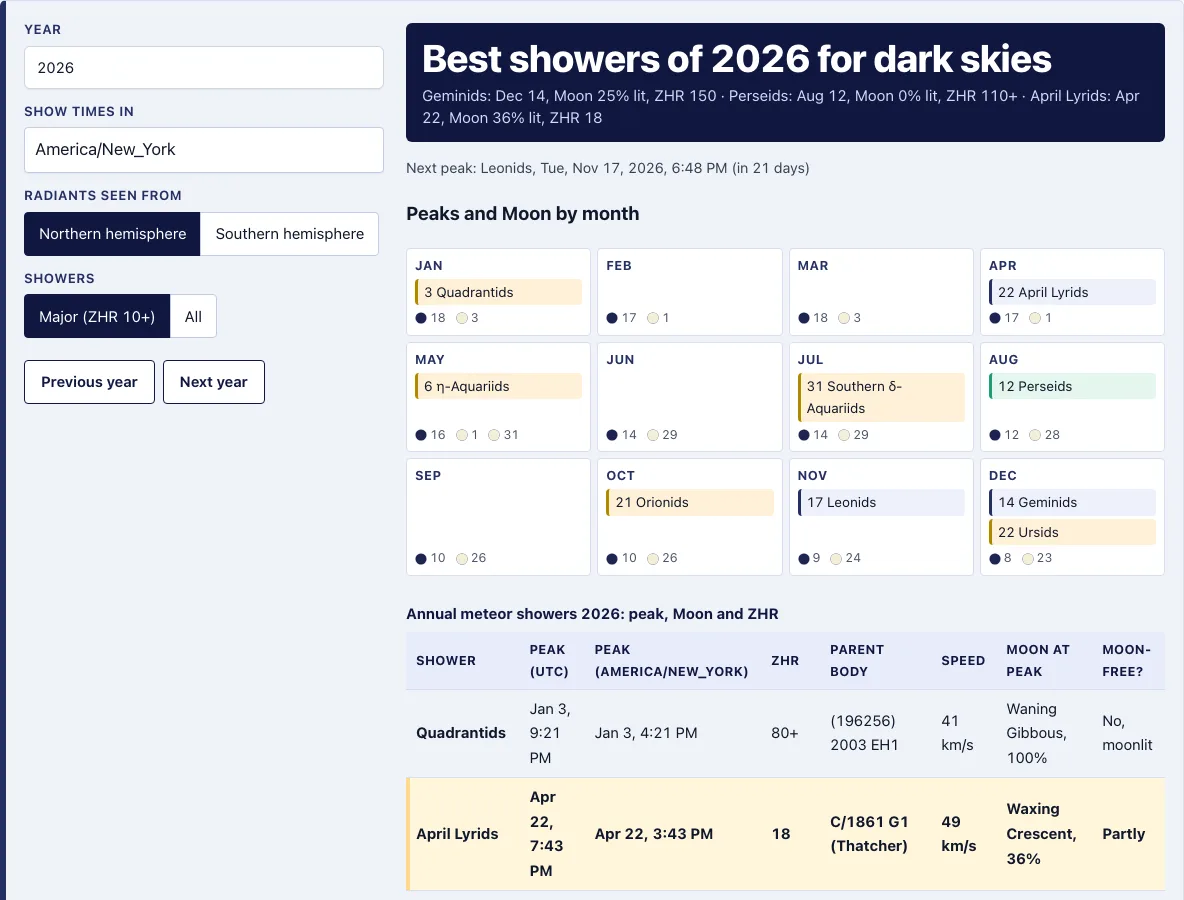
- Set Year. Type a number or use Previous year and Next year. It starts on the current year.
- Open Show times in and choose your time zone. It starts on your browser’s zone.
- Under Radiants seen from, choose Northern hemisphere or Southern hemisphere. The radiant is the point the meteors seem to come from, and how high it climbs depends on your latitude.
- Under Showers, choose Major (ZHR 10+) for the nine main showers or All for the whole working list.
- Read the headline “Best showers of the year for dark skies” and, for the current year, the line with the next peak.
- Look at Peaks and Moon by month: each month lists its peaks and the days of new and full Moon.
- Scan the table and compare Peak (UTC) with the peak in your zone, then check Moon at peak and Moon-free?.
Copy link repeats the page for the same settings. Print prints the table. The page updates as soon as you change a control, and the highlighted rows are the best showers of the year. With All selected, the daytime showers, whose radiant is near the Sun, are marked as such. The Moon column gives the phase name and the percent lit at the peak, and the Moon-free? column says Yes, dark sky, Partly or No, moonlit. The month grid colours each peak the same way, so you can spot the good nights at a glance.
What time is the next meteor shower?
The next peak is shown under the headline for the current year, in the time zone you chose, among the nine major showers. The IMO publishes each maximum as a solar longitude, and the tool finds the instant the Sun reaches that longitude in the chosen year, after correcting from the year-2000 equinox to the equinox of date.
The result matches the times the IMO prints. The April Lyrids of 2026 compute to 19:44 UT against the IMO’s 19:40, the Leonids to 23:49 against 23:45, and the Quadrantids of 2027 to 03:30 against 03:25. The IMO adds that real maxima can differ by hours, sometimes by a day.
What does the meteor shower calendar 2026 show?
The 2026 calendar has nine major showers. The Geminids score highest for dark skies, followed by the Perseids, which peak on August 13 at 02:05 UTC under a new Moon, and the April Lyrids.
| Shower | Peak (UTC) | Moon at peak | Moon-free? |
|---|---|---|---|
| Quadrantids | Jan 3, 21:22 | 100% | No, moonlit |
| April Lyrids | Apr 22, 19:44 | 36% | Partly |
| eta-Aquariids | May 6, 09:20 | 81% | No, moonlit |
| Southern delta-Aquariids | Jul 31, 13:31 | 96% | No, moonlit |
| Perseids | Aug 13, 02:05 | 0% | Yes, dark sky |
| Orionids | Oct 21, 18:25 | 79% | No, moonlit |
| Leonids | Nov 17, 23:49 | 55% | Partly |
| Geminids | Dec 14, 13:46 | 25% | Partly |
| Ursids | Dec 22, 22:13 | 98% | No, moonlit |
What does the meteor shower calendar 2027 show?
The best showers of 2027 are the Quadrantids (Jan 4, 03:30 UTC, Moon 12% lit), the eta-Aquariids (May 6, 15:15 UTC, new Moon) and the Southern delta-Aquariids (Jul 31, 19:40 UTC, Moon 4% lit). The Perseids and Geminids peak under a bright Moon, 87% and 98% lit.
The tool ranks showers by ZHR × (1 − 0.8 × Moon fraction) × sin(radiant height), where the radiant height uses a representative latitude of 40° north or 35° south, and keeps the top three whose peak is not moonlit. The Moon-free column reads Yes up to 25% lit, Partly up to 60% and No above that.
Geminids meteor shower: when is it and how strong?
The Geminids peak on December 14: at 13:46 UTC in 2026 with the Moon 25% lit, and at 19:57 UTC in 2027 with the Moon 98% lit. Their ZHR is 150, the highest of the year, and they hit the atmosphere at 35 km/s, slower than the Perseids at 59 and the Leonids at 71. The parent body is 3200 Phaethon, an asteroid.
What meteor shower happens in October 2026?
The Orionids peak on October 21, 2026 at 18:25 UTC, which is 2:25 PM in New York, with the Moon 79% lit. Their parent body is comet 1P/Halley, the same one behind the eta-Aquariids in May. In 2027 the peak is on October 22 at 00:41 UTC with the Moon 58% lit.
How this tool works and where the numbers come from
Peak = the instant the Sun reaches the shower’s IMO solar longitude (equinox J2000 converted to the equinox of date). Checked against the times printed in the IMO calendars 2026 and 2027 (within 1 hour) and the Table 5 maximum dates of both editions (within 1 day). Moon fraction from astronomy-engine, checked against Espenak’s new and full moon times.
Sources
Frequently asked questions
Why does a peak time differ from other calendars?
Each source uses its own reference time for a maximum that is really spread over many hours. This tool follows the IMO’s solar longitudes, so it agrees with the IMO calendar within minutes; other sites may round to a date or use a different reference.
Can I look at years after 2027?
Yes. The IMO has published its calendar for 2027, so that year can be compared with its tables, and the tool computes any year from 1900 to 2100 from the same solar longitudes.
What does Moon-free mean?
It describes the moonlight at the peak instant, wherever you are: “Yes, dark sky” up to 25% lit, “Partly” above 25% and up to 60%, and “No, moonlit” above 60%. The 2026 Geminids, with the Moon 25.08% lit, are just over the line and show Partly. Whether the Moon is above your horizon at the peak depends on your place.
What is ZHR?
The zenithal hourly rate is the number of meteors an ideal observer would count per hour with the radiant overhead under a sky where stars of magnitude 6.5 show. Real counts are lower.
Do the showers look the same in both hemispheres?
No. A high radiant needs the right latitude. The Quadrantid radiant sits at declination +49°, so it scores far lower when Radiants seen from is set to Southern hemisphere.
Peaks are only half the planning: the Moon decides the rest. New moon calendar lists the darkest nights, Full moon calendar the brightest, and Moon phase calendar every phase. Meteor shower tonight rates the night you pick, with the best hour and an estimated rate. Astronomical twilight calculator gives the start of true darkness, Planets visible tonight shows what else is up, and Eclipse calendar, Milky Way calendar and Stargazing calendar cover the rest of the year.
Planning a trip? The Night Gaze Camp app ranks campgrounds by tonight’s moonlight, clouds and sky darkness.