
Julian Date Calculator
Enter a date and time to get the Julian Date, Modified JD and Unix time, or enter a Julian Date to get the calendar date.
Free · runs in your browser · nothing is uploaded
A Julian Date (JD) is a continuous count of days, with a decimal fraction, from noon Universal Time on 1 January 4713 BC. This Julian date calculator converts both ways: a calendar date and time into a JD, or a JD, Modified Julian Date, Truncated Julian Date or Unix time back into a calendar date. Astronomers use the count because the gap between two moments becomes a simple subtraction.
Date mode takes a year, month, day, time, time zone and calendar. Number mode takes a value you already have and returns the UTC date and time. The results table also shows the Modified Julian Date, day of the year, day of the week, Unix time and the JD in Terrestrial Time, so one lookup answers most questions about a single moment.
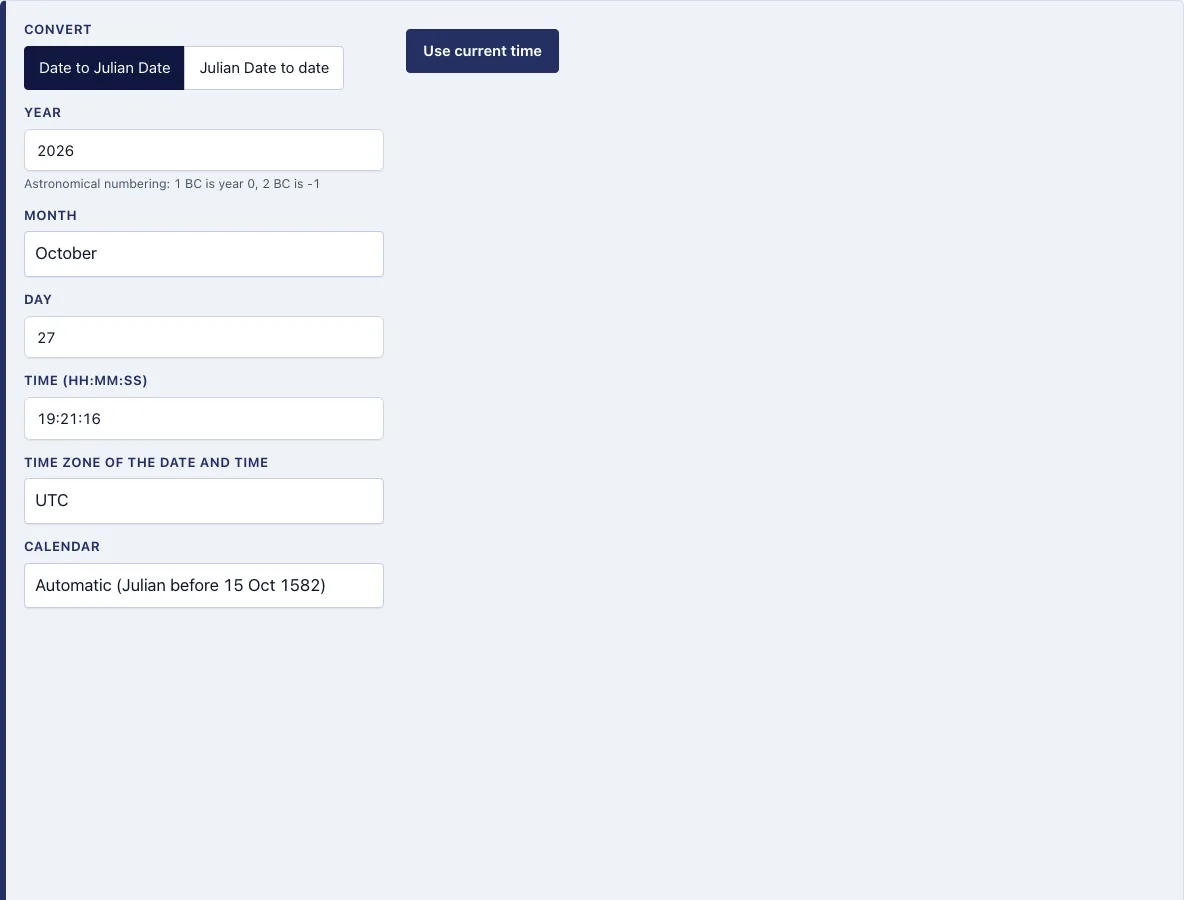
How to use the Julian Date Calculator
To convert a calendar date to a Julian Date:
- Open the page. The fields show the current UTC date and time and update every second.
- Edit any field to stop the live clock. Click Use current time to start it again.
- Enter Year, Month, Day and Time (HH:MM:SS). Years use astronomical numbering, so 1 BC is year 0 and 2 BC is year -1.
- Set Time zone of the date and time. It starts on UTC; pick any other zone from the list.
- Choose a Calendar: Automatic, Gregorian for all dates, or Julian for all dates.
- Make sure Date to Julian Date is selected under Convert, then read the results table.
To convert a Julian Date or another number back to a date:
- Select Julian Date to date under Convert.
- Enter a value in Number and pick its type under Number is a: Julian Date (JD), Modified Julian Date (MJD), Truncated Julian Date (TJD) or Unix time (seconds).
- Read the calendar date and time, which is shown in UTC.
Use Copy JD to copy the Julian Date to your clipboard. Copy link creates a link that reproduces your inputs, so you can send someone the exact calculation.
What is a Julian date?
A Julian Date (JD) is a count of days, with a decimal fraction, from noon Universal Time on 1 January 4713 BC in the Julian calendar. Astronomers use it because it is one unbroken number with no months, years or leap-year rules, so the time between two events is a simple subtraction.
The count starts at noon, so midnight dates end in .5. Midnight UT on 24 October 2026 is JD 2461337.5, and 18:00 UT that day is JD 2461338.25. The decimal part carries the time of day.
These reference points come up often:
| Reference point | Julian Date |
|---|---|
| JD 0: 1 January 4713 BC 12:00 (Julian calendar) | 0 |
| 4 October 1582 (Julian calendar) | 2299159.5 |
| 15 October 1582 (Gregorian calendar) | 2299160.5 |
| Modified Julian Date zero: 17 November 1858 00:00 | 2400000.5 |
| Unix epoch: 1 January 1970 00:00 | 2440587.5 |
| GPS time zero: 6 January 1980 00:00 UTC | 2444244.5 |
| J2000.0: 1 January 2000 12:00 | 2451545.0 |
How do you calculate a Julian date?
Use the algorithm in Jean Meeus’s Astronomical Algorithms, chapter 7, which this tool follows. Treat January and February as months 13 and 14 of the previous year, then JD = INT(365.25 × (Y + 4716)) + INT(30.6001 × (M + 1)) + D + B − 1524.5, where D is the day with the time of day as a fraction. For Gregorian dates B = 2 − A + INT(A / 4) with A = INT(Y / 100); for Julian-calendar dates B = 0.
For 24 October 2026 at 0h UT: INT(365.25 × 6742) = 2462515, INT(30.6001 × 11) = 336 and B = −13, so JD = 2462515 + 336 + 24 − 13 − 1524.5 = 2461337.5. Add 0.75 for 18:00 and the result is 2461338.25. The same method gives JD 2436116.31 for 4.81 October 1957 (Sputnik 1) and JD 2446822.5 for 27 January 1987 at 0h.
The Julian Date also removes calendar quirks from date arithmetic. Between 1 January 2000 at noon (JD 2451545.0) and 24 October 2026 at 0h UT (JD 2461337.5) lie 9792.5 days, found by one subtraction with no month lengths or leap years to count. The tool shows this count next to the Modified Julian Date, which starts at midnight and so avoids the half-day offset.
Calendar reform creates one edge case. Thursday 4 October 1582 (Julian) was followed by Friday 15 October 1582 (Gregorian), so the ten days from 5 to 14 October 1582 never existed. Automatic mode rejects those dates and tells you. Choosing Gregorian or Julian for all dates lets you enter them. Gregorian 15 October 1582 is exactly 1.0 JD after Julian 4 October 1582.
How this tool works and where the numbers come from
Calendar date to Julian Date follows Jean Meeus, Astronomical Algorithms (2nd ed.), chapter 7 (checked against his published values, including 4.81 October 1957 = JD 2436116.31, and against two independent integer algorithms). Dates before 15 October 1582 use the Julian calendar on the automatic setting. Terrestrial Time is UTC plus 32.184 s plus the leap-second count (37 s since 2017-01-01, from the IANA tz database list of leap seconds).
Sources
Frequently asked questions
What is the Julian date today?
The calculator opens in live mode and shows the current Julian Date for the UTC time you are viewing, so the number changes every second. For a fixed example, 24 October 2026 at 0h UT is JD 2461337.5.
What is the Julian date format YYDDD?
YYDDD is the day of the year, not a Julian Date. It often appears on packaging and manufacturing labels. 24 October 2026 is day 297, so it is written 26297 in YYDDD or 2026297 in YYYYDDD. The results table shows the day of the year.
What is the difference between the Julian date and the Julian calendar?
The Julian calendar is a way of organizing months and years, with a leap year every fourth year. The Julian Date is a continuous day count that starts from a date in that calendar, and it does not depend on months or years. The two systems also differ on leap years: 1900 had 366 days in the Julian calendar but 365 in the Gregorian.
What is Modified Julian Date?
The Modified Julian Date (MJD) is JD minus 2400000.5, so it starts at midnight on 17 November 1858 UTC. For 24 October 2026 at 18:00 UT, the MJD is 61337.75. The Truncated Julian Date (TJD) is JD minus 2440000.5, which gives 21337.75 for the same moment.
Is the Julian date in UTC or Terrestrial Time?
The calculator works in UT, which matches UTC to within 0.9 seconds. Terrestrial Time (TT) runs ahead of UTC by 69.184 seconds today, so a JD in TT is larger by 0.0008 day. Ephemeris tables often quote JD in TT, so check which time scale a source uses before comparing values.
What dates can the calculator handle?
It handles dates from JD 0 (4713 BC) to the year 9999. Years use astronomical numbering, so enter 0 for 1 BC and -1 for 2 BC.
- Sidereal Time Calculator: turn a Julian Date moment into the local sidereal time for an observing site.
- Angular Size Calculator: work out how large an object appears from its size and distance.
- Star Map Generator: draw the sky for a chosen place and date.
- Solar System Simulator: explore the planets of the solar system.
- Moon Phase Calculator: check the Moon’s phase on a particular date.
- Astronomical Twilight Calculator: find when the sky is fully dark.
- Next Solar Eclipse: find the date of the next solar eclipse.
Planning a trip? The Night Gaze Camp app ranks campgrounds by tonight’s moonlight, clouds and sky darkness.