
Full Moon Calendar
Choose a year and a time zone to see every full moon with its name, distance and eclipse flag.
Free · runs in your browser · nothing is uploaded
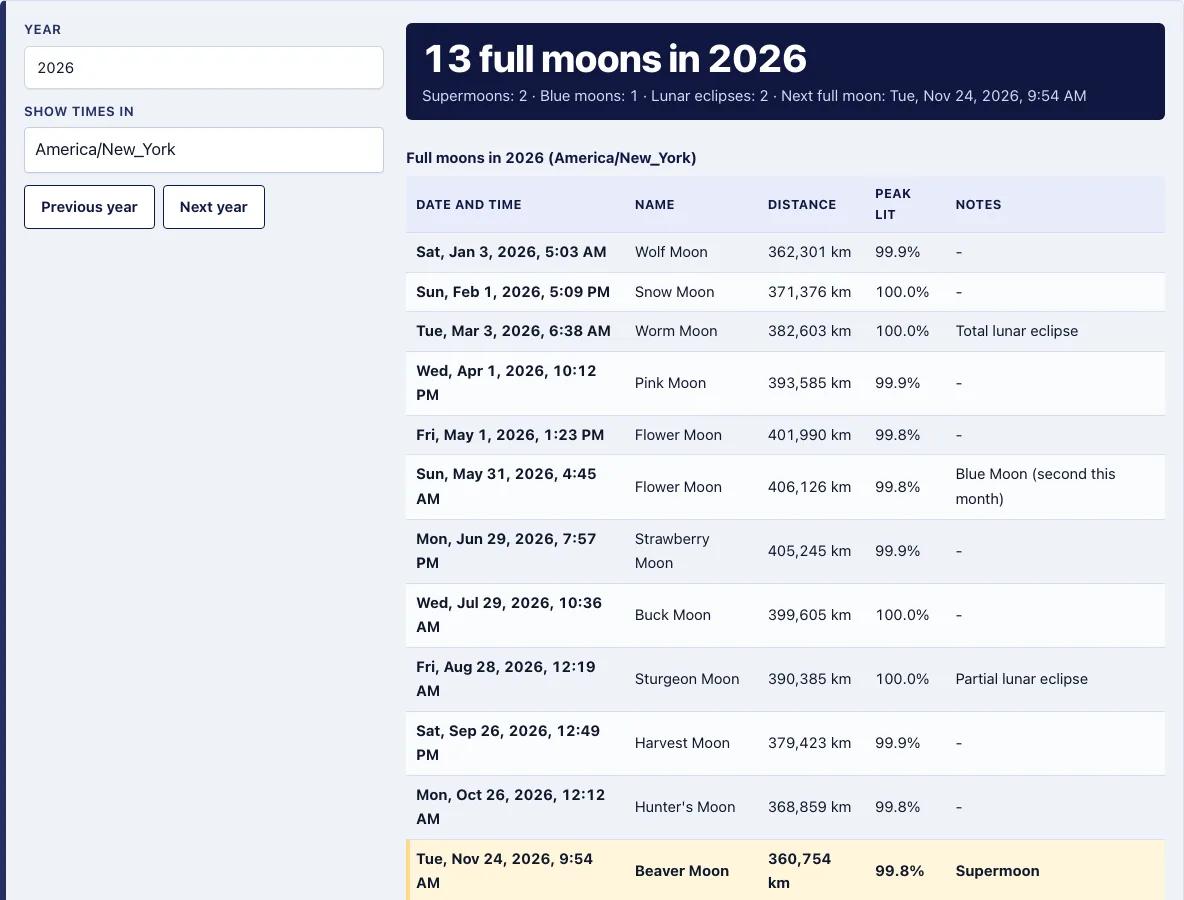
How to use the Full Moon Calendar
- Type a year into the Year box. It accepts 1900 to 2100 and starts on the current year.
- Click Previous year or Next year to move through the calendar one year at a time.
- Open the Show times in list and choose your time zone. The dates and times in the table update to match.
- Read the main table. Its columns are Date and time, Name, Distance, Peak lit and Notes.
- If you are viewing the current year, look for the highlighted row. That is the next upcoming full moon.
- Scroll to Full moons by month to see the 12 mini calendars, with each full moon day circled in gold.
- Check Full moon names and what they mean for the traditional meaning behind each name.
- Look at the Notes column for the labels Supermoon, Blue Moon (second this month) and the lunar eclipse type. Peak lit shows how much of the disc is lit at the exact moment of full moon.
- To compare places, change Show times in. A full moon near midnight can move to the previous or next date in another zone, and the highlighted row and the month calendars follow the zone you choose.
Copy link gives you a link to the page so you can share it. Print sends the full moon table to your printer if you want a paper copy of the year.
What are the 2026 full moon dates?
There are 13 full moons in 2026, counted in New York time. They fall on 3 Jan, 1 Feb, 3 Mar, 1 Apr, 1 May, 31 May, 29 Jun, 29 Jul, 28 Aug, 26 Sep, 26 Oct, 24 Nov and 23 Dec.
| Date (New York time) | Name | Notes |
|---|---|---|
| 3 Jan | Wolf Moon | |
| 1 Feb | Snow Moon | |
| 3 Mar | Worm Moon | Total lunar eclipse |
| 1 Apr | Pink Moon | |
| 1 May | Flower Moon | |
| 31 May | Flower Moon | Blue Moon, second full moon of May |
| 29 Jun | Strawberry Moon | |
| 29 Jul | Buck Moon | |
| 28 Aug | Sturgeon Moon | Partial lunar eclipse |
| 26 Sep | Harvest Moon | Full moon nearest the September equinox |
| 26 Oct | Hunter’s Moon | |
| 24 Nov | Beaver Moon | Supermoon |
| 23 Dec | Cold Moon | Supermoon, closest full moon of 2026 |
The Notes column carries the eclipse flags and the supermoon and Blue Moon labels, so you can scan a whole year at once.
What are the full moon names?
The names such as Wolf, Snow, Worm and Harvest come from a traditional list that spread through popular almanacs, books and websites. Each name points to something seen in nature or farming that month, such as animals or crops. They are a modern convention, not fixed ancient rules.
The familiar list is usually credited to the Old Farmer’s Almanac and was spread widely from the 1990s. It is often linked to Native American peoples or colonial settlers, but it is a modern convention and other lists exist. The earliest cited list appeared in the 1937 Maine Farmers’ Almanac and used English names such as Wolf Moon, Egg Moon and Harvest Moon.
Wolf refers to wolves howling in the winter cold, and Buck to male deer growing new antlers. Harvest Moon follows a precise rule: it is the full moon nearest the September equinox, so it falls in September or October. In 2026 that is 26 Sep, while in 2025 it fell on 7 Oct, and 7 Sep was the Corn Moon. The Hunter’s Moon is the full moon right after the Harvest Moon, as Wikipedia’s Full moon article puts it. That is usually the October full moon, but when the Harvest Moon falls in October, the Hunter’s Moon usually moves to November. In 2025 it was the full moon of 5 Nov, and the tool labels it that way. Some almanacs keep calling the November full moon the Beaver Moon every year, so you may see both names for it.
When is the next blue moon?
The next Blue Moon after 31 May 2026 is on 31 December 2028, the second full moon of that month (31 Dec 2028 at 16:49 UTC; the first is on 2 December UTC, which is still 1 December in the Americas). That date holds in UTC and in every zone up to UTC+7, which covers the Americas, Europe and Africa. From UTC+8 eastward (China, Japan, Australia), 16:49 UTC is already 1 January 2029, so the next Blue Moons there fall on 30 January and 30 March 2029. There is none in 2027. Pick 2028 above to see both December dates in your time zone. For the other side of the cycle, see the new moon calendar.
How this tool works and where the numbers come from
Full moon times come from astronomy-engine (the instant the Moon’s ecliptic longitude is 180 degrees from the Sun’s), shown in the chosen time zone. A supermoon here is a full moon closer than 361,400 km; a Blue Moon is the second full moon in a calendar month in that zone; the Harvest Moon is the full moon nearest the September equinox. Lunar eclipse flags use astronomy-engine and were compared with the NASA Five Millennium Catalog of Lunar Eclipses for 1900 to 2100 (459 eclipses, same dates and classes except three borderline cases with umbral magnitude within 0.005 of zero).
Sources
- astronomy-engine (Don Cross), the Sun and Moon position library used for every calculation
- NASA Eclipse Web Site (Fred Espenak), Five Millennium Catalog of Lunar Eclipses 2001 to 2100
- Wikipedia, Full moon: traditional names, the 1937 Maine Farmers' Almanac list and the Harvest Moon rule
- Project Pluto, Rules for determining Blue Moons (the 1937 Maine Farmers' Almanac source)
Frequently asked questions
What day is the full moon in October?
In 2026 the October full moon falls on 26 October, New York time, and its traditional name is the Hunter’s Moon. The day changes from year to year, so check the Date and time column for the year you want.
What is the December full moon?
In 2026 the December full moon is on 23 December in New York time. It is a supermoon at 356,729 km, the closest full moon of the year. In UTC the exact moment is 24 December at 01:29, so the date depends on your time zone.
What is a Blue Moon?
Here a Blue Moon is the second full moon in one calendar month, counted in the time zone you choose. In 2026 the full moons of 1 May and 31 May make 31 May a Blue Moon. The name has nothing to do with colour. Another definition is also common: the seasonal Blue Moon, the third full moon in an astronomical season that has four (NASA and many news sites called the full moon of 19 August 2024 a Blue Moon for this reason). This tool marks only the calendar-month kind.
Why does the date change with the time zone?
A full moon is a single instant, so the calendar date depends on where you read it. A full moon late on 31 December UTC can fall on 1 January elsewhere. Choose your zone in Show times in to see the local date.
Can I see the lunar eclipse from my town?
The Notes column flags a lunar eclipse at each full moon when the Moon crosses Earth’s shadow. In 2026 that is a total eclipse at the 3 March full moon and a partial one on 28 August. A flag does not mean you can see it, because the Moon must be above your horizon at that moment. The Moonrise Moonset Calculator can show you when the Moon rises at your location.
How many full moons are in a year?
A year has 12 or 13 full moons. 2026 has 13 in New York time, while 2027 has 12 and 2028 has 13 when counted in UTC.
Related tools
- Moon Phase Calendar: see all eight phases for each day of a month.
- New Moon Calendar: find new moon dates and the dark-sky nights that follow them.
- When Is the Next Full Moon: get a countdown to the next one.
- Moon Tonight: check tonight’s phase and moonrise.
- Moon Phase Today: check the phase for today only.
- Moonrise Moonset Calculator: work out rise and set times for your own place.
- Solunar Calendar: plan fishing and hunting periods around the Moon.
- Eclipse Calendar: look up solar and lunar eclipse dates.
Planning a night out? The Night Gaze Camp app ranks campgrounds by tonight’s moonlight, clouds and sky darkness, so you can pick a campsite around the full moons above.