
Eclipse Calendar
Choose a year to see every solar and lunar eclipse of that year, with times in your zone and a ten-year overview.
Free · runs in your browser · nothing is uploaded
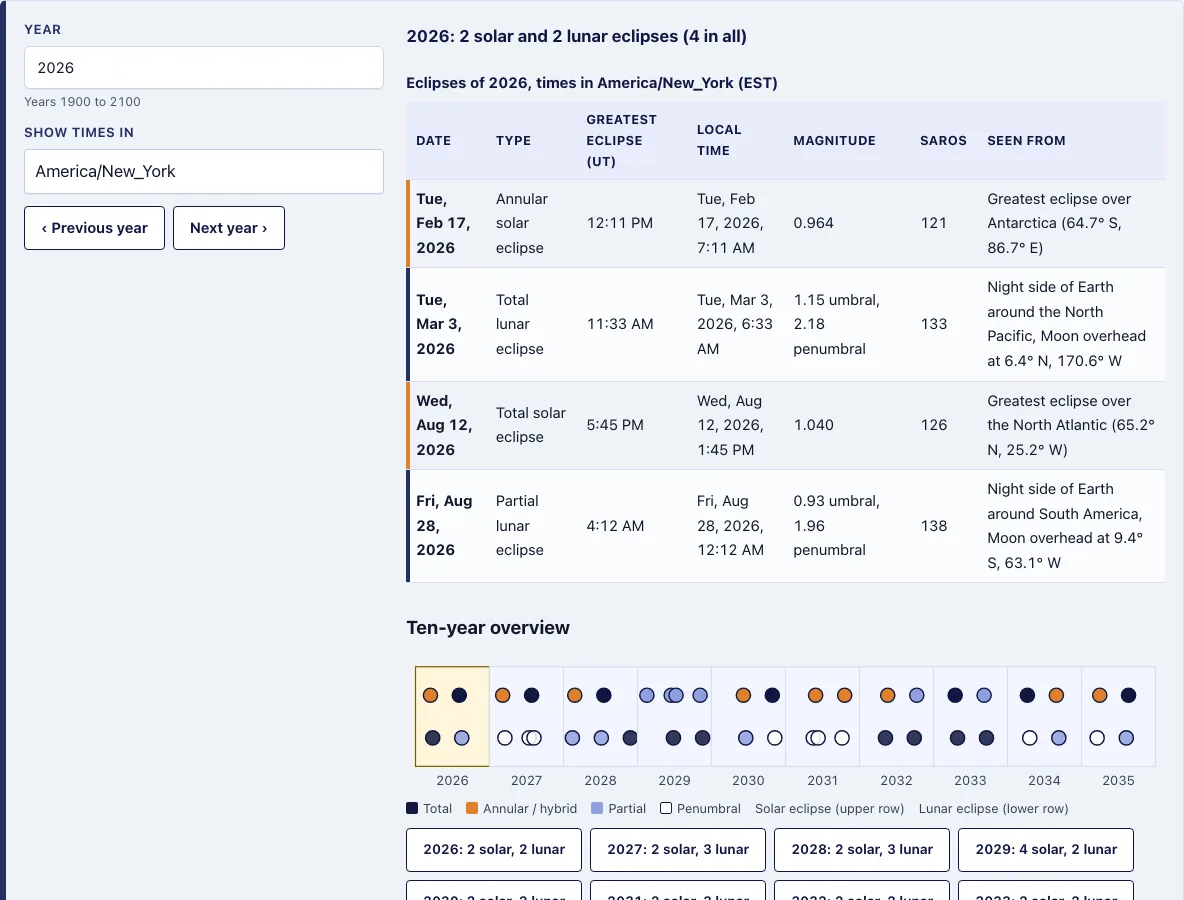
How to use the Eclipse Calendar
- Type a year from 1900 to 2100 into the Year box. It opens on the current year.
- Read the line above the table: it counts the year’s solar and lunar eclipses.
- Open Show times in and pick your time zone; the Local time column follows it.
- Scan the table. Columns: Date, Type, Greatest eclipse (UT), Local time, Magnitude, Saros and Seen from.
- Press Previous year or Next year to step through the calendar.
- Under the Ten-year overview strip, press a year button to jump to a year from 2026 to 2035. Solar eclipses sit in the upper row of the strip and lunar eclipses in the lower row, coloured by type.
- Press Copy link to share the year and zone you chose.
Start with the strip if you do not know which year to open, then type the year for the details. In the table, solar rows carry an orange bar on the left and lunar rows a dark blue one, so the two kinds are easy to tell apart. The Seen from column gives the exact latitude and longitude of the greatest eclipse for a solar eclipse, and the point where the Moon is overhead for a lunar one.
What are the eclipse dates?
The table of the chosen year is the list of dates. A year here is the calendar year in Universal Time; the Date column is in your zone, so an eclipse near midnight UT can land on a different day for you. The 2026 dates are:
| Date | Eclipse |
|---|---|
| 17 Feb 2026 | Annular solar eclipse |
| 3 Mar 2026 | Total lunar eclipse |
| 12 Aug 2026 | Total solar eclipse |
| 28 Aug 2026 | Partial lunar eclipse |
What is a solar eclipse calendar?
A solar eclipse calendar lists the new moons on which the Moon’s shadow touches Earth. Magnitude is the share of the Sun’s diameter covered at the point of greatest eclipse and is above 1 for a total eclipse. The Seen from column gives the region of that point with exact latitude and longitude; the region name is approximate, and the eclipse is partial over a far wider area. A hybrid eclipse changes along its path: the one on 14 November 2031 is annular at its ends and total in the middle.
What is a lunar eclipse calendar?
It lists the full moons on which the Moon crosses Earth’s shadow. Magnitude has two values: umbral, the share of the Moon’s diameter inside the dark shadow, and penumbral, the share inside the pale outer shadow. The Seen from column names the point where the Moon is overhead at greatest eclipse; the eclipse is visible from the night half of Earth around it.
How many eclipses are there in a year?
Between four and seven: two to five solar and two to four lunar (1900 to 2100; 2020, for example, had four penumbral lunar eclipses). The tool finds four to seven for every year from 1900 to 2100. From 2026 to 2035 the busiest year is 2029 with six (four solar, two lunar); 2026, 2030 and 2032 to 2035 have four each, and 2027, 2028 and 2031 have five.
Eclipses 18 years and 11 days apart belong to the same Saros series, so the Saros column shows repeats. All 913 eclipses of 1900 to 2100 were checked against NASA’s catalogs: dates, types, Saros numbers and magnitudes agree.
How this tool works and where the numbers come from
Eclipses are found with astronomy-engine; hybrid type, magnitudes and Saros series are added with our own geometry and a table of Saros series read from NASA’s catalog. All 454 solar and 459 lunar eclipses of 1900 to 2100 were checked against NASA’s Five Millennium Catalogs: date, type, Saros and magnitude agree, and greatest-eclipse times fall within a minute.
Sources
Frequently asked questions
What are the next 5 upcoming solar eclipses?
The table shows one year at a time. Open Next Solar Eclipse for a list that starts today, or press Next year to scan forward.
When is the next solar eclipse?
Look at the upper row of the Ten-year overview strip, or press Next year until a solar eclipse appears. Next Solar Eclipse gives the answer for your place directly.
Can I see a solar eclipse from my place?
The Seen from column gives the point of greatest eclipse. A partial eclipse is visible over a much wider area, so check Next Solar Eclipse for your own coordinates.
What is a Saros series?
A family of eclipses that repeat every 18 years and 11 days with a similar geometry. The Saros column gives the series number, so two rows with the same number are one family.
Why does a year have between four and seven eclipses?
Eclipses need the Moon near the plane of Earth’s orbit at new or full moon, which happens in two seasons about six months apart, each with up to three eclipses. The tool counts four to seven in every year from 1900 to 2100.
Is it safe to watch a solar eclipse?
Not without solar viewing glasses that meet ISO 12312-2; ordinary sunglasses are not safe.
Where can I see a lunar eclipse?
From anywhere on the night side of Earth where the Moon is above the horizon, which is the half around the point in the Seen from column. No equipment is needed.