
Astronomical Twilight Calculator
Enter a place and a date to get civil, nautical and astronomical dawn and dusk, how long true night lasts and the best Moon-free hour for deep-sky objects.
Free · runs in your browser · nothing is uploaded
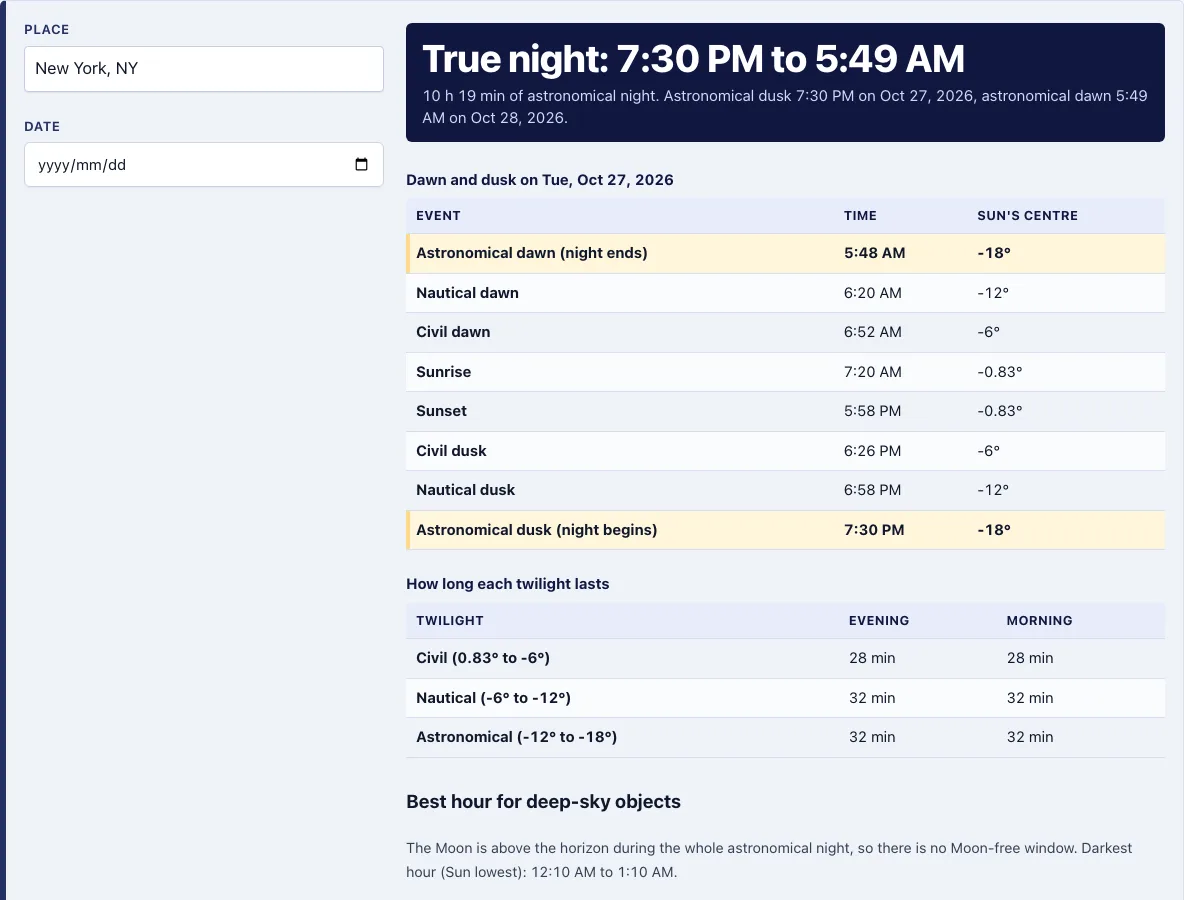
- Open Place and choose a dark-sky place, a US city or a world city, or pick My location (this device). For your own spot choose Custom coordinates and enter Latitude, Longitude and Time zone.
- Set Date. It starts on today’s date at the place.
- Read the headline True night: astronomical dusk of your date, astronomical dawn the next morning and the length.
- Check the table Dawn and dusk for astronomical, nautical and civil dawn and dusk, sunrise and sunset, each with the Sun’s height.
- Read the second table for how long each twilight lasts in the evening and the morning.
- Under Best hour for deep-sky objects, note the longest stretch of true night with the Moon below the horizon.
- Scroll to the year chart. Shaded stretches mark days with no astronomical night.
Copy link repeats the page for the same place and date. The highlighted rows are astronomical dawn and dusk. Results update as soon as you change a control, and a place with no astronomical night shows “Sun stays above” instead of a time. The year chart marks the chosen date with a dashed line, so you can see whether your nights are getting longer or shorter. Times are shown in the time zone of the place you picked, and the length of each twilight is given in minutes.
What are the three levels of twilight?
The three levels are civil, nautical and astronomical twilight, set by how far the centre of the Sun is below the horizon. Civil runs from sunset to 6 degrees, nautical from 6 to 12 degrees and astronomical from 12 to 18 degrees. True night starts below 18 degrees.
| Stage | Sun’s centre below the horizon |
|---|---|
| Sunrise and sunset | 0.833° |
| Civil twilight | 0.833° to 6° |
| Nautical twilight | 6° to 12° |
| Astronomical twilight | 12° to 18° |
| True night | more than 18° |
Sunrise and sunset use 0.833 degrees, which allows for refraction and the Sun’s upper edge. The 6, 12 and 18 degree events use the Sun’s geometric altitude with no refraction, as the US Naval Observatory tables do.
What is the difference between twilight and astronomical twilight?
Twilight is the glow that follows sunset and precedes sunrise. Astronomical twilight is its last and darkest stage, from 12 to 18 degrees below the horizon, when the sky looks dark to most people but faint stars and deep-sky objects are still washed out.
Take New York on 24 October 2026 (EDT). Civil dusk is at 6:31 PM, nautical dusk at 7:03 PM and astronomical dusk at 7:34 PM. Astronomical dawn the next morning is at 5:47 AM, so true night lasts 10 hours 12 minutes. The twilights last 28, 32 and 32 minutes. The Moon, two days before full, is up all night, so there is no Moon-free window and the tool names the darkest hour, 12:10 AM to 1:10 AM.
When is there no astronomical night?
At high latitudes in summer the Sun never drops below 18 degrees, so there is no astronomical dusk or dawn. London on 21 June 2026 has nautical dawn at 2:41 AM and nautical dusk at 11:24 PM but no astronomical twilight at all. At about 51.5 degrees north the year chart shows no astronomical night from about 22 May to 20 July, 60 days.
For New York the longest night is 11 h 28 min on December 21 and the shortest 4 h 42 min on June 20. At the equator true night lasts about 9.4 to 9.6 hours all year. Near the poles the Sun can stay below 18 degrees for the whole day: about 24 days around the winter solstice at 85 degrees south.
Can you still see during astronomical twilight?
Yes. During astronomical twilight you can see well, and the brighter stars and planets are out, but the faintest stars, galaxies and nebulae are still washed out by scattered sunlight. They show at their best once true night begins.
How is the best hour for deep-sky objects chosen?
The tool takes the longest stretch of true night with the Moon’s centre below the horizon, sampled every 5 minutes, and centres the hour in it. If the Moon is up the whole night it says so and gives the darkest hour, when the Sun is lowest, instead.
How this tool works and where the numbers come from
Dusk and dawn are the moments the centre of the Sun crosses -6, -12 and -18 degrees (geometric altitude, no refraction); sunrise and sunset use -0.833 degrees. Checked within 2 minutes against PyEphem (35 dusk and dawn pairs, seven places, five dates) and sunrise-sunset.org (four places in both hemispheres, all eight events).
Sources
Frequently asked questions
What is 30 minutes before sunrise called?
The half hour before sunrise has no name of its own. The stage that ends at sunrise is civil twilight, which lasts about 28 minutes in New York in late October and longer at high latitudes.
Nautical twilight vs astronomical twilight: what is the difference?
Nautical twilight is the Sun 6 to 12 degrees below the horizon and astronomical twilight 12 to 18 degrees. In nautical twilight the horizon is still visible, which is why sailors used it for star sights; in astronomical twilight the faint stars start to show.
Astronomical twilight vs night: are they the same?
No. Astronomical twilight is the band from 12 to 18 degrees below the horizon; night starts at astronomical dusk, when the Sun passes 18 degrees below, and ends at astronomical dawn. The headline shows that window.
How long does astronomical twilight last?
It depends on place and date. In New York on 24 October 2026 it lasts 32 minutes in the evening. Nearer the poles it stretches out and in summer it can merge with the next dawn so that no true night occurs.
How accurate are the times?
They agree with PyEphem within 2 minutes for 35 dusk and dawn pairs at seven places, and with sunrise-sunset.org within 2 minutes for all eight events in four places on both sides of the equator.
Why does a time show “Sun stays above”?
On that date the Sun never reaches that depth at your latitude, so the event does not occur. The year chart shows how many days that affects.
Darkness is the first condition, the Moon the second. Moon tonight shows the Moon’s phase and its rise and set, Moonrise and moonset calculator works for any date and New moon calendar finds the darkest nights of the month. Milky Way calendar and Stargazing calendar say when to go. Planets visible tonight and Meteor shower tonight show what to look at, Astrophotography calculator helps with exposures and Sidereal time calculator with pointing.
Planning a trip? The Night Gaze Camp app ranks campgrounds by tonight’s moonlight, clouds and sky darkness.