
Angular Size Calculator
Give any two of object size, distance and angular size and get the third, with NASA presets for the Moon, Sun and planets.
Free · runs in your browser · nothing is uploaded
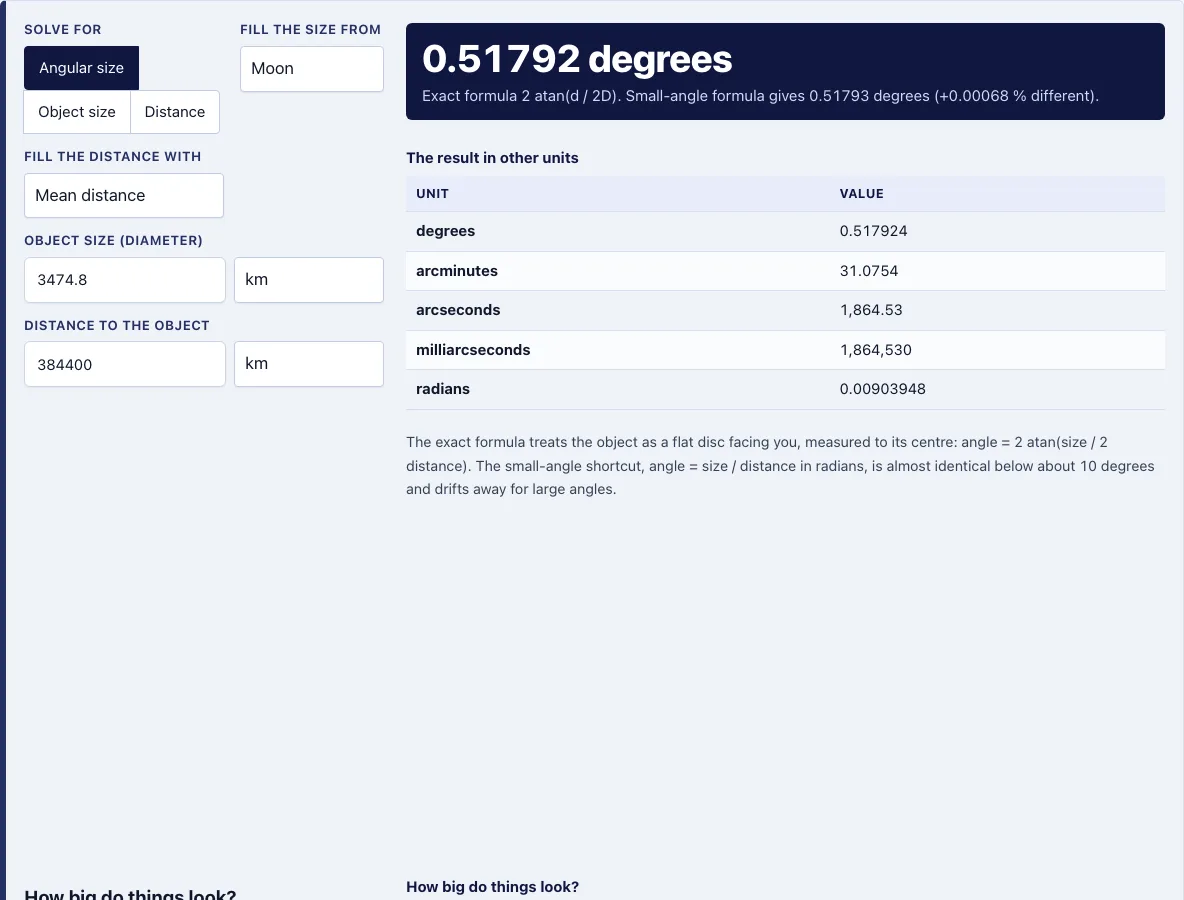
An angular size calculator turns any two of three values (object size, distance and angular size) into the third. Choose which one to solve for, enter the other two with units, and the answer card gives the exact result from the arctangent formula, the small-angle shortcut and the percent difference between them.
Presets fill in NASA fact-sheet diameters and distances for the Moon, Sun and planets, so you can check how big Jupiter or the Moon looks from Earth. A table shows how big familiar things look, from your fist at arm’s length to Pluto, and a Moon versus Sun block compares their angular diameters on any date, which explains why some solar eclipses are total and others annular.
How to use the Angular Size Calculator
- Pick a Solve for button: Angular size, Object size, or Distance. This chooses the unknown.
- Enter the other two values. Each one needs a unit. Length units are km, m, miles, AU, light-years, ft, and cm. Angle units are degrees, arcminutes, arcseconds, milliarcseconds, and radians.
- To start from a real body, use Fill the size from and choose Moon, Sun, Mercury, Venus, Mars, Jupiter, Saturn, Uranus, Neptune, or Pluto.
- Use Fill the distance with to choose Mean distance (Moon and Sun), Closest to Earth, or Farthest from Earth. For the Moon, these use mean perigee and mean apogee.
- Read the answer card. It shows the exact result and the small-angle result, plus the percent difference between them.
- Check the table below the answer for the same result in every unit.
The page opens on the Moon at its mean distance: a 3,474.8 km diameter at 384,400 km. Change any preset or unit and the answer updates. Pick a date in the Moon versus Sun block to see both angular diameters and the ratio between them, or scroll to the table of familiar objects to compare your result with a fist, a coin or a planet. The Moon versus Sun block lets you pick a date and compare both bodies as seen from Earth’s centre.
How do you calculate angular size?
Use the exact formula: angular size = 2 × arctan(size / (2 × distance)). Divide the object’s width by twice its distance, take the arctangent, then double the result. When the object is small compared with its distance, the shortcut angle in radians = size / distance gives almost the same answer. Multiply radians by 57.2958 to get degrees.
To solve for the other unknowns, rearrange the formula: size = 2 × distance × tan(angle / 2), and distance = size / (2 × tan(angle / 2)).
The shortcut is off by roughly angle² / 12 of the value. That is 0.25% at 10 degrees and about 3% at 35 degrees. It breaks down badly for wide objects. A 2 m object seen from 1 m away spans exactly 90 degrees, but the shortcut gives 2 radians, or 114.6 degrees, which is 27% too large. Angles of 180 degrees or more are rejected.
What is the difference between angular size and physical size?
Physical size is how long an object really is, in km, m, or ft. Angular size is the angle that object covers in your view, and it shrinks as the object moves farther away. Two objects with the same physical size can have very different angular sizes if they sit at different distances. As a benchmark, an object 1 AU wide seen from 1 parsec away (206,264.8 AU) has an angular size of exactly 1 arcsecond.
What does angular size mean?
Angular size tells you how much of your field of view an object fills. It is measured as an angle, in degrees, arcminutes, or arcseconds. One degree is about the width of your little finger at arm’s length, so the Moon, at half a degree, is half that width. Because it is an angle, it describes what you see, not how big the object is.
What is the angular size of the Moon?
From Earth’s centre, at the mean distance of 384,400 km, the Moon’s angular size is about 0.5179 degrees, or 31.08 arcminutes. Over its orbit it ranges from 0.491 to 0.548 degrees, because its distance changes. The Moon looks about 1.7% larger from the Earth’s surface than from the centre when it is overhead (up to about 1.8% at perigee), since an observer can stand up to one Earth radius closer to it: 6,378 / (384,400 − 6,378) = 1.7%.
What is the angular size of the Sun?
At 1 AU (149,597,870.7 km), the Sun’s angular size is 0.5329 degrees, or 1,919 arcseconds. That matches NASA’s figure of 1919 arcseconds at 1 AU. Over the year it ranges from 0.524 to 0.542 degrees. The Moon and Sun almost match in apparent size, which is why a total solar eclipse is possible. If the Moon’s angular size is clearly larger than the Sun’s at a new moon, it can cover the Sun completely. If it is clearly smaller, a bright ring remains. When the two are within about 1.7%, the observer’s position decides.
How this tool works and where the numbers come from
Exact angular diameter = 2 arctan(d / 2D); the small-angle form is d / D in radians. Diameters and Earth distances come from the NASA Goddard Planetary Fact Sheets and reproduce NASA’s published apparent diameters (for example the Sun 1919 arcsec at 1 AU and Jupiter 50.1 arcsec at closest). Moon and Sun distances for the date come from astronomy-engine; eclipse types were checked against Fred Espenak’s eclipse list.
Sources
Frequently asked questions
How big is your fist at arm’s length in degrees?
A closed fist at arm’s length covers about 10 degrees of your view. For comparison, a spread hand covers about 20 degrees, a thumb about 2, and the little finger about 1. These are rules of thumb, and hand sizes vary, so measure your own hand against a known angle if you need accuracy.
Why does the calculator show two answers?
The exact result uses the arctangent formula and is correct at any angle below 180 degrees. The small-angle result uses the shortcut, and the percent difference shows how far apart they are. For small angles, such as the Moon at about 0.5 degrees, the two agree to within a fraction of a percent.
How big does the International Space Station look from Earth?
The ISS is about 109 m wide and sits roughly 420 km up, which gives an angular size of about 53.5 arcseconds. That is slightly larger than Jupiter at its closest, which measures 50.1 arcseconds. Enter 109 m and 420 km to check; the 420 km altitude is approximate.
Can the Moon cover the Sun during an eclipse?
Yes, when the Moon looks larger than the Sun from where you stand. Compare the two angular diameters seen from the Earth’s centre at new moon. A ratio of about 1.017 or more means a total eclipse, and about 0.983 or less means a ring of sunlight stays, an annular eclipse. In between, the result depends on where you are, because an observer with the Moon overhead sees it about 1.7% larger: the eclipse can be total in some places and annular in others (a hybrid eclipse), so the geocentric ratio cannot decide. For example, 8 April 2024 had a ratio of 1.04 (total) and 2 October 2024 had 0.92 (annular). Across the eclipses listed by Fred Espenak for 2024 to 2036, every annular one has a ratio below 0.991 and every total one is above 1.016. The hybrid eclipse of 14 November 2031 is about 0.99 to 0.995.
- Telescope Magnification Calculator: see how much a telescope enlarges the angles you just calculated.
- Solar System Scale Calculator: build a scale model of the solar system.
- Next Solar Eclipse: find the next total or annular eclipse.
- Moon Phase Today: check tonight’s Moon phase.
- Julian Date Calculator: convert a date to a Julian Date.
- Star Map Generator: draw the sky for a place and date.
- Solar System Simulator: explore the planets of the solar system.
Planning a trip? The Night Gaze Camp app ranks campgrounds by tonight’s moonlight, clouds and sky darkness.